Can desire come back after years of distance?
6 min read
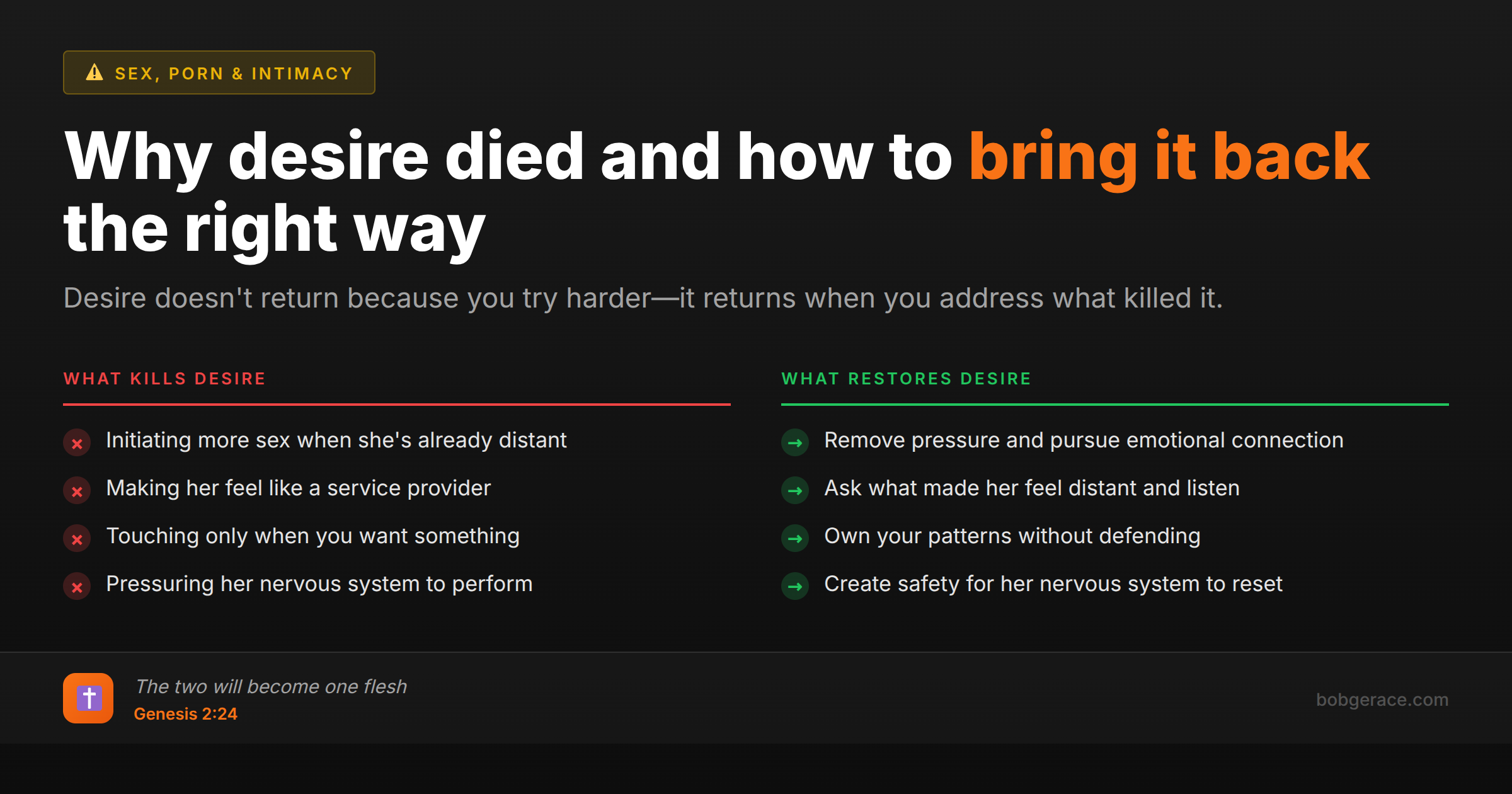
Yes, but not by doing more of what you've already tried. Desire doesn't return because you initiate more, compliment her more, or wait patiently for her to "come around." It returns when the conditions that shut it down are addressed. For most wives, sexual desire is responsive, not spontaneous. It grows in the presence of safety, emotional connection, and a nervous system that feels calm—not pursued, pressured, or performing. If your wife has lost desire after years of distance, it's likely because something in the relationship changed how she experiences you. Maybe she feels like a service provider—touched only when you want sex. Maybe she's carrying resentment from years of feeling unseen, unheard, or alone in the marriage. Maybe she's exhausted from work, kids, and the mental load, and sex feels like one more thing she has to give. The path back to desire starts with understanding what killed it, not with trying harder to revive it.
Why Desire Dies and What It's Really Signaling
A sexless marriage is almost never just about sex. It's a symptom of a relational dynamic that has made intimacy feel unsafe, obligatory, or disconnected. Your wife may have lost desire because she no longer feels desired as a person—only as a body. She may feel like you're affectionate only when you want something. She may have learned that closeness leads to pressure, so she avoids it altogether.
Many men interpret their wife's lack of desire as rejection. But for her, it may be protection. If sex has become a source of stress, disappointment, or disconnection, her body will shut it down. This is not a moral failure. It's a nervous system response. Her brain is saying, "This doesn't feel safe anymore." That safety might be emotional—she doesn't feel seen or valued outside the bedroom. It might be relational—she's carrying resentment from years of unmet needs. Or it might be physiological—she's touched out, exhausted, or hormonally depleted.
Years of distance don't happen overnight. They accumulate through small moments of disconnection: the conversation you didn't have, the hurt you didn't acknowledge, the pattern where you pursued and she withdrew. Over time, she may have stopped trying to connect because it felt futile. She may have stopped initiating because you didn't notice. And now, the gap feels too wide to cross. But it's not. Desire can return. It just requires a different approach than the one that got you here.
Responsive Desire, Nervous System Regulation, and Resentment
Most women experience responsive desire, not spontaneous desire. This means arousal doesn't start in her body—it starts in her environment. She needs to feel safe, connected, and free from resentment before her body even considers sex. If her nervous system is in a chronic state of stress, hypervigilance, or shutdown, desire won't happen. Her body is prioritizing survival, not intimacy.
Dr. Emily Nagoski's research shows that desire is not a drive like hunger. It's a response to context. If the context is pressure, obligation, or disconnection, her body will say no. If the context is safety, playfulness, and emotional attunement, her body may say yes. This is why "trying harder" doesn't work. More pursuit, more compliments, more initiation—all of it can feel like more pressure. And pressure is the opposite of safety.
Resentment is one of the most common killers of desire. If your wife feels like she's been carrying the emotional labor of the marriage, the mental load of the household, or the loneliness of an emotionally unavailable husband, she's not going to want to be vulnerable with you. Resentment creates a wall. It says, "You don't get access to my body when you haven't shown up for my heart." This isn't punishment. It's self-protection. Her body is refusing to give what her heart hasn't received.
Attachment theory also plays a role. If your wife has an anxious attachment style, she may have pursued you for years, trying to get your attention, your presence, your emotional engagement. When that didn't work, she may have shifted into avoidant behavior—withdrawing, shutting down, protecting herself from further disappointment. If you have an avoidant attachment style, you may have interpreted her need for connection as neediness, and pulled away. Now, you're both stuck in a pursue-withdraw cycle that has killed intimacy. Breaking that cycle requires you to move toward her emotionally, not just sexually.
One Flesh, Mutual Honor, and the Patience of Love
Scripture calls marriage a one-flesh union (Genesis 2:24). This is not just about sex. It's about emotional, spiritual, and physical intimacy woven together. When one part of that union is broken, the whole thing suffers. If your wife has lost desire, it's likely because the one-flesh connection has been fractured somewhere deeper than the bedroom.
Paul writes, "The husband should fulfill his marital duty to his wife, and likewise the wife to her husband" (1 Corinthians 7:3). But duty without desire is not the goal. God designed sex to be a place of mutual joy, vulnerability, and connection. If your wife feels like sex is an obligation, something has gone wrong. The question is not, "How do I get her to fulfill her duty?" The question is, "How do I create a relationship where she wants to be close to me?"
Love is patient (1 Corinthians 13:4). This is not passive waiting. It's active, humble, persistent pursuit of her heart—not her body. It's asking, "What do you need from me?" and then actually doing it. It's repenting for the ways you've been emotionally absent, dismissive, or self-focused. It's honoring her as a co-heir of grace (1 Peter 3:7), not as a means to your sexual fulfillment. When you lead with honor, patience, and emotional presence, you create the conditions for desire to return. But you don't control the timeline. You control your character.
Action Steps
-
1
Stop initiating sex for 30 days. This removes pressure and gives her nervous system space to reset. Use that time to pursue emotional connection without a sexual agenda.
-
2
Ask her directly: "What has made you feel distant from me?" Then listen without defending, explaining, or fixing. Just hear her.
-
3
Identify one pattern that has contributed to the distance—pursuit/withdrawal, emotional unavailability, resentment from unmet needs—and own it. Say, "I see how I've done this. I'm sorry."
-
4
Rebuild non-sexual touch. Hold her hand. Hug her without it leading anywhere. Kiss her goodnight. Let her body learn that closeness doesn't always mean sex.
-
5
Work with a coach or counselor who understands responsive desire, attachment, and the neuroscience of intimacy. This is not a problem you can solve alone with good intentions.
Related Questions
- How do I talk about our sexless marriage without pressuring her?
- Is a sexless marriage really about sex?
- Should I accept a sexless marriage or fight for intimacy?
- Why is my wife not interested in sex anymore?
- Is porn use in marriage harmless if we still have sex?
- What should I not say after she catches me with porn?
Also find Bob on
Subscribe for weekly videos on Christian marriage.
Desire Doesn't Return by Accident
If your marriage has been sexless for months or years, you need more than tips. You need a roadmap that addresses the relational dynamics underneath. Let's build one together.
Talk to Bob →