How do I handle sexual rejection without becoming needy or angry?
5 min read
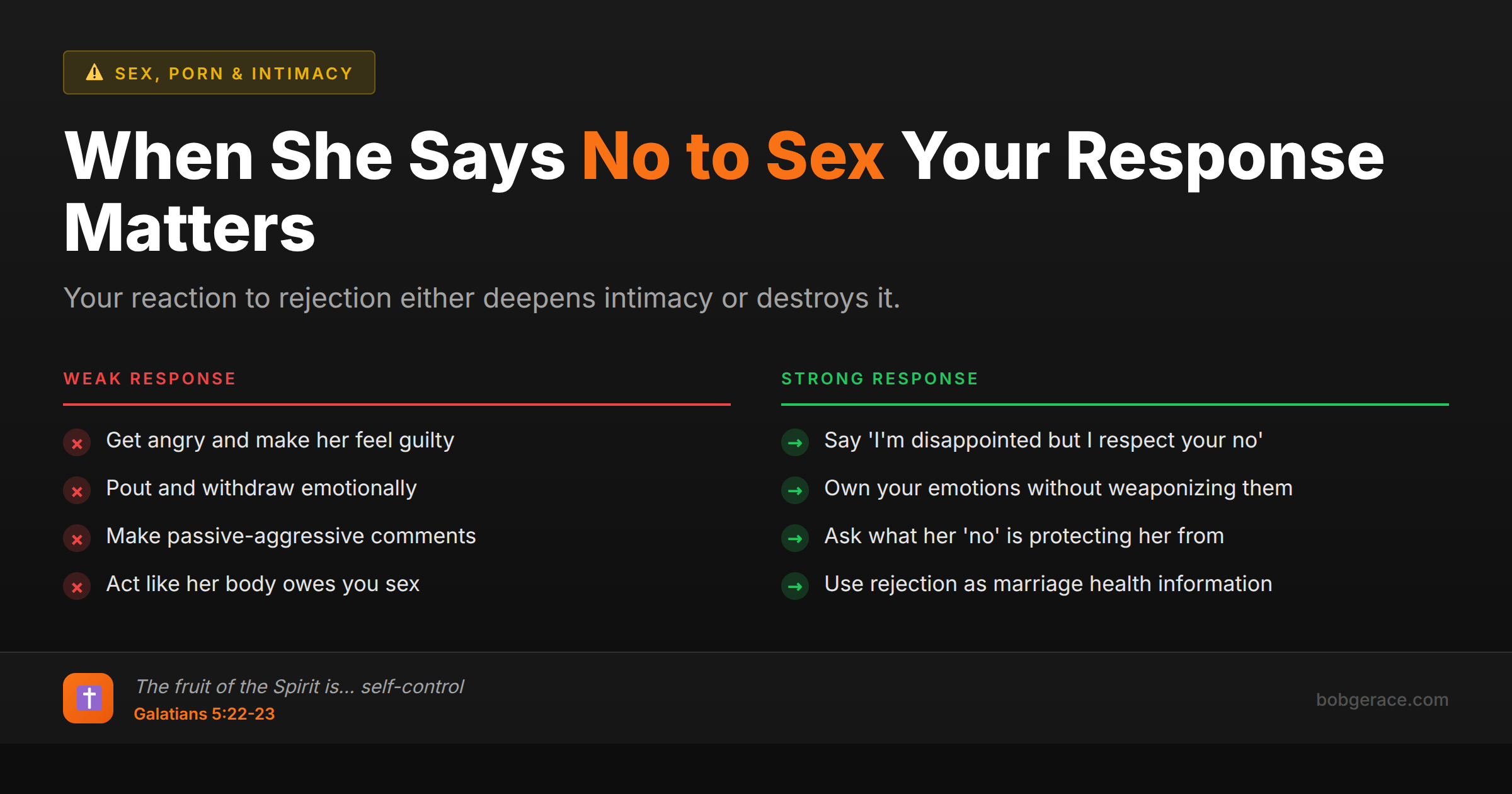
You handle sexual rejection by recognizing that her no is not an attack on your worth—it is information about the state of your marriage. Your response in the moment of rejection will either reinforce her shutdown or begin to rebuild safety. Neediness and anger both communicate that her body exists to regulate your emotions. Strength and self-awareness communicate that you can hold your own disappointment without making it her problem. This does not mean you pretend rejection does not hurt. It does. But maturity means you feel the hurt without weaponizing it. You acknowledge your disappointment, take responsibility for your emotional state, and use the rejection as a signal to examine the relational environment you have both been living in. The goal is not to eliminate rejection—it is to respond in a way that does not deepen the distance between you.
The Full Picture: Why Your Response Matters More Than You Think
Sexual rejection lands hard because it touches core wounds: fear of inadequacy, fear of abandonment, fear that you are undesirable or unloved. When your wife says no, it can feel like she is rejecting you as a man, not just declining sex. That pain is real. But how you handle that pain determines whether intimacy has a future in your marriage.
If you respond with neediness—pouting, withdrawing, guilt-tripping, or making her responsible for your emotional state—you confirm her fear that intimacy is about managing your needs, not connecting with her. If you respond with anger—criticism, coldness, passive-aggression, or overt hostility—you make her body even less safe. Both responses reinforce the cycle: she shuts down further, you feel more rejected, and the distance grows.
Your response also reveals what intimacy means to you. If rejection sends you into emotional collapse or rage, it suggests that sex has become your primary source of validation, connection, or emotional regulation. That is too much weight for intimacy to carry. Your wife cannot be responsible for your sense of worth or your emotional stability. When you make her responsible, she feels the pressure and withdraws further. Handling rejection well requires you to own your emotional world, process your pain without punishing her, and address the deeper relational issues that are driving the rejection in the first place.
Clinical Insight: Attachment Wounds and Emotional Regulation
Sexual rejection often activates attachment wounds from childhood or past relationships. If you experienced emotional neglect, abandonment, or conditional love growing up, rejection from your wife can trigger those early wounds. Your nervous system interprets her no as confirmation that you are unlovable or unwanted. This is not rational—it is a deeply wired survival response.
Neediness is a protest behavior. It is your attachment system trying to pull her closer because distance feels life-threatening. Anger is also a protest behavior, but it pushes her away while simultaneously demanding she come back. Both are attempts to regulate your own nervous system by controlling hers. Neither works. Both make her feel unsafe.
Emotional maturity means you learn to self-regulate. You feel the disappointment, the hurt, the fear—and you hold it without collapsing or exploding. You do not make her responsible for soothing you. You do not punish her for having boundaries. You acknowledge your pain, process it with God or a trusted friend or coach, and then re-engage with her from a grounded place. This is not suppression. It is strength. It is the ability to feel your emotions without being controlled by them.
Handling rejection well also requires you to see her no as information, not attack. Her rejection is telling you something about the relational environment: she does not feel safe, she is carrying resentment, she is exhausted, she does not trust your motives, or she has been objectified. Your job is not to override her no. Your job is to understand what her no is protecting her from, and to address that.
Biblical Framework: Self-Control, Love, and Sacrificial Leadership
Galatians 5:22-23 lists self-control as a fruit of the Spirit. Self-control is not just about resisting temptation—it is about governing your emotional responses. If you cannot handle sexual rejection without becoming needy or angry, you are not walking in the Spirit. You are being controlled by your wounds, your fear, or your flesh. Growth means you learn to feel disappointment without letting it dictate your behavior.
Ephesians 4:26-27 says, "Be angry and do not sin; do not let the sun go down on your anger, and give no opportunity to the devil." Anger at rejection is not sin. But what you do with that anger can be. If you use anger to punish, manipulate, or control your wife, you are sinning against her and against God. Righteous anger is directed at the brokenness in your marriage, not at your wife. It moves you toward repentance, repair, and change—not blame.
1 Peter 3:7 calls husbands to live with their wives in an understanding way, honoring them as co-heirs. Honoring her means respecting her no. It means treating her body as hers, not yours. It means recognizing that her rejection is not a failure of submission—it is often a response to your failure to love her well. If you have made her feel unsafe, objectified, or emotionally abandoned, her no is a boundary, not a betrayal. Your job is to honor that boundary and do the work to rebuild trust.
Action Steps
-
1
When she says no, pause. Take a breath. Say something like, 'I hear you. I'm disappointed, but I respect your no.' Then leave the room if you need to process your emotions alone.
-
2
Do not pout, withdraw emotionally, or make passive-aggressive comments. Do not guilt-trip her or make her responsible for managing your disappointment. Own your emotional state.
-
3
After you have calmed down, ask yourself: What is her no protecting her from? Is it exhaustion, resentment, pressure, objectification, or lack of emotional safety? Write down your honest answer.
-
4
Bring your pain to God, a coach, or a trusted friend—not to her. Process your hurt, your fear, and your attachment wounds in a place where you can be honest without punishing her.
-
5
If rejection is a pattern, stop initiating for a season and focus on rebuilding emotional intimacy, non-sexual affection, and trust. Work with a coach who can help you identify the relational dynamics driving the rejection.
Related Questions
Also find Bob on
Subscribe for weekly videos on Christian marriage.
Learn to Lead Through Rejection
If sexual rejection is triggering neediness or anger, the issue is not just your wife's no—it is the unhealed wounds and relational patterns underneath your response. I help men develop the emotional maturity and self-awareness to handle rejection with strength and rebuild intimacy from a grounded place.
Talk to Bob →