What should I stop doing if I want intimacy back?
6 min read
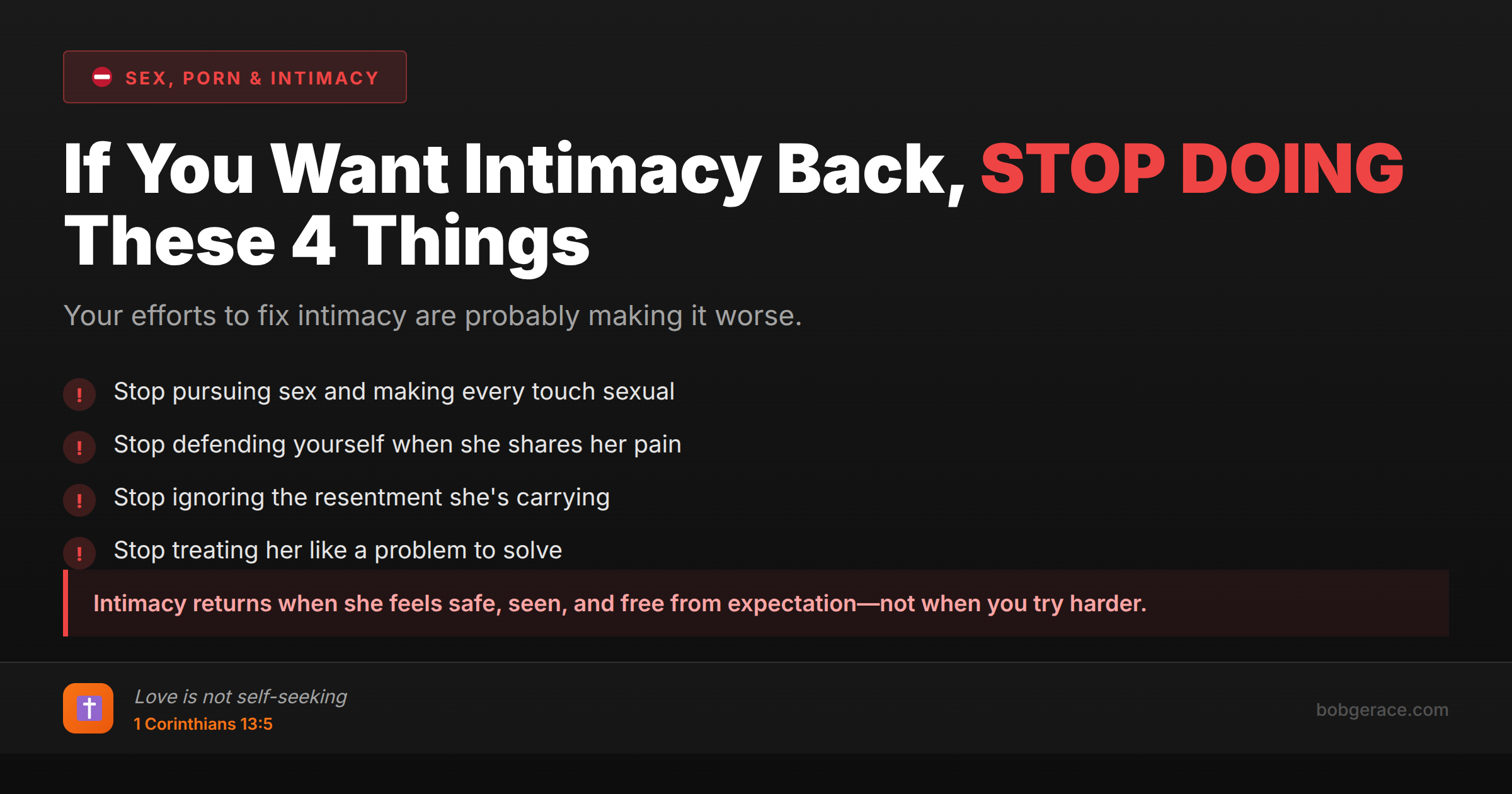
If you want intimacy back, stop pursuing sex. Stop making every touch sexual. Stop defending yourself when she tells you how she feels. Stop ignoring the resentment she's carrying. Stop treating her like a problem to solve. These behaviors feel like effort to you, but they feel like pressure, dismissal, or control to her. Intimacy returns when your wife feels safe, seen, and free from expectation. That means you have to stop the behaviors that make her feel unsafe. Most men don't realize they're doing these things. You think you're showing love or trying to fix the problem. But your actions are often making it worse. The path forward is not about doing more. It's about stopping what's not working and leading differently.
The Full Picture: What Kills Intimacy Without You Knowing
Most men in sexless marriages are working hard to fix the problem. You initiate sex. You compliment her. You try to be affectionate. You read articles. You ask what she needs. But none of it works. The issue is not effort. The issue is that many of the things you're doing feel like love to you but feel like pressure, dismissal, or control to her.
First, stop pursuing sex. Every time you initiate, hint, or complain about the lack of intimacy, you're activating her stress response. She doesn't experience your pursuit as desire for her. She experiences it as demand. Her nervous system reads your advances as pressure, and she pulls further away. The more you pursue, the less safe she feels. The less safe she feels, the less desire she has. You're stuck in a cycle where your effort is making the problem worse.
Second, stop making every touch sexual. If every hug turns into a grope, every kiss into a move toward the bedroom, every compliment into a setup for sex, your wife learns that physical closeness is not safe. She can't trust your affection to stay non-sexual, so she avoids all of it. You think you're showing attraction. She experiences transaction. She stops letting you touch her because she knows where it's going.
Third, stop defending yourself when she tells you how she feels. When your wife says she feels alone, pressured, or unseen, your instinct is to explain why she's wrong. You list everything you do for her. You point out that you're trying. You tell her she's being unfair. But defensiveness is a form of dismissal. It tells her that her feelings don't matter, only your intentions do. Every time you defend instead of listen, you add another brick to the wall between you.
Finally, stop ignoring the resentment she's carrying. Your wife may have told you for years that she needs more help, more emotional presence, or less porn. She may have asked you to listen, to stop dismissing her, or to prioritize her over work. If you've defended yourself, minimized her concerns, or promised to change without following through, she's carrying resentment. Resentment is a desire killer. You can't pursue your way past it. You have to address it directly.
Clinical Insight: How Your Behavior Shapes Her Nervous System Response
Intimacy is not a decision. It's a nervous system response. When your wife feels safe, her ventral vagal system is online. She can relax, connect, play, and feel desire. When she feels pressured, dismissed, or unsafe, her sympathetic or dorsal vagal systems take over. She's in fight-flight or shutdown. In that state, sexual desire is biologically offline. Your behavior directly shapes which system is active.
Pursuing sex activates her stress response. Research shows that women's sexual desire is highly context-dependent. If the context feels unsafe—if she's stressed, resentful, or feeling pressured—her body will not respond sexually. Every time you initiate when she's not ready, you're training her nervous system to associate your touch with demand. Over time, she starts avoiding all physical closeness because her body has learned it's not safe.
Defensiveness is another major issue. The Gottman Institute identifies defensiveness as one of the Four Horsemen of relationship breakdown. When you defend yourself instead of listening, you're telling your wife that her reality doesn't matter. This activates her attachment wounds. If she has an anxious attachment style, your defensiveness makes her feel unimportant. If she's avoidant, it confirms that emotional intimacy with you is not safe. Either way, defensiveness erodes trust.
Resentment is one of the strongest predictors of low sexual desire in women. When a wife feels chronically unheard, unsupported, or hurt, her body keeps score. She may still love you, but her nervous system has learned that closeness with you comes with a cost. Resentment builds when issues go unaddressed, when apologies are shallow, or when behavior doesn't change. You can't restore intimacy without addressing the resentment she's carrying. It's not optional.
Biblical Framework: Stop Demanding, Start Serving
First Corinthians 13:5 says love is not self-seeking. If your pursuit of intimacy is primarily about your needs, it's not biblical love. It's self-interest. Jesus didn't pursue the church for His own satisfaction. He pursued her good. He served. He sacrificed. He listened. If you want intimacy back, you have to stop seeking your own and start seeking hers.
James 1:19 says, "Be quick to listen, slow to speak, and slow to become angry." Most men do the opposite. When their wife shares pain, they're quick to speak, slow to listen, and quick to defend. This is the opposite of biblical wisdom. Listening without defending is an act of humility. It says, "Your experience matters more than my reputation." That's the posture that rebuilds trust.
Ephesians 4:31-32 says, "Get rid of all bitterness, rage and anger, brawling and slander, along with every form of malice. Be kind and compassionate to one another, forgiving each other, just as in Christ God forgave you." If your wife is carrying resentment, it's often because you've been defensive, dismissive, or slow to repent. Biblical love requires you to own your part, ask for forgiveness, and change your behavior—not to get sex, but because it's right.
Proverbs 18:13 says, "To answer before listening—that is folly and shame." If you're defending yourself before your wife finishes speaking, you're operating in folly. You're prioritizing your comfort over her pain. The biblical path forward is to stop defending, stop pursuing, and start listening. Trust God with the outcome. Your job is to love her well, not to control her response.
Action Steps
-
1
Stop all sexual pursuit for at least 30 days. No initiating, no hinting, no complaining. Let her nervous system reset without pressure.
-
2
Stop making every touch sexual. Hug her, hold her hand, kiss her—and walk away. Rebuild safety in physical closeness with zero agenda.
-
3
Stop defending yourself when she shares pain. Listen fully. Say, 'I hear you. I'm sorry.' Resist the urge to explain or justify.
-
4
Ask her directly what resentment she's carrying. Listen without interrupting. Apologize specifically for your part. Don't expect immediate forgiveness.
-
5
Work with a coach or counselor who understands nervous system dynamics, attachment, and resentment. You can't see your blind spots alone.
Related Questions
- How do I talk about our sexless marriage without pressuring her?
- Is a sexless marriage really about sex?
- Should I accept a sexless marriage or fight for intimacy?
- Why is my wife not interested in sex anymore?
- How do I handle sexual rejection without becoming needy or angry?
- What if my wife loves me but does not desire me?
Also find Bob on
Subscribe for weekly videos on Christian marriage.
You're Working Hard, But in the Wrong Direction
If your efforts to restore intimacy are making things worse, you need a new approach. I help men stop the behaviors that kill desire and start leading in ways that rebuild safety and connection.
Talk to Bob →