Why did my wife lose desire for me?
6 min read
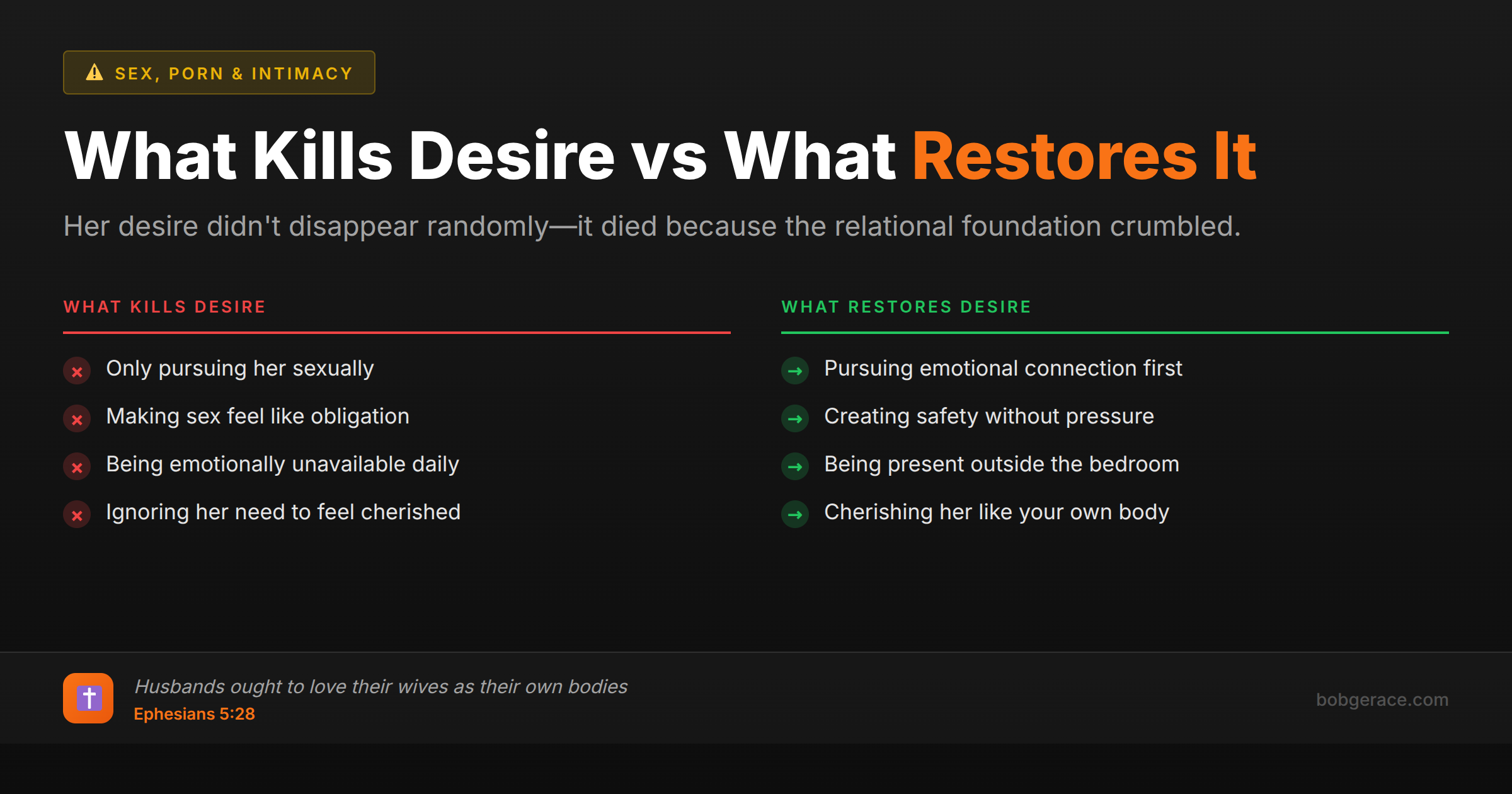
Your wife didn't lose desire randomly. Desire for women is relational, not automatic. It grows in environments of emotional safety, pursuit, presence, and respect—and it dies when those things disappear. If she's pulled away sexually, it's likely because the relational foundation that made her feel safe and wanted has eroded. She may be carrying resentment you haven't addressed, feeling unseen in ways you haven't noticed, or protecting herself from feeling used or pressured. The loss of desire isn't about your attractiveness or her libido. It's about what sex has come to represent in your marriage. If it feels like obligation, pressure, or the only time you're emotionally present, her body will shut it down. Desire doesn't return because you ask for it or initiate more. It returns when the relationship becomes a place where she feels cherished, pursued outside the bedroom, and safe enough to be vulnerable again. The repair starts with you rebuilding the emotional intimacy that makes physical intimacy possible.
What Kills Desire in a Wife
Desire in women is not a switch—it's a garden. It requires tending, safety, and the right conditions to grow. When those conditions disappear, desire withers. The most common killers are emotional disconnection, resentment, pressure, and the feeling of being wanted only for sex. If your wife feels like a means to your satisfaction rather than a person you delight in, her body will protect her by shutting down desire.
Many men assume their wife's lack of interest is about attraction, aging, or hormones. But in most cases, it's relational. She's responding to patterns in the marriage that have made intimacy feel unsafe or transactional. Maybe you're emotionally distant except when you want sex. Maybe you get irritable or withdrawn when she says no. Maybe she's been carrying the mental load of the household while you've been buried in work. Maybe there's unresolved conflict, unspoken hurt, or secrecy (like porn) that's fractured trust. All of these things register in her nervous system as 'not safe,' and her body won't let her be vulnerable with you.
Rresentment is the silent killer of desire. If she's been hurt, dismissed, or neglected—and you've never fully owned it—she can't desire you. She may still function as a wife and mother, but the part of her that wants to be close to you has shut down. She's not withholding to punish you. She's protecting herself from further pain. And until you address the relational wounds underneath, no amount of flowers, date nights, or compliments will bring desire back.
The Neuroscience of Female Desire
Female desire is primarily responsive, not spontaneous. That means it doesn't just happen—it's cultivated through emotional connection, safety, and presence. Her brain has to feel safe before her body can feel arousal. If her nervous system is in a state of stress, hypervigilance, or shutdown (often due to relational disconnection or unresolved conflict), her body will not produce the conditions for desire. This is not a choice. It's neurological.
When you pursue sex without first pursuing her emotionally, her brain reads it as demand or pressure. That activates her sympathetic nervous system—fight, flight, or freeze. She may comply out of duty, but there's no desire, no pleasure, no connection. Over time, this creates an aversion response. She starts avoiding touch altogether because she knows where it leads, and she doesn't have the emotional or physical capacity to go there. The bedroom becomes a place of anxiety rather than intimacy.
The repair requires you to stop pursuing sex and start pursuing her heart. That means non-sexual affection, emotional presence, curiosity about her inner world, and respect for her boundaries. It means addressing the resentment she's carrying by owning your part in it—without defensiveness or minimizing. It means creating a relational environment where she feels seen, safe, and wanted for more than her body. Desire doesn't return because you try harder. It returns when the relationship becomes a place where vulnerability feels safe again.
Cherishing, Not Consuming
Ephesians 5:28-29 says, "Husbands ought to love their wives as their own bodies. He who loves his wife loves himself. For no one ever hated his own flesh, but nourishes and cherishes it, just as Christ does the church." The word 'cherish' means to care for tenderly, to hold as precious. If your pursuit of your wife is only sexual, you're not cherishing her—you're consuming her. And she feels the difference.
God's design for intimacy is not transactional. It's covenantal. It's meant to be a reflection of Christ's love for the church—sacrificial, pursuing, delighting, present. If your wife has lost desire, the question isn't 'What's wrong with her?' It's 'Have I been loving her the way Christ calls me to?' Have you nourished her emotionally? Have you pursued her heart? Have you made her feel safe, seen, and wanted for more than what she can give you physically?
Proverbs 5:18-19 calls husbands to rejoice in the wife of their youth and be intoxicated always in her love. But intoxication is mutual—it requires both people to be fully present, fully engaged, fully safe. If she's pulled away, it's a sign that something in the relational foundation has broken. The path back isn't more pressure. It's repentance, pursuit, and the hard work of rebuilding trust and emotional intimacy. God's design works—but only when you follow the whole design, not just the parts you want.
Action Steps
-
1
Stop initiating sex and start initiating connection. Spend 30 days pursuing her emotionally without any sexual agenda.
-
2
Ask her directly: 'What have I done or not done that's made you feel unsafe, unseen, or unwanted?' Listen without defending.
-
3
Identify patterns that may have killed desire: anger, withdrawal, porn, work obsession, emotional unavailability, dismissiveness. Own them specifically.
-
4
Offer daily non-sexual affection—hand-holding, hugs, compliments—with no expectation of where it leads. Let her nervous system recalibrate.
-
5
Address resentment by confessing your part in the relational breakdown. Don't wait for her to forgive you before you change.
Related Questions
Also find Bob on
Subscribe for weekly videos on Christian marriage.
Desire Doesn't Come Back on Its Own
Loss of desire is a relational problem, not a libido problem. I help men identify what killed intimacy and rebuild the emotional foundation that brings it back. Let's get to work.
Talk to Bob →