Why does my wife reject me sexually but act normal otherwise?
6 min read
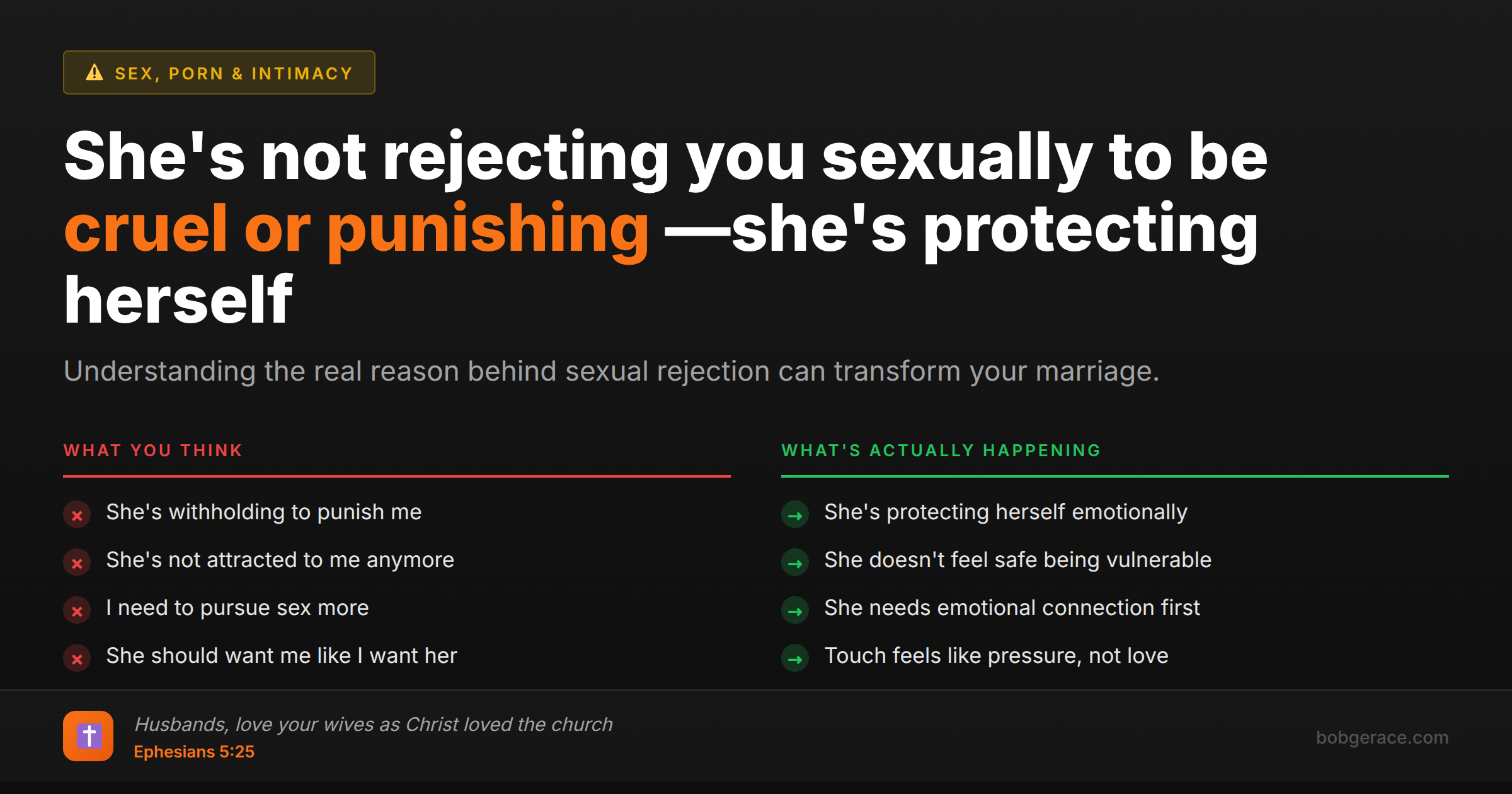
Your wife can function as a roommate—managing the house, co-parenting, even being pleasant—while completely shutting down sexually because sex requires a level of emotional safety and vulnerability that the rest of daily life doesn't. She's not withholding to punish you. She's protecting herself from feeling used, unseen, or unsafe. When a woman doesn't feel emotionally connected, pursued outside the bedroom, or respected in her nos, her body won't let her say yes. The rejection isn't about your attractiveness or her libido. It's about what sex has come to represent: pressure, obligation, being touched only when you want something, or the only time you're fully present. She may smile, cook, and co-parent because those roles don't require her to be vulnerable with you. But sex does. And right now, she doesn't trust that vulnerability will be met with presence, tenderness, or care. The path forward isn't more pursuit for sex. It's rebuilding the emotional and relational foundation that makes her want to be close to you again.
Why She Can Function Everywhere Except the Bedroom
Sex is not a isolated behavior. It's the most vulnerable, exposed, and emotionally loaded part of marriage. Your wife can manage logistics, smile at dinner, and keep the household running because those tasks don't require her to open her heart or body to you. But sex does. And if she doesn't feel safe, seen, or desired outside the bedroom, her nervous system will shut down the moment you initiate.
Many men misread this as low libido or lack of attraction. But in most cases, it's a response to relational dynamics that have made sex feel like a transaction, an obligation, or the only time you pursue her. If the only touch she gets is sexual, if you're distant or irritable when she says no, if she feels like a means to your release rather than a person you delight in, her body will protect her by shutting down desire. This isn't conscious. It's physiological. Her nervous system is saying, 'This isn't safe.'
She may also be carrying years of unspoken resentment—about your work hours, your phone use, your emotional unavailability, your anger, your porn use, or the way you've dismissed her concerns. Resentment is the libido killer. She can't desire someone she resents. And if you've never addressed the underlying hurt, asking for sex feels like asking her to pretend everything is fine when it's not. She'd rather avoid the bedroom entirely than fake intimacy she doesn't feel.
The Nervous System and Desire
Desire for women is not primarily physical—it's relational and neurological. Her brain has to feel safe before her body can feel desire. If her nervous system is in a state of chronic stress, hypervigilance, or shutdown (often due to relational disconnection, unresolved conflict, or feeling unseen), her body will not produce the conditions for arousal. This is not a choice. It's biology.
When you pursue sex without first pursuing her heart, her brain reads it as pressure or demand. That activates her sympathetic nervous system—fight, flight, or freeze. She may comply out of duty, but there's no desire, no presence, no connection. Over time, this creates an aversion response. The bedroom becomes a place of anxiety rather than intimacy. She starts avoiding touch altogether because she knows where it leads, and she doesn't have the emotional capacity to go there.
The repair requires you to stop pursuing sex and start pursuing her. That means non-sexual touch, emotional presence, curiosity about her inner world, and respect for her no without pouting or withdrawal. It means addressing the resentment she's carrying by owning your part in it. It means creating a relational environment where she feels cherished, not used. Desire doesn't return because you ask for it more gently. It returns when the relationship becomes a place where she feels safe, seen, and wanted for more than her body.
Love, Honor, and the One-Flesh Design
Scripture calls husbands to love their wives "as Christ loved the church and gave himself up for her" (Ephesians 5:25). That's sacrificial, other-centered, pursuing love—not transactional or self-serving. If your pursuit of your wife is only sexual, you're not loving her as Christ does. You're using her. And she feels it.
Paul also instructs husbands to "live with your wives in an understanding way, showing honor to the woman as the weaker vessel" (1 Peter 3:7). Understanding means knowing her—her fears, her needs, her wounds, her heart. Honor means treating her with dignity, not as a means to your satisfaction. If you're frustrated by her rejection but haven't invested in understanding why she's pulling away, you're missing the call to lead with empathy and presence.
The one-flesh union God designed (Genesis 2:24) is not just physical—it's emotional, spiritual, and relational. When those dimensions are fractured, the physical dimension suffers. You can't have a thriving sex life in a relationally broken marriage. God's design is integrated. If you want intimacy in the bedroom, you have to cultivate intimacy everywhere else first. That's not manipulation—it's how He made marriage to work.
Action Steps
-
1
Stop initiating sex for 30 days. Use that time to pursue her emotionally—ask questions, listen without fixing, spend time together without expectation.
-
2
Identify and own the relational patterns that have made her feel unsafe: anger, withdrawal, phone use, work obsession, porn, dismissiveness. Confess specifically.
-
3
Offer non-sexual touch daily—hand-holding, hugs, back rubs—with no agenda. Let her nervous system learn that touch doesn't always lead to demand.
-
4
Ask her directly: 'What would make you feel more seen, safe, or cherished by me?' Then do those things without keeping score.
-
5
Address resentment by listening to her pain without defending yourself. Let her feel heard before you try to fix anything.
Related Questions
Also find Bob on
Subscribe for weekly videos on Christian marriage.
You Can't Fix This Alone
A sexless marriage is a symptom, not the disease. I help men identify the relational patterns that killed desire and rebuild the emotional safety that brings it back. Let's get you unstuck.
Talk to Bob →