Can spiritual leadership affect sexual desire?
6 min read
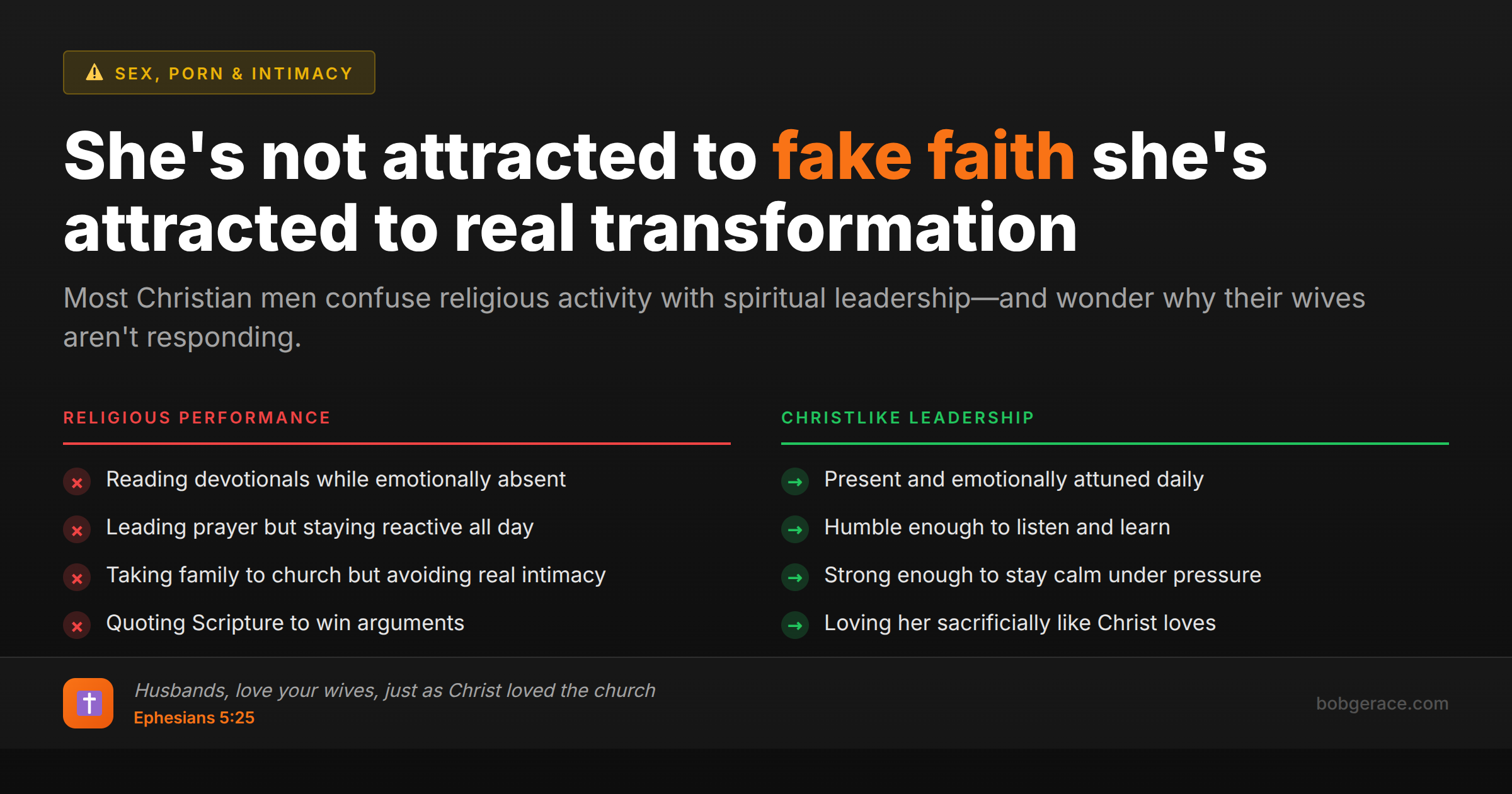
Yes. Spiritual leadership directly affects sexual desire—but not the way most men think. Your wife isn't turned on by you reading a devotional or leading family prayer if you're emotionally absent, reactive, or spiritually performative the rest of the day. Real spiritual leadership is about embodying Christ's character—presence, humility, strength, emotional attunement, sacrificial love. When you lead like that, you create safety. And safety is the foundation of desire. Most Christian men confuse spiritual leadership with religious activity. They think if they pray more, read the Bible, or take the family to church, their wife will respect and desire them. But she can feel when your faith is a performance, not a transformation. She's not attracted to a man who checks spiritual boxes. She's attracted to a man whose walk with God makes him more present, more humble, more emotionally mature, and more capable of loving her well. That kind of leadership doesn't just earn respect—it ignites desire.
What Spiritual Leadership Actually Looks Like
Most Christian husbands think spiritual leadership means being the Bible answer guy. You lead prayer. You pick the church. You correct theology. You make sure the family looks Christian. But your wife feels alone. You're spiritually active but emotionally unavailable. You quote Scripture but don't listen to her heart. You pray for the family but don't pursue her inner world. That's not leadership—it's religious performance. And it doesn't create desire.
Real spiritual leadership is about Christlikeness in the trenches of daily life. It's about how you respond when she's overwhelmed. It's about whether you notice her loneliness or just her to-do list. It's about whether you lead with humility when you're wrong or defensiveness when you're challenged. It's about whether your faith makes you more patient, more present, more emotionally attuned—or just more rigid and self-righteous.
Here's what she's watching: Does your relationship with God make you a better husband? Does it make you quicker to apologize, slower to anger, more curious about her heart? Does it make you strong enough to stay calm in conflict and humble enough to admit when you're wrong? Or does your faith just give you a platform to lecture her, correct her, or spiritualize your avoidance of real emotional work?
When you lead spiritually in a way that's grounded, humble, and emotionally intelligent, you create safety. She feels seen, known, and cared for. Her nervous system relaxes. Her respect deepens. And her body responds. But when your spiritual leadership is performative, controlling, or disconnected from emotional reality, it does the opposite. She feels judged, unseen, and alone. That kills desire faster than anything.
How Spiritual Leadership Shapes the Nervous System
From a clinical perspective, spiritual leadership affects desire because it shapes the relational environment. Desire requires a regulated nervous system. When a woman feels emotionally safe, her ventral vagal system is activated—she's calm, connected, open. When she feels unsafe, her system moves into sympathetic (anxiety, hypervigilance) or dorsal (shutdown, numbness). In that state, desire is biologically unavailable.
Spiritual leadership, when done well, is a nervous system regulator. A man who is grounded in his faith, emotionally present, and humble in his leadership creates co-regulation. His calm presence helps her nervous system settle. His emotional attunement makes her feel seen. His humility makes conflict safe. His strength (not rigidity) gives her a sense of security. All of this creates the conditions for desire.
But when spiritual leadership is performative or controlling, it does the opposite. A man who uses Scripture to avoid emotional work, who leads with rigidity instead of humility, who spiritualizes his need for control—that man creates dysregulation. His wife's nervous system stays on high alert. She feels judged, not seen. Controlled, not loved. Her body shuts down. Desire disappears.
This is compounded by attachment dynamics. If she has an anxious attachment style, she's hypervigilant to emotional disconnection. If you're spiritually active but emotionally absent, she'll feel abandoned. If she's avoidant, she'll withdraw from your spiritual leadership if it feels controlling or intrusive. Either way, the relational dynamic breaks down.
The clinical reality: spiritual leadership affects desire because it affects emotional safety. If your faith makes you more present, more humble, more attuned, you'll create an environment where her body can relax and respond. If your faith makes you more rigid, more controlling, more emotionally distant, you'll kill desire—no matter how many devotionals you lead.
Leading Like Christ, Not Like Pharisees
Ephesians 5:25 says, "Husbands, love your wives, just as Christ loved the church and gave himself up for her." This is the model for spiritual leadership. Christ didn't lead with control or performance. He led with sacrificial love. He washed feet. He listened. He saw people. He was present, humble, and emotionally attuned. That's the leadership that transforms—and attracts.
Most Christian men miss this. They think spiritual leadership is about authority, decision-making, or theological correctness. But Jesus rebuked the Pharisees for that kind of leadership. They had all the religious activity, all the Bible knowledge, all the external performance—but their hearts were hard. They used Scripture to control, not to love. They led with pride, not humility. Jesus called them whitewashed tombs. That's what your spiritual leadership becomes when it's disconnected from love.
1 Peter 3:7 says to live with your wife "in an understanding way." Understanding requires emotional attunement. It requires you to know her heart, not just manage her behavior. It requires you to lead with curiosity, not correction. When you lead like that, you honor her. And God takes that seriously—your prayers are hindered when you fail to honor your wife.
Biblical spiritual leadership isn't about being the Bible answer guy. It's about being a man whose walk with God makes him more like Jesus—humble, present, emotionally intelligent, sacrificially loving. That kind of leadership doesn't just earn respect. It creates desire. Because a woman's body responds to a man who loves her the way Christ loves the church—with presence, with sacrifice, with attunement, with grace.
Action Steps
-
1
Ask your wife, 'Do you feel spiritually led by me, or spiritually managed?' and listen to her answer without defending.
-
2
Spend one week focusing on Christlike character (patience, humility, attunement) instead of religious activity (devotionals, prayer, church attendance).
-
3
Identify one area where you've used Scripture or spiritual language to avoid emotional work, and own it with your wife.
-
4
Practice co-regulation: when she's stressed or upset, stay calm and present instead of fixing, lecturing, or spiritualizing.
-
5
Join Wingman Academy or book a session with Bob to learn how to lead spiritually in a way that creates safety and desire.
Related Questions
- What if she says she wants emotional connection before physical intimacy?
- Why does my wife feel pressure even when I am being nice?
- Can I rebuild attraction after years of resentment?
- What if my wife says she does not feel emotionally safe with me?
- Why does physical closeness feel disconnected now?
- What if my wife says sex feels like obligation?
Also find Bob on
Subscribe for weekly videos on Christian marriage.
Lead in a Way That Draws Her In
If your spiritual leadership isn't creating desire, you need a new model. Bob helps men lead like Christ—with presence, humility, and strength.
Talk to Bob →