What does nonsexual affection rebuild in marriage?
5 min read
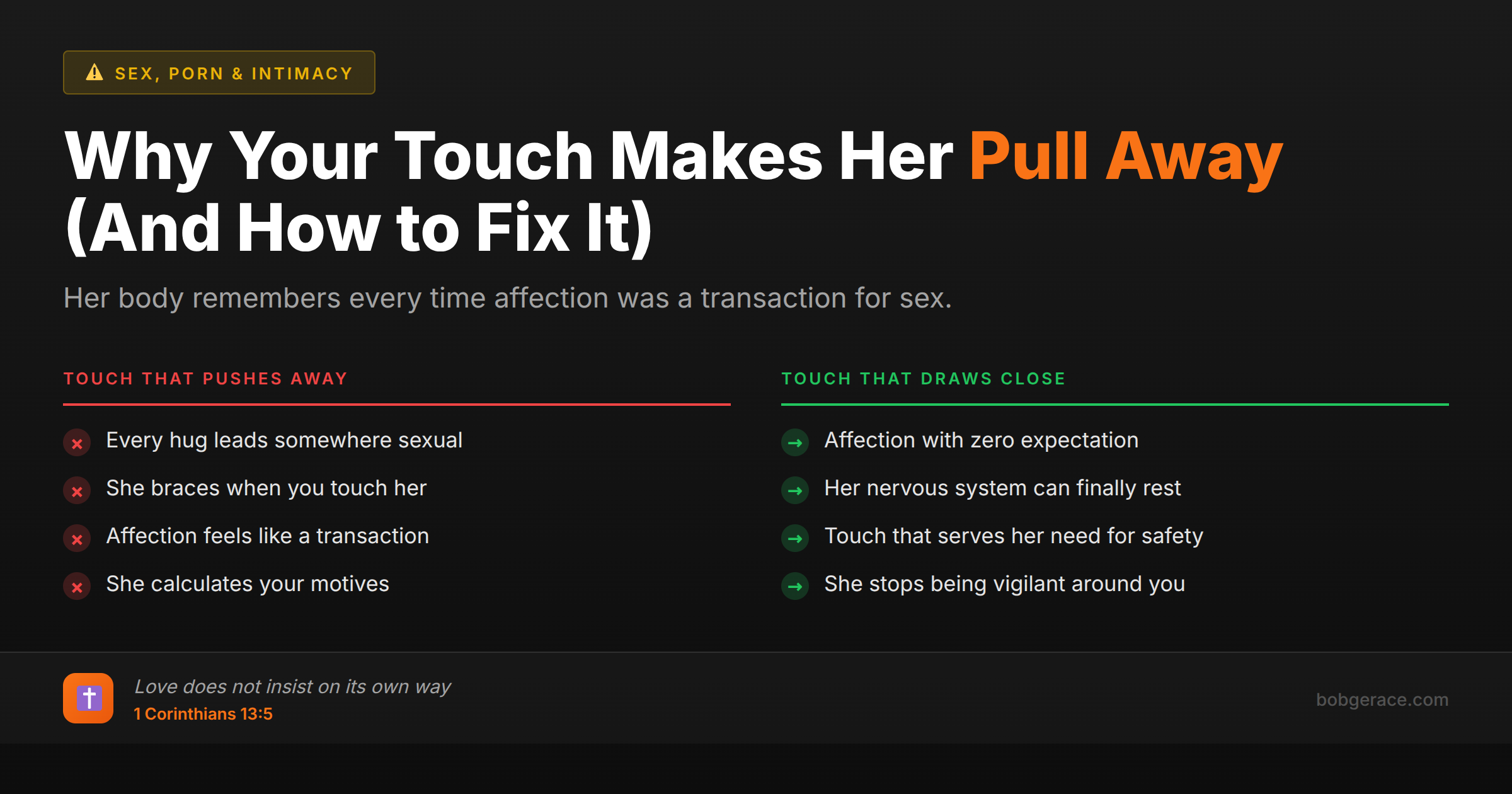
Nonsexual affection rebuilds emotional safety, nervous system regulation, and trust. When your wife experiences touch that doesn't lead to sex, her body learns you're safe again. She stops bracing. She stops calculating whether a hug means you want something. That shift—from vigilance to rest—is what opens the door to desire. Most men skip this step. They go straight from months of distance to initiation, wondering why she pulls away. But her body remembers every time affection was a transaction. Nonsexual touch rewrites that story. It tells her: I see you. I'm here. You're not just a body to me. That's the foundation intimacy is built on.
The Full Picture: Why She Stopped Trusting Your Touch
Your wife didn't wake up one day and decide to reject affection. She learned—over months or years—that your touch had an agenda. A hand on her back became a bid for sex. A kiss goodnight turned into pressure. A compliment felt like foreplay. So her nervous system adapted. It started treating affection as a threat, not a gift.
This isn't conscious. She's not sitting there thinking, "I'll punish him by pulling away." Her body is doing what bodies do when they feel unsafe: it creates distance. She tenses when you reach for her because her system is asking, "What does he want from me now?" That's not contempt. It's self-protection.
Meanwhile, you're starving for connection. You want her. You miss her. So you try harder—more compliments, more touch, more initiation. But to her, that feels like more pressure. The gap widens. Resentment builds on both sides. You feel rejected. She feels used. And the cycle deepens.
Nonsexual affection breaks the cycle. It's touch with no agenda. A hand on her shoulder while she's cooking. A hug that doesn't linger. Sitting close on the couch without escalating. These moments tell her nervous system: he's not hunting me. He's just here. That's when her body can finally exhale. That's when trust starts to rebuild. And trust is the soil desire grows in.
Clinical Insight: Nervous System Regulation and Attachment Repair
When your wife pulls away from affection, you're witnessing a polyvagal response. Her nervous system has shifted into a defensive state—either hypervigilance (fight/flight) or shutdown (freeze/collapse). Touch that once felt connective now triggers a threat response. Her body is saying: "I need to protect myself."
This happens when affection becomes transactional. If touch consistently leads to sexual pressure, her brain starts associating your hands with demand, not safety. The ventral vagal system—the part of her nervous system responsible for social engagement and bonding—goes offline. She can't relax into your presence because her body is busy calculating risk.
Nonsexual affection is a co-regulation tool. When you offer touch without expectation, you're signaling safety. You're helping her nervous system downregulate. Over time, her body learns: his touch doesn't mean I have to perform. I can receive without owing. That's attachment repair in real time.
This also addresses anxious-avoidant dynamics. If you've been pursuing (anxious attachment) and she's been withdrawing (avoidant), nonsexual touch lets you step out of the pursuer role. You're not chasing. You're present. You're offering connection she can accept on her terms. That shift alone can interrupt years of relational pattern.
The key is consistency without scorekeeping. If you give her a back rub and then three days later say, "I've been so affectionate and you still won't have sex," you've just confirmed her fear: it was transactional all along. Nonsexual touch only works when it's truly nonsexual—no hidden agenda, no timeline, no resentment when it doesn't lead anywhere.
Biblical Framework: Love That Serves, Not Demands
Ephesians 5 tells husbands to love their wives as Christ loved the church. That's sacrificial, other-centered love. Christ didn't touch the church to get something from her. He gave Himself up for her. Nonsexual affection is a small, daily picture of that kind of love—touch that serves her need for safety, not your need for sex.
First Corinthians 13 says love is patient, love is kind, love does not insist on its own way. When you offer affection without expectation, you're practicing that. You're saying: I'm not here to take. I'm here to give. That's the posture that softens hearts and rebuilds trust.
Jesus touched people to heal, comfort, and restore—never to use. He touched lepers when everyone else pulled away. He touched children when the disciples thought they were a nuisance. His touch communicated worth, not demand. Your wife needs to experience that from you. She needs to know your hands are safe, that your presence is a refuge, not a negotiation.
This doesn't mean you deny your own needs. It means you lead with her need for safety first. Proverbs 3:27 says, "Do not withhold good from those to whom it is due, when it is in your power to do it." Nonsexual affection is good you can give right now. It's in your power. And it's what she's been starving for.
Action Steps
-
1
Give her a 60-second shoulder rub tonight with zero expectation—don't escalate, don't linger, just serve and walk away.
-
2
Hug her when you get home and when you leave, holding for 3-5 seconds without letting your hands wander or your body press for more.
-
3
Sit next to her on the couch this week without initiating sex—just be close, maybe hold her hand, and let that be enough.
-
4
Compliment something non-physical once a day: her wisdom, her patience with the kids, the way she handled a hard situation.
-
5
Ask her directly: 'What kind of touch feels safe and connecting to you right now?' Then honor her answer without defensiveness.
Related Questions
- What if she says she wants emotional connection before physical intimacy?
- Why does my wife feel pressure even when I am being nice?
- Can I rebuild attraction after years of resentment?
- What if my wife says she does not feel emotionally safe with me?
- What if she discovered porn and now questions our whole marriage?
- How do I repair the comparison wound porn created?
Also find Bob on
Subscribe for weekly videos on Christian marriage.
Rebuild Trust Before You Rebuild Intimacy
If your wife has been pulling away and you don't know how to close the gap without making it worse, let's talk. I'll help you rebuild safety, regulate your own system, and lead your marriage out of this cycle.
Talk to Bob →