What if affection only comes back after trust returns?
5 min read
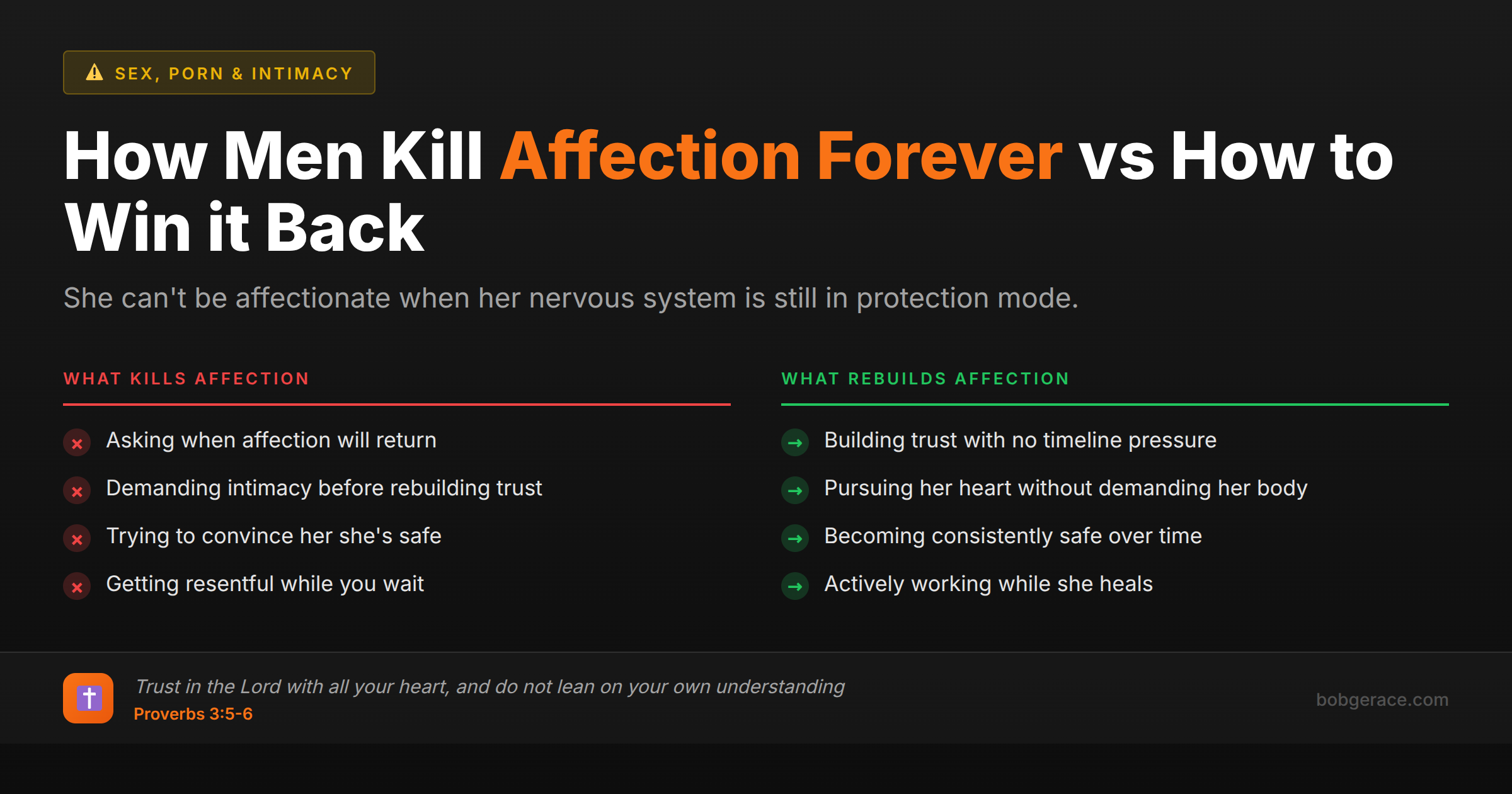
Then you build trust. You don't negotiate for affection while trust is broken. You don't ask her to perform intimacy before she feels safe. You accept that affection is a fruit of safety, not a favor she owes you. If she can't be affectionate yet, it's because her nervous system is still in protection mode. Your job isn't to convince her she's safe. It's to become safe—consistently, over time, with no shortcuts. This means you do the work whether or not she softens. You own your failures. You stop the behaviors that broke trust. You show up emotionally. You pursue her heart without demanding her body. And you wait. Not passively. Not resentfully. But actively building the kind of man she can trust again.
Why Affection Requires Safety First
Affection isn't a light switch. It's not something she can turn back on because you apologized or because enough time has passed. Affection flows from a nervous system that feels safe. When trust is broken—by porn, by emotional absence, by years of being unseen, by an affair, by chronic anger—her system goes into protection mode. She can't relax into your touch. She can't open her heart. Not because she's punishing you, but because her body won't let her.
You might see her laughing with friends, warm with the kids, engaged at work. Then you try to hug her and she goes stiff. You wonder why she can be present everywhere else but not with you. It's because you're the source of the threat. You're the one who broke trust. Her system has categorized you as unsafe, and no amount of logic or apology overrides that without consistent proof over time.
Most men respond to this by withdrawing or resenting her. You think, "I'm trying. I said I'm sorry. How long do I have to pay for this?" But that framing misses the point. She's not withholding affection to punish you. She's protecting herself because you haven't yet proven you're safe. And every time you pressure her to be affectionate before she's ready, you confirm that you still don't get it. You're still prioritizing your need for her warmth over her need for safety.
Trust takes longer to rebuild than it took to break. If you broke it over years, it won't heal in weeks. Accept that timeline or you'll sabotage the process by rushing her.
The Neurobiology of Safety and Affection
Affection and desire live in the ventral vagal state—the parasympathetic mode where the nervous system feels safe, connected, and open. When trust is broken, your wife's system shifts into sympathetic (fight/flight) or dorsal vagal (shutdown) states. In those states, affection isn't accessible. Her body is in survival mode, not connection mode.
You can't think your way into ventral vagal. You can't logic your way into feeling safe. Safety is established through consistent, predictable, non-threatening presence over time. Her nervous system needs to experience you as safe in dozens of small moments before it will risk vulnerability in big ones. Every time you show up emotionally, listen without defensiveness, touch without agenda, or own a mistake without blame-shifting, you're making a micro-deposit into her safety account.
But every time you get defensive, dismiss her feelings, pressure her for affection, or revert to old patterns, you make a withdrawal. And the math isn't one-to-one. It takes many deposits to offset one withdrawal. That's not fair, but it's how trauma and broken trust work. Her system is hypervigilant now. It's scanning for evidence that you're still the man who hurt her. You have to prove otherwise, consistently, until the scanning stops.
This is why demanding affection backfires. When you say, "How long until you're affectionate again?" her system hears, "How long until you perform for me regardless of how you feel?" That's not safety. That's coercion. And coercion kills desire.
Trust, Time, and Christlike Patience
Proverbs 3:5-6 says, "Trust in the Lord with all your heart, and do not lean on your own understanding." You want affection back on your timeline. God's asking you to trust His timeline. You want her to forgive and move on. God's asking you to steward the long, slow work of rebuilding without demanding results you haven't earned.
Jesus rebuilt trust with Peter after Peter's betrayal. He didn't shame him. He didn't rush him. He asked him three times, "Do you love me?" matching the three denials (John 21:15-17). He gave Peter space to own the failure and re-commit. Then He gave him a mission. Jesus didn't withhold relationship, but He also didn't pretend the betrayal didn't matter. He let the weight of it sit while He rebuilt the foundation.
That's your model. You don't withhold presence or love while trust rebuilds. But you also don't demand that she act like everything's fine before it is. You stay engaged. You serve her. You pursue her heart. You let her feel what she feels without trying to manage it. And you trust that God is at work in the waiting.
First Peter 3:7 tells husbands to live with their wives in an understanding way, "showing honor to the woman as the weaker vessel." That doesn't mean she's fragile or inferior. It means you steward her heart with care, recognizing that you have power to harm or heal. If you've harmed her, you don't get to decide when she's healed. You get to faithfully tend the relationship and trust God with the fruit.
Action Steps
-
1
Stop asking when affection will return. Every time you ask, you're pressuring her and proving you're still focused on your needs, not her healing.
-
2
Identify the specific behaviors that broke trust (porn, anger, emotional absence, criticism) and get external accountability to stop them—not just try harder, but structurally change your life so they're not accessible.
-
3
Pursue her emotionally every day with no expectation of physical affection: ask about her inner world, carry a burden she's been holding, notice what she needs before she asks.
-
4
When she does offer small affection (a smile, a touch, a softening), receive it without escalating or interpreting it as a green light for more. Let small affection be enough.
-
5
Work with a coach or counselor to process your own frustration, shame, and impatience so you're not leaking resentment onto her while you wait.
Related Questions
- What if she says she wants emotional connection before physical intimacy?
- Why does my wife feel pressure even when I am being nice?
- Can I rebuild attraction after years of resentment?
- What if my wife says she does not feel emotionally safe with me?
- How do I become patient without becoming passive?
- How should a Christian husband confess porn without self-protection?
Also find Bob on
Subscribe for weekly videos on Christian marriage.
Rebuild Trust the Right Way
Waiting for affection to return is brutal, especially when you're trying and she's still distant. I help men navigate this season without sabotaging the process or losing themselves in resentment.
Talk to Bob →