What if our marriage looks fine but the bedroom is dead?
6 min read
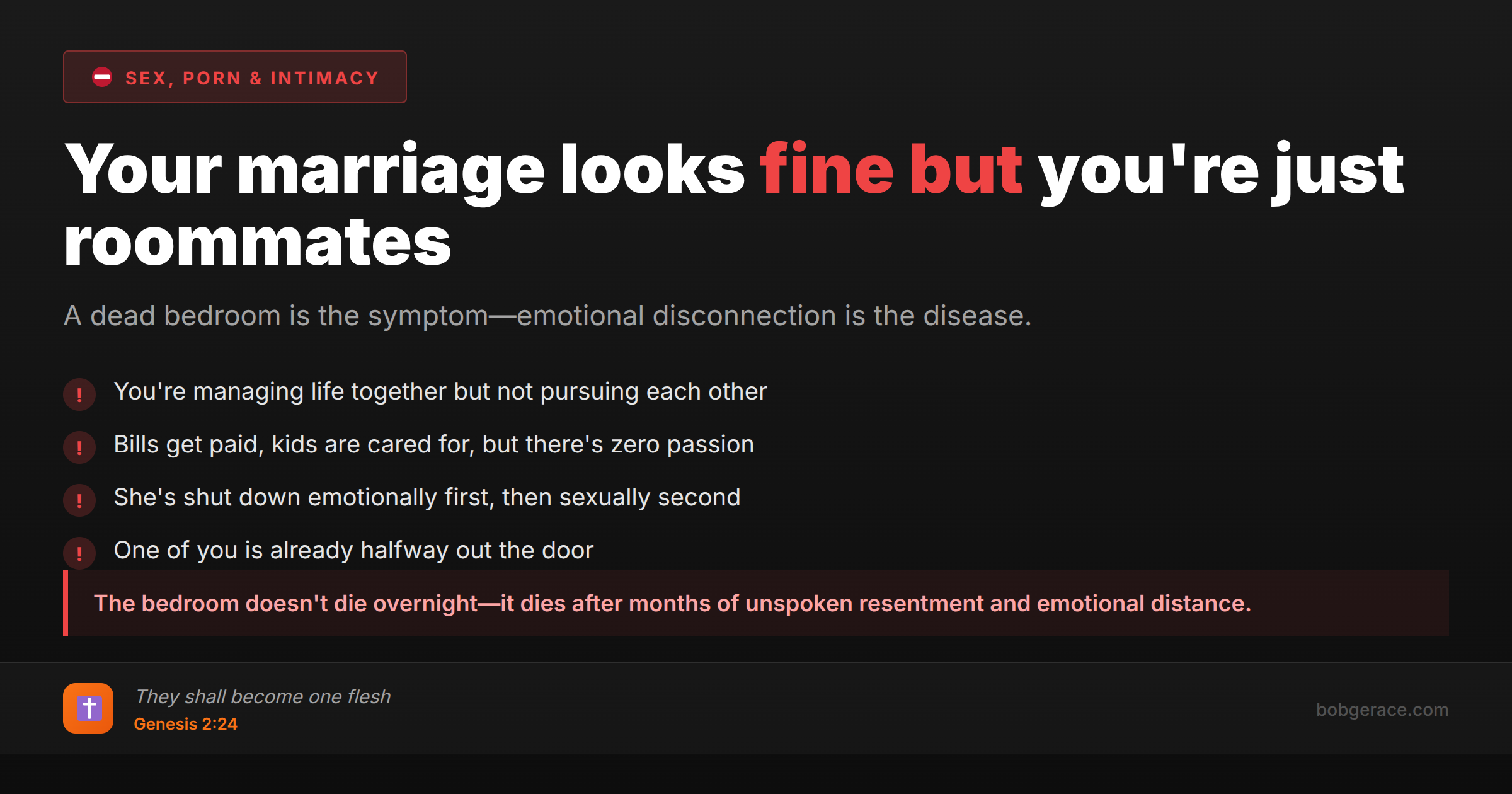
A marriage that looks fine on the outside but has a dead bedroom is often a marriage running on autopilot—functional but not connected. You're roommates managing a life together, not lovers pursuing each other. The bills get paid, the kids are cared for, you're polite at dinner, but there's no passion, no pursuit, no emotional or physical intimacy. This isn't fine. It's a slow fade that most couples don't notice until one person is already halfway out the door. The bedroom doesn't die overnight. It dies after months or years of unspoken resentment, emotional distance, unresolved conflict, or one person feeling alone in the marriage. You may not be fighting, but you're not connecting either. And for many wives, a lack of emotional intimacy makes physical intimacy feel empty, obligatory, or even repulsive. If she's shut down sexually, it's often because she's shut down emotionally first.
The Full Picture: When Everything Looks Fine But Nothing Feels Alive
From the outside, your marriage might look enviable. You've got the house, the kids, the careers, the social life. You don't yell at each other. You're not in crisis. But inside, there's a quiet emptiness. You sleep in the same bed but don't touch. You talk about logistics but not about feelings. You have sex rarely, if at all, and when you do, it feels mechanical or obligatory.
This is one of the most dangerous stages of marriage because it doesn't feel urgent. There's no affair, no blowup, no obvious threat. So you tell yourself it's just a season—work is busy, the kids are demanding, life is stressful. But seasons turn into years, and before you know it, you've built a life together without actually being together.
For many men, this dynamic is confusing. You're doing what you think you're supposed to do: providing, protecting, being responsible. You're not mean or neglectful in obvious ways. But you're also not present. You're not pursuing her emotionally. You're not asking the deeper questions. You're not creating space for her to feel seen, known, or desired beyond the bedroom.
Your wife may have tried to tell you this years ago. She may have asked for more time, more conversation, more emotional connection. And you may have heard it as criticism or nagging, so you tuned it out. Over time, she stopped asking. She stopped expecting. She stopped hoping. And now, she's emotionally detached. The bedroom is dead because the emotional connection died first.
This pattern is especially common in high-performing marriages. You're both competent, both busy, both managing your domains. But competence doesn't create intimacy. Efficiency doesn't create desire. And a well-run household is not the same as a connected marriage.
Clinical Insight: Emotional Bid Failures, Resentment, and Shutdown
Clinically, what you're describing is often the result of years of failed emotional bids. Dr. John Gottman's research shows that couples who stay connected respond to each other's bids for attention, affection, or connection. A bid might be your wife saying, 'I had a hard day,' or 'Can we talk?' or even just reaching for your hand. If you consistently turn away from those bids—by staying on your phone, giving a distracted 'uh-huh,' or changing the subject—she learns that you're not available. Eventually, she stops bidding. That's when the marriage starts to feel dead.
Resentment builds in the silence. She resents that you don't notice her, don't ask, don't pursue. You resent that she's not interested in sex, that she seems distant or cold. Both of you are hurt, but neither of you is talking about it. Instead, you're both protecting yourselves by staying surface-level. This is called 'stable but empty'—a marriage that functions but doesn't thrive.
From a nervous system perspective, your wife's body may be in a chronic state of shutdown. Shutdown happens when someone feels helpless or hopeless about change. It's not depression, necessarily, but it's a physiological state where the body conserves energy and stops reaching out. In this state, sexual desire is nearly impossible. Her body doesn't feel safe enough to be vulnerable, even if there's no overt conflict.
Another factor is the loss of polarity. In many high-functioning marriages, both spouses become task-oriented and gender-neutral in their roles. You're both managing, both executing, both in your heads. There's no masculine-feminine dynamic, no pursuit and response, no tension or playfulness. You're business partners, not lovers. Restoring polarity requires you to step back into your masculine role—not as a boss, but as a leader who creates safety, presence, and direction.
Biblical Framework: Marriage as Covenant, Not Contract
A marriage that looks fine but feels dead is a marriage that's become contractual rather than covenantal. You're fulfilling obligations—paying bills, raising kids, showing up—but you're not pursuing oneness. Genesis 2:24 says a man shall leave his father and mother and hold fast to his wife, and they shall become one flesh. One flesh isn't just about sex; it's about deep, intimate, vulnerable union. If you're living parallel lives, you're not one.
Jesus said in Matthew 5:8, 'Blessed are the pure in heart, for they shall see God.' Purity of heart isn't just about sexual morality; it's about singleness of devotion. Are you fully devoted to your wife, or are you divided—by work, by distractions, by secret sin, by emotional unavailability? If your heart is divided, your marriage will feel divided.
Ephesians 5 calls husbands to love their wives as Christ loved the church. Christ didn't love from a distance. He didn't love transactionally. He pursued, sacrificed, and gave Himself fully. If your marriage looks fine but the bedroom is dead, the question is: are you loving her the way Christ loves, or are you just managing a household?
Proverbs 5:15-19 celebrates sexual intimacy in marriage, but it's in the context of faithfulness and delight. If you're not delighting in your wife—if you're not pursuing her, enjoying her, making her feel desired—she will feel it. And if she's not feeling delighted in, her body will not respond. God designed sex to be the overflow of covenant love, not a duty or a transaction.
Action Steps
-
1
Sit down with your wife and say, 'I know we look fine, but I don't think we're connected. I want to change that. Will you help me understand how you're really feeling?'
-
2
Identify three emotional bids she's made in the last week that you missed or dismissed. Apologize specifically and ask her to keep reaching out—you're learning to respond.
-
3
Schedule a weekly date night with no agenda other than being present. No phones, no logistics talk, no problem-solving. Just connection.
-
4
If there's secret sin (porn, emotional affairs, financial secrecy), confess it and get help. A dead bedroom is often the fruit of hidden betrayal.
-
5
Work with a coach who can help you rebuild emotional and sexual intimacy from the ground up. You can't fix this by trying harder at the same things.
Related Questions
- How do I talk about our sexless marriage without pressuring her?
- Is a sexless marriage really about sex?
- Should I accept a sexless marriage or fight for intimacy?
- Why is my wife not interested in sex anymore?
- What does porn addiction do to a marriage?
- Why is my marriage sexless even though I provide well?
Also find Bob on
Subscribe for weekly videos on Christian marriage.
Don't Wait Until She's Done
A marriage that looks fine but feels dead won't stay that way forever. Eventually, one of you will stop pretending. If you want to rebuild real intimacy before it's too late, let's talk.
Talk to Bob →