What does porn addiction do to a marriage?
6 min read
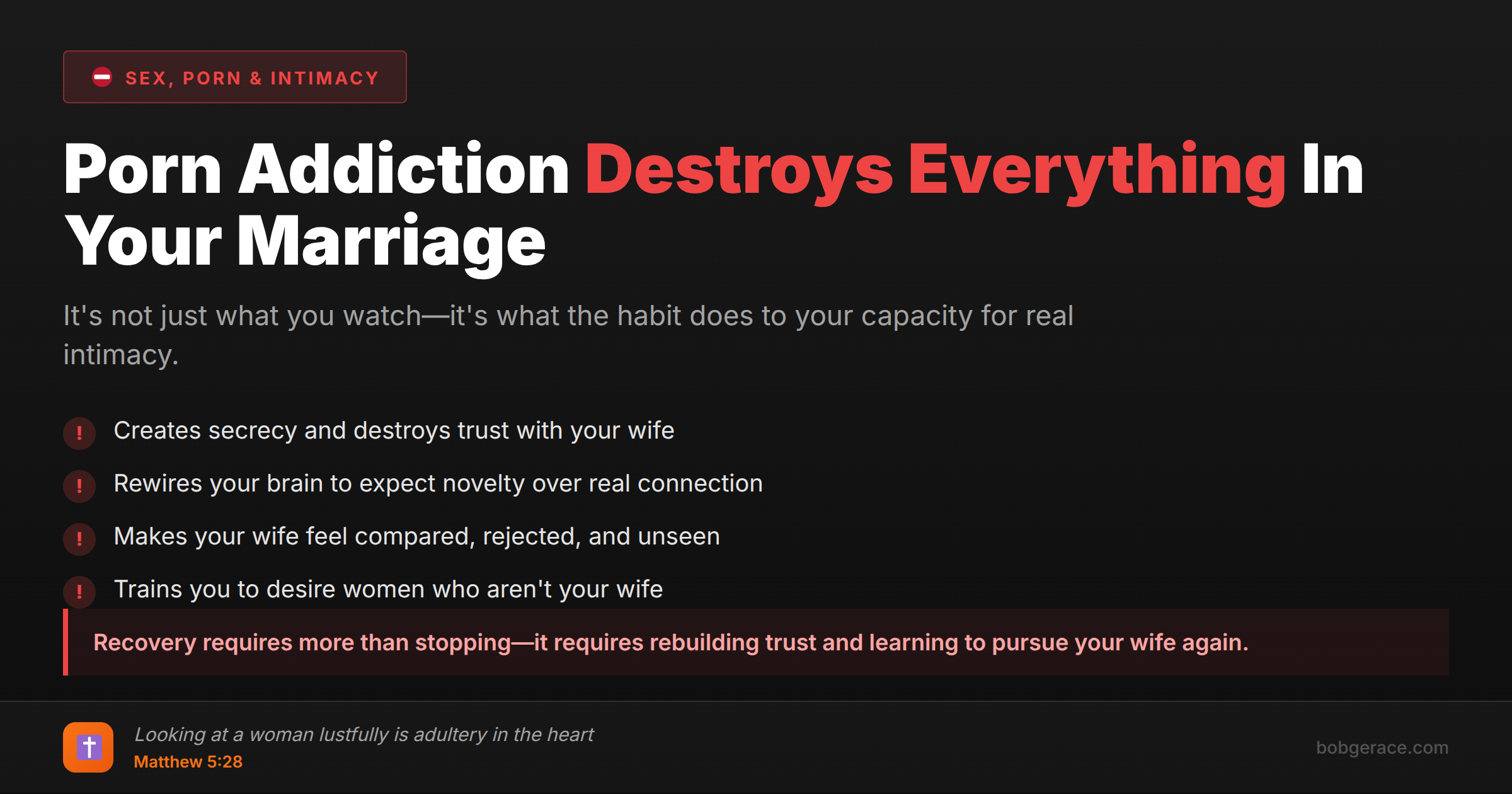
Porn addiction destroys trust, creates secrecy, rewires your brain's reward system, and changes the way your wife experiences intimacy with you. It is not just about what you watch—it is about what the habit does to your capacity for presence, honesty, and emotional connection. Your wife may feel compared, rejected, or like she is performing for a man who is never fully there. Even if she does not know about the porn, she feels the distance, the irritability, and the sense that something is off. The damage is not only moral—it is neurobiological and relational. Porn trains your brain to expect novelty, intensity, and instant reward without the vulnerability of real intimacy. Over time, this makes your wife less interesting, sex less satisfying, and emotional connection feel like work. The secrecy creates a double life, and the lying erodes the foundation of your marriage. Recovery requires more than stopping the behavior—it requires rebuilding trust, owning the full impact, and learning to pursue your wife in ways that make her feel safe and seen again.
The Full Relational Impact of Porn Addiction
Porn addiction does not stay contained. It leaks into every part of your marriage. It changes how you look at your wife, how you pursue her, how you respond when she says no, and how present you are when you are together. You may think it is just a private habit, but your wife feels it as emotional distance, sexual pressure, or a sense that she is never enough. She may not have the language to name it, but her nervous system knows something is wrong.
The secrecy is its own betrayal. Every time you hide your phone, clear your browser history, or lie about where you have been, you are choosing the porn over her. You are choosing to protect your habit instead of protecting your marriage. This creates a trust wound that goes deeper than the images themselves. She begins to question everything—your affection, your compliments, your interest in sex. She wonders if you are thinking about her or about what you watched last night. She feels compared, and she feels like she is losing.
Porn also changes your brain. It hijacks your dopamine system and creates a cycle of craving, use, shame, and withdrawal. Over time, your brain becomes less responsive to real intimacy. Your wife's body, her pace, her need for emotional connection—all of it feels slow and boring compared to the novelty and intensity of porn. You may find yourself less interested in sex with her, more irritable when she is not available, or unable to stay present during intimacy because your mind is elsewhere. This is not a moral failure—it is a neurobiological pattern. But it is also a relational injury that requires you to take full responsibility for the harm it has caused.
The Neurobiological and Attachment Damage of Porn Use
Porn addiction rewires your brain's reward pathways. It floods your system with dopamine in a way that real intimacy cannot match. Over time, your brain begins to crave the novelty, the visual intensity, and the control that porn provides. Real sex requires vulnerability, attunement, and responsiveness to another person's needs. Porn requires none of that. It trains you to be a passive consumer instead of an active, emotionally present partner. This is why many men with porn addictions struggle with erectile dysfunction, delayed ejaculation, or lack of interest in their wives—not because their wives are not attractive, but because their brains have been conditioned to respond only to the hyper-stimulation of porn.
From an attachment perspective, porn often becomes a way to avoid intimacy while still getting a dopamine hit. If you grew up in a home where emotions were unsafe, where you learned to self-soothe instead of co-regulate, porn becomes an extension of that avoidant pattern. You do not have to risk rejection, conflict, or emotional exposure. You do not have to deal with your wife's needs, her hurt, or her disappointment. You can regulate your nervous system on your own terms. But this also means you never build the capacity to stay present in conflict, to repair after disconnection, or to co-regulate with your wife when she is upset.
Your wife's nervous system responds to your secrecy and withdrawal. She may become hypervigilant—checking your phone, questioning your mood, feeling anxious when you are alone. This is not her being controlling—it is her body detecting a threat to the relationship. The secrecy creates an insecure attachment loop: you hide, she pursues or withdraws, you feel shame and hide more. The cycle deepens until trust is nearly gone. Recovery requires you to break the secrecy, own the impact, and rebuild safety through consistent, honest, emotionally present behavior over months and years, not days.
A Christian Perspective on Lust, Secrecy, and Covenant Repair
Jesus said that looking at a woman lustfully is adultery in the heart (Matthew 5:28). This is not legalism—it is a recognition that desire, attention, and imagination are relational. Where you direct your desire matters. Porn trains you to desire women who are not your wife, to fantasize about bodies and scenarios that have nothing to do with the covenant you made before God. It is not just a private sin—it is a relational betrayal that damages the one-flesh union God designed for marriage.
Paul writes that your body is not your own—you were bought with a price (1 Corinthians 6:19-20). This means your sexuality is not yours to do with as you please. It belongs to God, and in marriage, it belongs to the covenant you made with your wife. Porn is a form of theft—it takes sexual energy, attention, and desire that belong to your wife and gives it to images, fantasies, and women you will never know. It is consumptive, not covenantal. It takes without giving. It desires without knowing. It uses without serving.
Repentance is not just stopping the behavior. It is turning fully toward your wife and toward God. It is confessing not only the sin but the impact—how it hurt her, how it created distance, how it made her feel unsafe and unseen. It is rebuilding trust through transparency, accountability, and the long, hard work of becoming a man who can be emotionally present, sexually generous, and spiritually grounded. God offers grace and forgiveness, but grace does not mean your wife must trust you immediately. Trust is rebuilt through time, honesty, and changed behavior. You must become a man who is worthy of her trust again, and that requires more than words—it requires a transformed life.
Action Steps
-
1
Stop lying. If your wife asks if you have been using porn, tell the truth. Do not trickle-truth her. Do not wait until she finds evidence. Own it fully, now.
-
2
Confess the full impact, not just the behavior. Say, 'I was wrong. I hurt you. I made you feel compared and unseen. I chose secrecy over you. I am sorry.' Do not defend or minimize.
-
3
Get real accountability. Not a friend who also struggles. A coach, therapist, or mentor who will ask hard questions, check your phone, and hold you to a standard of honesty.
-
4
Rebuild transparency over time. Give her access to your devices, your location, your schedule. Let her see that you are choosing honesty even when it is uncomfortable.
-
5
Pursue her emotionally, not just sexually. Touch her without expecting sex. Ask about her day. Sit with her when she is upset. Show her that intimacy is about connection, not just your arousal.
Related Questions
Also find Bob on
Subscribe for weekly videos on Christian marriage.
Rebuild Trust Before It's Too Late
Porn recovery is not just about stopping the behavior—it's about becoming a man your wife can feel safe with again. If you are ready to own the damage, rebuild trust, and lead your marriage with integrity, let's talk.
Talk to Bob →