What if porn is how I cope with stress?
6 min read
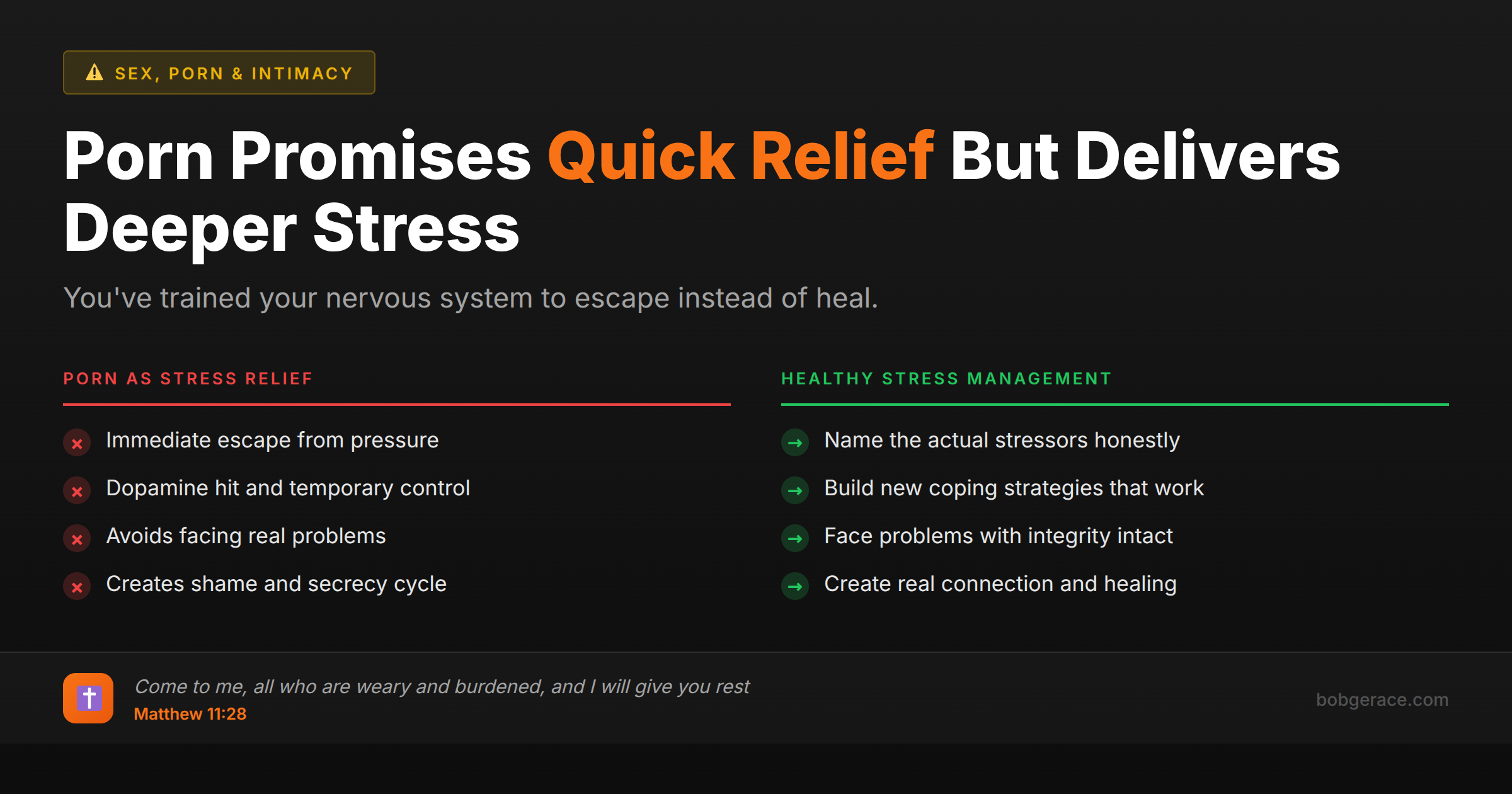
If porn is how you cope with stress, you have trained your nervous system to seek relief through secrecy, fantasy, and disconnection instead of real intimacy, presence, or emotional regulation. Porn works in the short term because it offers immediate escape, dopamine release, and control. But it does not actually resolve stress. It compounds it by creating shame, secrecy, relational distance, and a pattern of avoiding the real issues in your life and marriage. The problem is not that you experience stress. The problem is that porn has become your primary strategy for managing it. And that strategy is destroying your integrity, your marriage, and your capacity for real connection. The path forward is not willpower or shame. It is building new, healthier ways to regulate your nervous system and address the underlying stress you are avoiding.
The Full Picture: Why Porn Feels Like It Works
Porn feels like it works because it does—temporarily. When you are stressed, overwhelmed, lonely, or anxious, porn offers immediate relief. It is private, accessible, predictable, and requires nothing from you. No conflict. No vulnerability. No risk of rejection. Just a quick hit of dopamine, a few minutes of escape, and a temporary sense of control.
But that relief comes at a cost. Porn does not resolve the stress. It distracts you from it. The work pressure, the marital tension, the financial worry, the loneliness, the fear—none of it goes away. It just gets buried under secrecy and shame. And the more you use porn to cope, the less capable you become of facing stress directly.
Over time, porn becomes a reflex. Bad day at work? Porn. Fight with your wife? Porn. Feeling inadequate, invisible, or overwhelmed? Porn. Your brain learns that stress equals escape, and escape equals porn. This is not about moral weakness. It is about neurological conditioning. You have trained your nervous system to seek relief in a way that disconnects you from yourself, from God, and from your wife.
Meanwhile, your wife may sense the distance. She may not know about the porn, but she feels the secrecy. She feels your emotional absence, your irritability when she interrupts your alone time, the way you are present in body but not in spirit. If she discovers the porn, the betrayal is not just about the images. It is about the hidden life, the lies, the years of choosing fantasy over her.
Many men minimize porn as a private habit that does not hurt anyone. But secrecy always creates distance. And distance kills intimacy. If porn is how you cope with stress, your marriage is paying the price—whether your wife knows it yet or not.
Clinical Insight: Stress, Dopamine, and Avoidance Patterns
From a clinical perspective, using porn to cope with stress reflects a dysregulated nervous system and an avoidance-based coping strategy. When you experience stress, your nervous system moves into a state of activation: fight, flight, or freeze. Healthy regulation involves processing the stress, addressing the source, or using adaptive coping strategies like exercise, prayer, connection, or rest.
Porn short-circuits this process. It offers a dopamine hit that temporarily calms your nervous system without requiring you to face the stressor. This is called experiential avoidance—using a behavior to escape uncomfortable emotions rather than processing them. Over time, this pattern becomes entrenched. Your brain learns that stress equals porn, and porn equals relief. The neural pathway strengthens. The behavior becomes automatic.
This is how addiction develops. Porn is not just a habit. It is a coping mechanism that hijacks your brain's reward system. The more you use it, the more you need it. Tolerance builds. What used to relieve stress now barely registers. You need more frequency, more intensity, more novelty. Meanwhile, your capacity for real intimacy, emotional regulation, and stress tolerance atrophies.
Porn also creates a shame cycle. You use porn to cope with stress. You feel shame afterward. The shame creates more stress. You use porn again to cope with the shame. The cycle deepens. You feel stuck, powerless, and increasingly disconnected from your values, your wife, and your faith.
The way out is not willpower. It is building new pathways for stress regulation. You must learn to sit with discomfort, name your emotions, address the real sources of stress, and develop healthier coping strategies. This requires self-awareness, accountability, and often professional support. You cannot shame yourself into freedom. You must build a new way of being.
Biblical Framework: True Rest vs. Counterfeit Escape
Scripture is clear that God cares about how you handle stress, temptation, and the condition of your heart. Jesus offers true rest: "Come to me, all who are weary and burdened, and I will give you rest" (Matthew 11:28). But porn is not rest. It is escape. It is a counterfeit that promises relief but delivers bondage.
Paul writes, "No temptation has overtaken you except what is common to mankind. And God is faithful; he will not let you be tempted beyond what you can bear. But when you are tempted, he will also provide a way out so that you can endure it" (1 Corinthians 10:13). Porn is not the way out. It is the way deeper in. The way out is confession, repentance, accountability, and learning to bring your stress to God instead of hiding it in secrecy.
Jesus also warns that what is hidden will be brought to light (Luke 8:17). Secrecy always has consequences. If you are using porn to cope with stress, you are building a hidden life. That hidden life creates distance from your wife, from God, and from your own integrity. It may feel manageable now, but secrecy always grows. And when it is exposed—and it will be—the damage is far greater than if you had faced it honestly from the start.
God does not condemn you for feeling stress. He invites you to bring it to Him. "Cast all your anxiety on him because he cares for you" (1 Peter 5:7). But you cannot cast your anxiety on God while you are medicating it with porn. You must choose: will you run to God with your stress, or will you run to secrecy? One leads to freedom. The other leads to bondage.
Repentance is not just feeling bad about porn. It is turning away from it and turning toward God, truth, and real intimacy. It is building a life where stress is met with prayer, community, and presence—not escape.
Action Steps
-
1
Name the real stressors in your life: work pressure, financial fear, marital tension, loneliness, inadequacy. Write them down. Stop using porn to avoid facing them.
-
2
Identify your triggers. When do you turn to porn? What emotions precede it? What situations make you vulnerable? Build awareness of the pattern so you can interrupt it.
-
3
Build new coping strategies for stress: exercise, prayer, journaling, calling a friend, taking a walk, deep breathing. Practice these when stress hits, before the urge for porn takes over.
-
4
Install accountability software (Covenant Eyes, Truple, etc.) and give access to a trusted friend, mentor, or coach. Secrecy is the enemy. Bring your struggle into the light.
-
5
Work with a coach, counselor, or support group (like Pure Desire or Samson Society) to address the underlying issues driving your porn use. You cannot willpower your way out of this. You need support, strategy, and a new way of regulating your nervous system.
Related Questions
- Is husband porn addiction damaging my marriage?
- What does porn addiction do to a marriage?
- Why do I keep going back to porn when I love my wife?
- How do I rebuild trust after hiding porn?
- How do I become emotionally present before I ask for physical closeness?
- What if she says I only want her for sex?
Also find Bob on
Subscribe for weekly videos on Christian marriage.
Stop coping in secret. Build real freedom.
If porn has become your go-to for stress and you are ready to break the cycle, Bob helps men build the self-awareness, accountability, and new patterns needed to walk in integrity and real intimacy.
Talk to Bob →