Why do I keep going back to porn when I love my wife?
5 min read
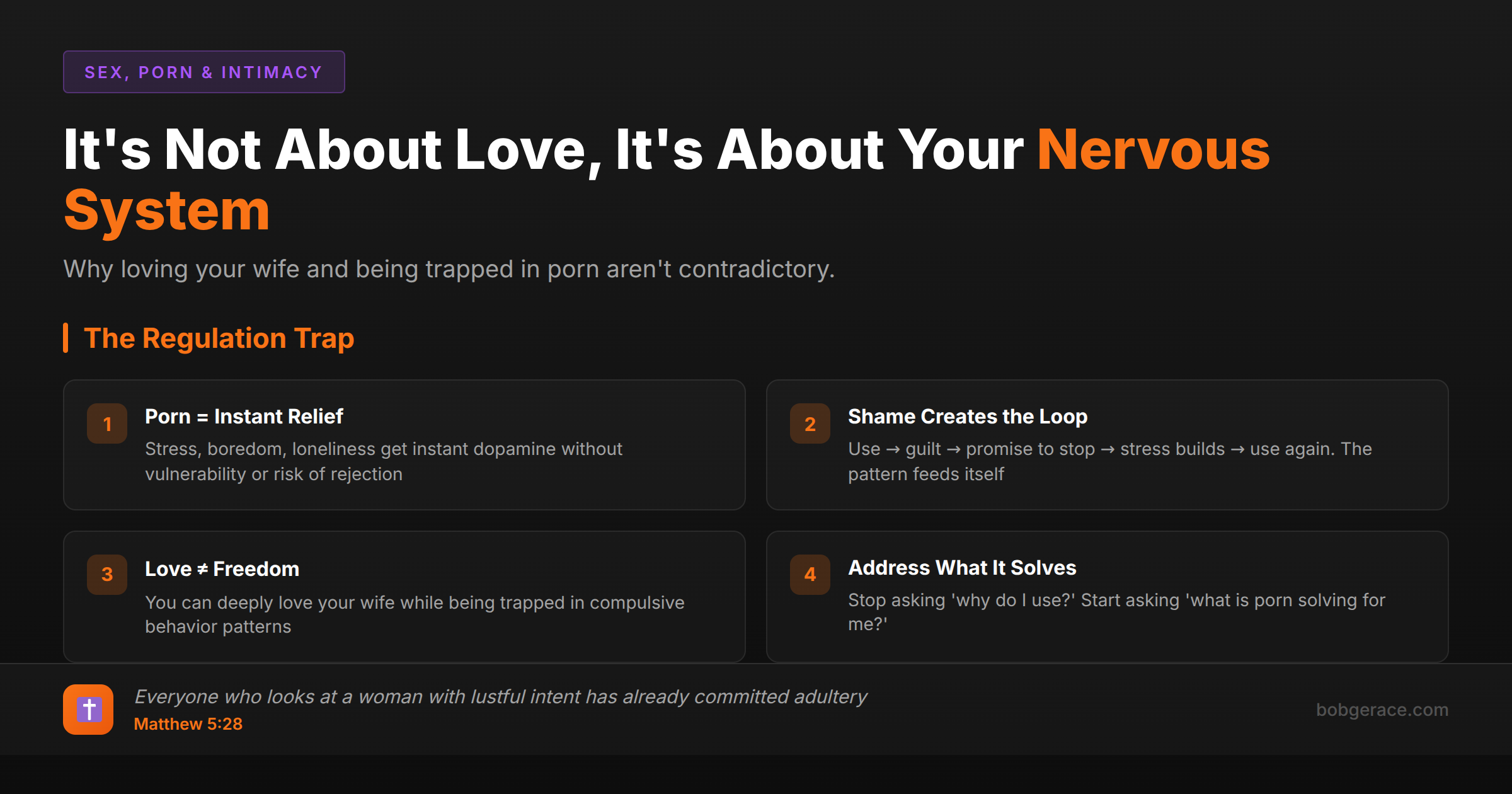
You keep going back to porn because it's become your primary nervous system regulator—not because you don't love your wife. Porn offers instant relief from stress, boredom, loneliness, or performance pressure without requiring vulnerability, emotional presence, or the risk of rejection. It's a predictable dopamine hit that asks nothing of you. Your wife isn't the problem. The pattern is. Porn creates a shame loop: use, guilt, promise to stop, stress builds, use again. Meanwhile, it rewires your arousal template, increases secrecy, and makes real intimacy feel harder. Loving your wife and being trapped in a compulsive pattern aren't contradictory—they coexist until you address what porn is actually solving for you.
The Full Picture: What Porn Is Actually Doing in Your Marriage
Porn isn't just a private habit. It changes the way you show up. Your wife may not know the details, but she feels the distance. She notices when you're less present during sex, when your eyes don't meet hers, when affection only appears when you want something. She may feel compared, rejected, or like a service provider rather than a desired woman.
You're not a monster. You're a man using a tool that worked—until it didn't. Porn offered relief when you were stressed, lonely, or avoiding conflict. It gave you control when intimacy felt risky or your wife felt distant. But now it's creating the very disconnection you're trying to escape. The secrecy alone erodes trust. The dopamine pattern makes real arousal harder. The shame makes you withdraw further.
Many Christian men carry an additional layer: spiritual shame. You know it's wrong. You've confessed it. You've promised God and yourself you'll stop. Then you're back at it within days or weeks. This isn't a willpower problem—it's a nervous system and intimacy problem. Porn has become your go-to when you're dysregulated, and stopping requires building new pathways for stress, connection, and arousal. Your wife can't fix this for you, but your marriage can't heal while you're living in secret.
Clinical Insight: The Neurobiology of the Porn Loop
Porn hijacks your brain's reward system. It delivers supernormal stimuli—novelty, variety, escalation—that natural sexual encounters can't match. Over time, your dopamine pathways become conditioned to screen-based arousal. Real intimacy, which requires presence, emotional attunement, and vulnerability, feels less compelling by comparison.
This isn't moral weakness. It's neuroplasticity. Your brain has learned that porn = relief. When stress, boredom, anger, or loneliness spike, your nervous system reaches for the fastest regulator available. Porn works within seconds. Talking to your wife, processing emotions, or sitting with discomfort takes longer and feels riskier.
The shame cycle compounds the problem. After using porn, you feel guilt. You avoid your wife or overcompensate with niceness. She senses something is off. The disconnection increases your stress. Your nervous system seeks relief again. The loop tightens. Breaking it requires more than accountability software or promises. You need to identify your triggers, build alternative regulation tools, and relearn intimacy as a safe, embodied experience. This is behavioral rewiring, not just sin management.
Biblical Framework: Lust, Secrecy, and Covenant Intimacy
Jesus said, "Everyone who looks at a woman with lustful intent has already committed adultery with her in his heart" (Matthew 5:28). This isn't about thought policing—it's about the orientation of your desire. Porn trains you to consume women as objects for your arousal rather than honor your wife as a covenant partner made in God's image.
Paul writes, "Flee from sexual immorality. Every other sin a person commits is outside the body, but the sexually immoral person sins against his own body" (1 Corinthians 6:18). Porn isn't just a private sin—it affects your body, your brain, your marriage, and your witness. It creates a divided heart. You can't pursue purity in secret while living in deception.
God's design for sex is oneness—vulnerable, mutual, embodied intimacy within covenant (Genesis 2:24-25). Porn is the opposite: detached, one-sided, hidden. Repentance isn't just feeling bad—it's changing direction. Confess to God, yes. But also bring the pattern into the light with a trusted brother, counselor, or coach. Secrecy is where sin thrives. Healing happens in honest community and renewed pursuit of your wife.
Action Steps
-
1
Identify your three most common triggers (time of day, emotion, situation) and write them down. Awareness breaks autopilot.
-
2
Install accountability software (Covenant Eyes, Truple) and give access to a trusted man, not your wife. She's your spouse, not your monitor.
-
3
Build a 60-second regulation tool for each trigger: box breathing, cold water on face, push-ups, text a friend. Give your nervous system an alternative.
-
4
Confess the pattern to your wife without minimizing or demanding immediate forgiveness. Say: 'I've been using porn. It's been secret. I'm getting help. I'm sorry for the ways this has hurt you.'
-
5
Work with a coach or counselor who understands porn as a nervous system and intimacy issue, not just a sin-management problem. Rewiring takes guided practice.
Related Questions
Also find Bob on
Subscribe for weekly videos on Christian marriage.
You Don't Have to Stay Stuck in This Loop
Porn isn't just a private struggle—it's changing your marriage whether your wife knows or not. I help men break the shame cycle, rebuild trust, and relearn intimacy without secrecy or performance pressure.
Talk to Bob →