Why does my wife seem relieved when I stop pursuing sex?
6 min read
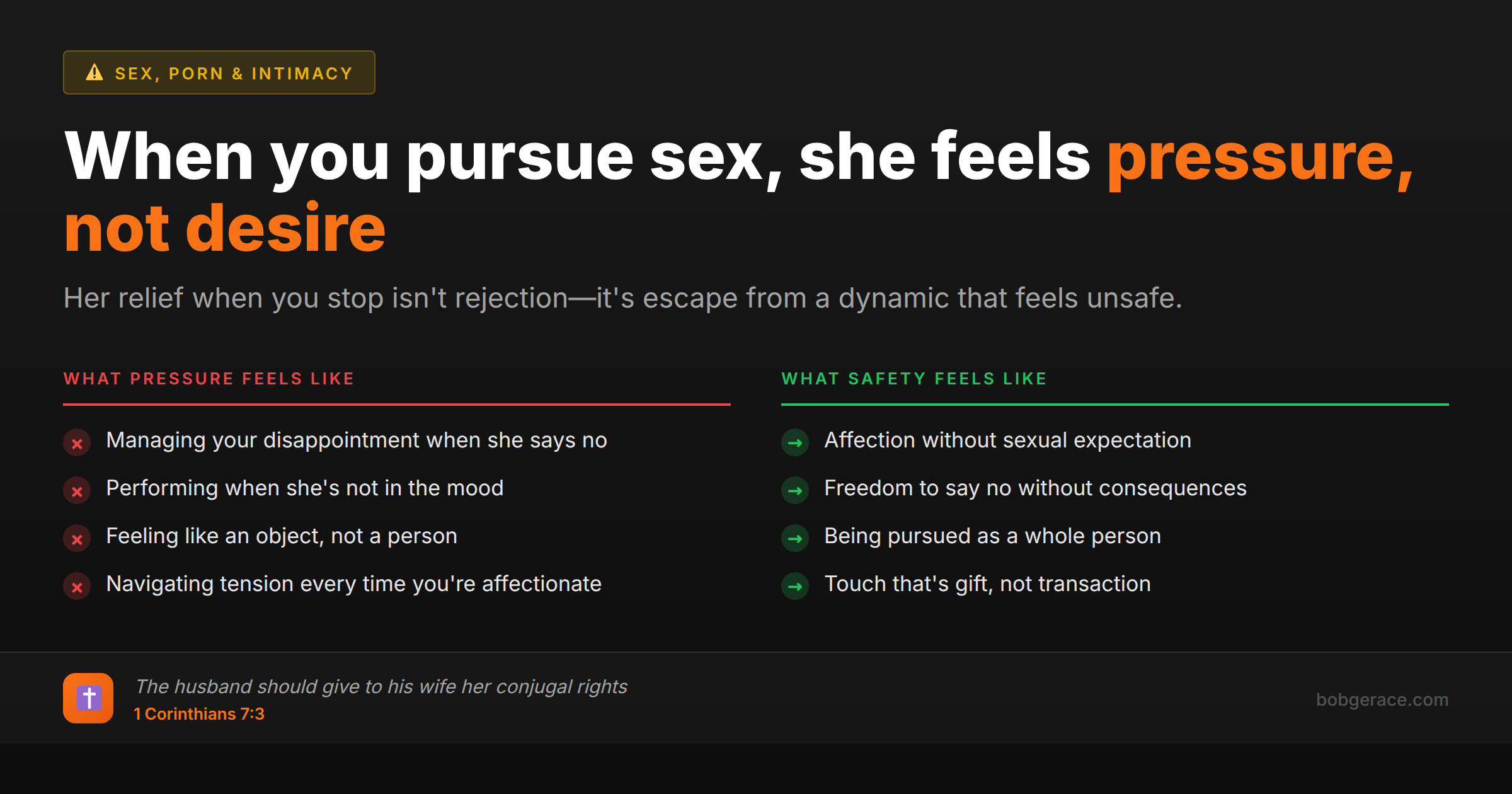
If your wife seems relieved when you stop pursuing sex, it's because your pursuit has felt like pressure, not desire. She's not relieved that you don't want her. She's relieved that she doesn't have to manage your disappointment, perform when she's not in the mood, or navigate the tension that comes when she says no. The relief is a sign that sex has become a source of stress, not connection. This is one of the most painful realizations for a husband: the thing you want most—intimacy with your wife—has become the thing she's trying to avoid. But her relief isn't about rejecting you. It's about escaping a dynamic that's made her feel unsafe, objectified, or obligated. The repair starts when you stop pursuing and start rebuilding the emotional safety that makes desire possible.
The Full Picture: Relief Signals a Broken Pursuit Dynamic
When your wife seems relieved that you've stopped pursuing sex, it's not because she doesn't love you. It's because the way you've been pursuing her has felt like pressure, not invitation. She's been saying yes out of duty, fear of conflict, or a desire to keep you happy—not because she wants intimacy. And every time she says yes when she doesn't want to, it erodes her desire a little more.
Many men don't realize how their pursuit lands. You think you're expressing love and desire. She experiences it as expectation and obligation. You think you're initiating intimacy. She feels like she's being set up for sex every time you touch her. You think you're being patient. She feels the weight of your disappointment every time she says no. Over time, your pursuit becomes something she has to manage, not something she looks forward to.
The relief you're seeing is her nervous system finally getting a break. She doesn't have to brace herself for initiation. She doesn't have to decide whether to say yes when she's not in the mood. She doesn't have to manage your hurt feelings or reassure you that she still loves you. For the first time in months—maybe years—she can just be with you without the undercurrent of sexual expectation.
This dynamic doesn't develop overnight. It builds over years of mismatched desire, unspoken resentment, and a relational climate where sex became transactional instead of connective. Maybe you've been irritable when she says no. Maybe you've made comments about how long it's been. Maybe you've only touched her when you wanted sex. Maybe you've been emotionally distant, and sex became the only way you knew how to connect. Whatever the pattern, the result is the same: she's learned that your affection comes with strings attached.
Clinical Insight: Pressure, Obligation, and the Shutdown Response
Your wife's relief is a nervous system response. When pursuit feels like pressure, her body goes into a defensive state. She may not consciously think, 'I need to avoid him.' But her nervous system registers your touch, your tone, or your timing as a threat to her autonomy. Over time, she begins to associate your affection with obligation. Her body tenses when you hug her. She avoids being alone with you. She stays up late or goes to bed early to avoid the conversation.
This is called the pursuer-distancer dynamic, and it's one of the most common patterns in sexless marriages. The more you pursue, the more she withdraws. The more she withdraws, the more desperate and resentful you become. Your pursuit intensifies. Her avoidance deepens. The cycle becomes self-reinforcing until both of you are miserable—you feel rejected and unwanted, she feels pressured and objectified.
The relief she feels when you stop pursuing isn't about rejecting you. It's about her nervous system finally feeling safe. When you stop initiating, she doesn't have to brace for disappointment. She doesn't have to perform. She doesn't have to manage your emotions. For the first time in a long time, she can relax in your presence. That relief is actually a good sign—it means her body is capable of feeling safe with you. The question is whether you can create that safety consistently, not just when you've stopped pursuing.
Repair requires breaking the cycle. That means stepping back from pursuit without withdrawing emotionally. It means offering affection without expectation. It means rebuilding emotional intimacy so that when you do pursue her again, it feels like desire—not pressure. And it means getting honest about the ways your pursuit may have been driven by your own need for validation, reassurance, or control rather than genuine connection.
Biblical Framework: Invitation, Not Coercion
God's design for marital intimacy is mutual, generous, and free. Paul writes, "The husband should give to his wife her conjugal rights, and likewise the wife to her husband" (1 Corinthians 7:3). But this isn't a license to demand sex. It's a call to mutual care, presence, and generosity. Sex in marriage is meant to be a gift, not an obligation. When it becomes coercive—even subtly—it violates the covenant love God intended.
Jesus modeled invitation, not coercion. He pursued people with love, patience, and respect for their freedom. He didn't manipulate, guilt, or pressure. He invited. He waited. He created space for people to respond freely. That's the model for how you pursue your wife. Not with pressure, but with presence. Not with expectation, but with invitation. Not with resentment when she says no, but with patience and trust that desire can be rebuilt.
The Song of Solomon shows mutual pursuit and mutual delight. The bride says, 'Let him kiss me with the kisses of his mouth' (Song of Solomon 1:2). She initiates. She desires. But that desire grows in a context of safety, affection, and emotional connection. If your wife seems relieved when you stop pursuing, it's a sign that the relational context has broken down. The call isn't to stop desiring her. It's to rebuild the safety and connection that make mutual desire possible.
God calls you to love your wife 'as Christ loved the church and gave himself up for her' (Ephesians 5:25). That means laying down your agenda. It means prioritizing her safety and flourishing over your sexual satisfaction. It means creating a relational environment where she feels free to say yes—and free to say no—without fear of your disappointment, anger, or withdrawal.
Action Steps
-
1
Stop all sexual initiation for 30 days. Tell your wife you're doing this to rebuild connection, not to punish her. Let her nervous system recalibrate.
-
2
Offer affection without expectation. Hug her, hold her hand, kiss her goodbye—without it leading to sex. Show her your touch isn't transactional.
-
3
Ask her directly: 'What has my pursuit felt like to you?' Listen without defending. Her answer will reveal the relational damage you need to repair.
-
4
Rebuild emotional intimacy. Spend time with her daily—talking, laughing, being present. Let her experience you as safe, not just sexually interested.
-
5
Work with a coach or counselor to understand your own need for validation through sex. Desire is healthy. Desperation and pressure are not.
Related Questions
- What if our sex life only happens when I initiate?
- How do I stop making sex the scoreboard for our marriage?
- Why does she tense up when I try to be affectionate?
- How do I show desire without making her feel hunted?
- Why does she compare herself to what I watched?
- What if I tell myself all men watch porn?
Also find Bob on
Subscribe for weekly videos on Christian marriage.
Stop the Cycle Before It's Too Late
If your wife is relieved when you stop pursuing, the dynamic is already broken. I help men rebuild safety, break pursuer-distancer cycles, and create the conditions where desire can return—without pressure or resentment.
Talk to Bob →