Does God still love me if I fail?
6 min read
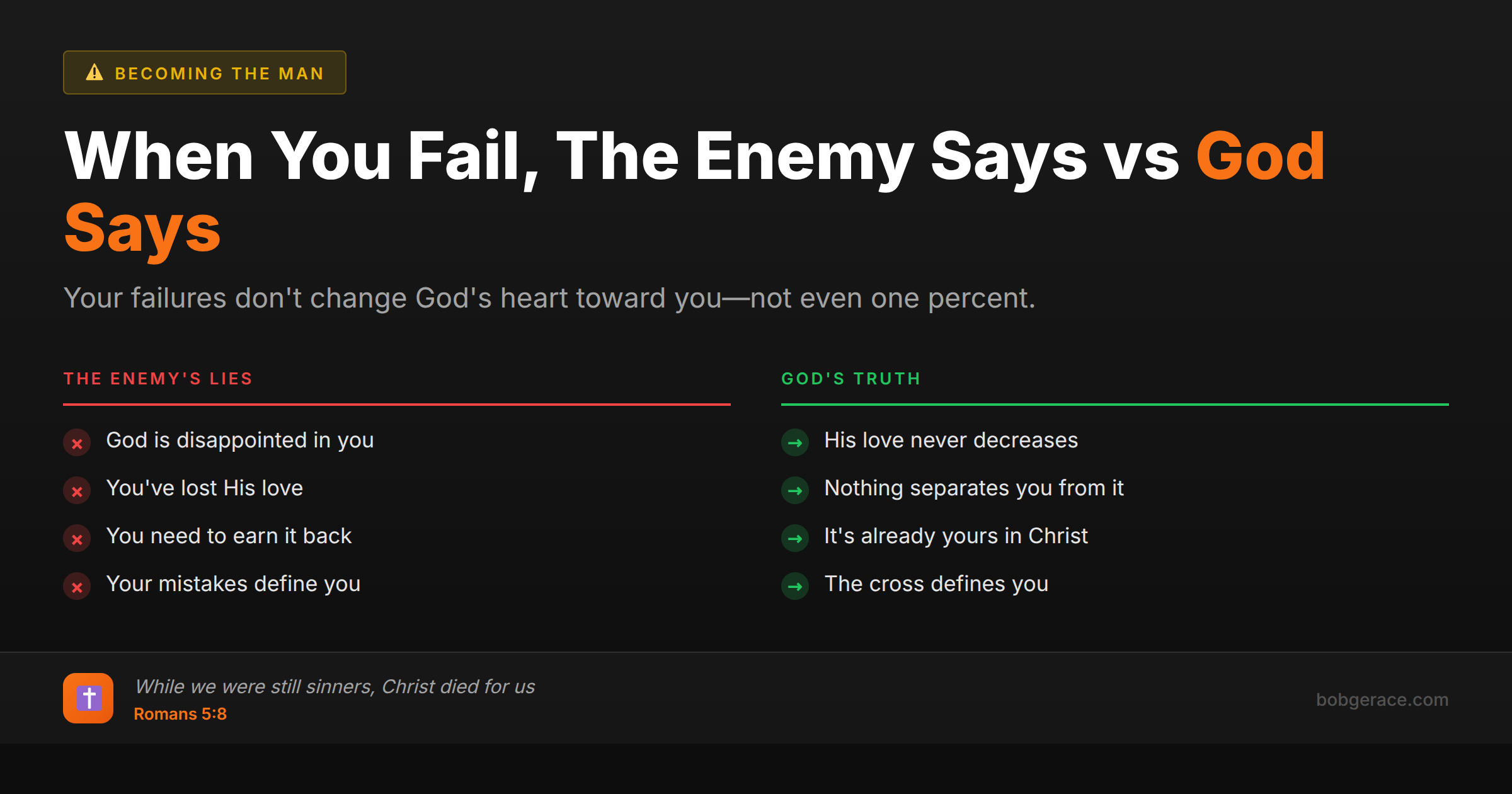
Yes, absolutely. God's love for you is not based on your performance—it's based on His character. When you fail, His love doesn't decrease by even one percent. This is the radical truth of the gospel: while we were still sinners, Christ died for us (Romans 5:8). Your failures don't surprise God, and they don't change His heart toward you. The enemy wants you to believe that failure equals rejection from God, but that's a lie. God's love is unconditional, unchanging, and unearned. He knew every mistake you'd make before you were born, and He chose to love you anyway. Your worth isn't determined by your track record—it's determined by the cross.
The Full Picture
Let's get something straight: feeling like God doesn't love you when you fail is one of the most common—and destructive—lies Christians believe. I've counseled thousands of couples, and this toxic thought pattern shows up in almost every marriage crisis.
Here's what happens: You mess up. Maybe you lose your temper with your spouse, look at something you shouldn't have, or make a decision that hurts your family. Immediately, shame floods in with whispers like "God must be so disappointed" or "How could He love someone who keeps failing like this?"
But this thinking is based on a fundamental misunderstanding of how God's love works. Human love is often conditional—we love people more when they perform well and less when they disappoint us. We project this onto God, assuming He operates the same way. He doesn't.
God's love isn't like human love. It's covenant love—steadfast, loyal, and unchanging. The Hebrew word *hesed* appears over 240 times in the Old Testament, describing God's faithful love that endures despite our failures. This isn't sentimental emotion; it's fierce, committed love that refuses to let go.
The cross proves this. Jesus didn't die for the version of you that has it all together. He died for the you that fails, struggles, and falls short. If God's love was conditional on your performance, there would have been no need for a Savior.
Your failures reveal your need for grace—they don't disqualify you from receiving it. In fact, recognizing your failures often brings you closer to God, not further away. The prodigal son's failure led him home to his father's embrace.
What's Really Happening
From a psychological perspective, the belief that failure equals lost love often stems from early attachment experiences. Many people learned as children that love was conditional on good behavior—parents were warm when they performed well but distant when they messed up.
This creates what we call a performance-based identity. Your sense of worth becomes tied to your achievements and mistakes rather than your inherent value. When you carry this into your relationship with God, you unconsciously apply the same conditional framework.
Shame is the emotional core of this struggle. Unlike guilt, which says "I did something bad," shame says "I am bad." Shame tells you that your failures define you and make you unworthy of love. This toxic emotion creates a cycle: failure triggers shame, shame makes you hide from God, isolation increases your sense of unworthiness, leading to more failure.
The antidote to shame is unconditional positive regard—the experience of being fully known and fully loved. This is exactly what God offers. Research shows that people who experience secure, unconditional love are more resilient, make better decisions, and recover from failures more quickly.
Healing happens when you internalize the truth that your identity is separate from your performance. You are not what you do—you are who God says you are. This cognitive shift, supported by repeated experiences of grace and acceptance, literally rewires your brain's response to failure. Instead of triggering shame and withdrawal, mistakes become opportunities for growth and deeper intimacy with God.
What Scripture Says
Scripture is crystal clear about God's unwavering love through our failures. Let's look at what God actually says:
Romans 8:38-39 - "For I am convinced that neither death nor life, neither angels nor demons, neither the present nor the future, nor any powers, neither height nor depth, nor anything else in all creation, will be able to separate us from the love of God that is in Christ Jesus our Lord." Notice what's not on this list? Your failures. Nothing—including your worst mistakes—can separate you from His love.
1 John 3:20 - "If our hearts condemn us, we know that God is greater than our hearts, and he knows everything." When your own heart is telling you God can't love you because of your failures, remember that God is greater than your condemning thoughts. He knows everything about you and loves you completely.
Psalm 103:10-12 - "He does not treat us as our sins deserve or repay us according to our iniquities. For as high as the heavens are above the earth, so great is his love for those who fear him; as far as the east is from the west, so far has he removed our transgressions from us." God doesn't love you according to what you deserve—He loves you according to His nature.
Romans 5:8 - "But God demonstrates his own love for us in this: While we were still sinners, Christ died for us." He didn't wait for you to get your act together. He loved you at your worst.
Jeremiah 31:3 - "I have loved you with an everlasting love; I have drawn you with unfailing kindness." Everlasting means it doesn't end. Unfailing means it doesn't decrease when you mess up.
What To Do Right Now
-
1
Stop and declare out loud: 'God's love for me is not based on my performance.' Say it until you feel the truth of it in your heart.
-
2
Read Romans 8:31-39 daily for the next week. Let this truth about God's unshakeable love penetrate your mind and heart.
-
3
Confess your failure to God specifically, then thank Him that His love remains constant despite what you've done.
-
4
Identify the lie you've believed about earning God's love and replace it with the truth of His unconditional grace.
-
5
Share your struggle with a trusted Christian friend or mentor who can remind you of God's love when shame attacks.
-
6
Practice receiving God's love daily through prayer, worship, and meditating on His promises rather than trying to earn it through good behavior.
Related Questions
- Is God punishing me?
- Does God want me to stay in this marriage?
- How do I pray through this?
- How do I trust a God who let this happen?
- What does 'new creation' mean for my history?
- Can God heal what happened to me?
- What does 'godly sorrow' look like in practice?
- What does repentance look like for accumulated sin?
- How do I forgive when I'm still hurt?
- Is my suffering redemptive?
Also find Bob on
Subscribe for weekly videos on Christian marriage.
You Don't Have to Figure This Out Alone
A coach who knows your actual marriage can help you apply this truth when shame is loud and your wife is still hurt. Bring your specific situation to someone in your corner.
Talk to Bob →