How do I become emotionally safe for my wife?
6 min read
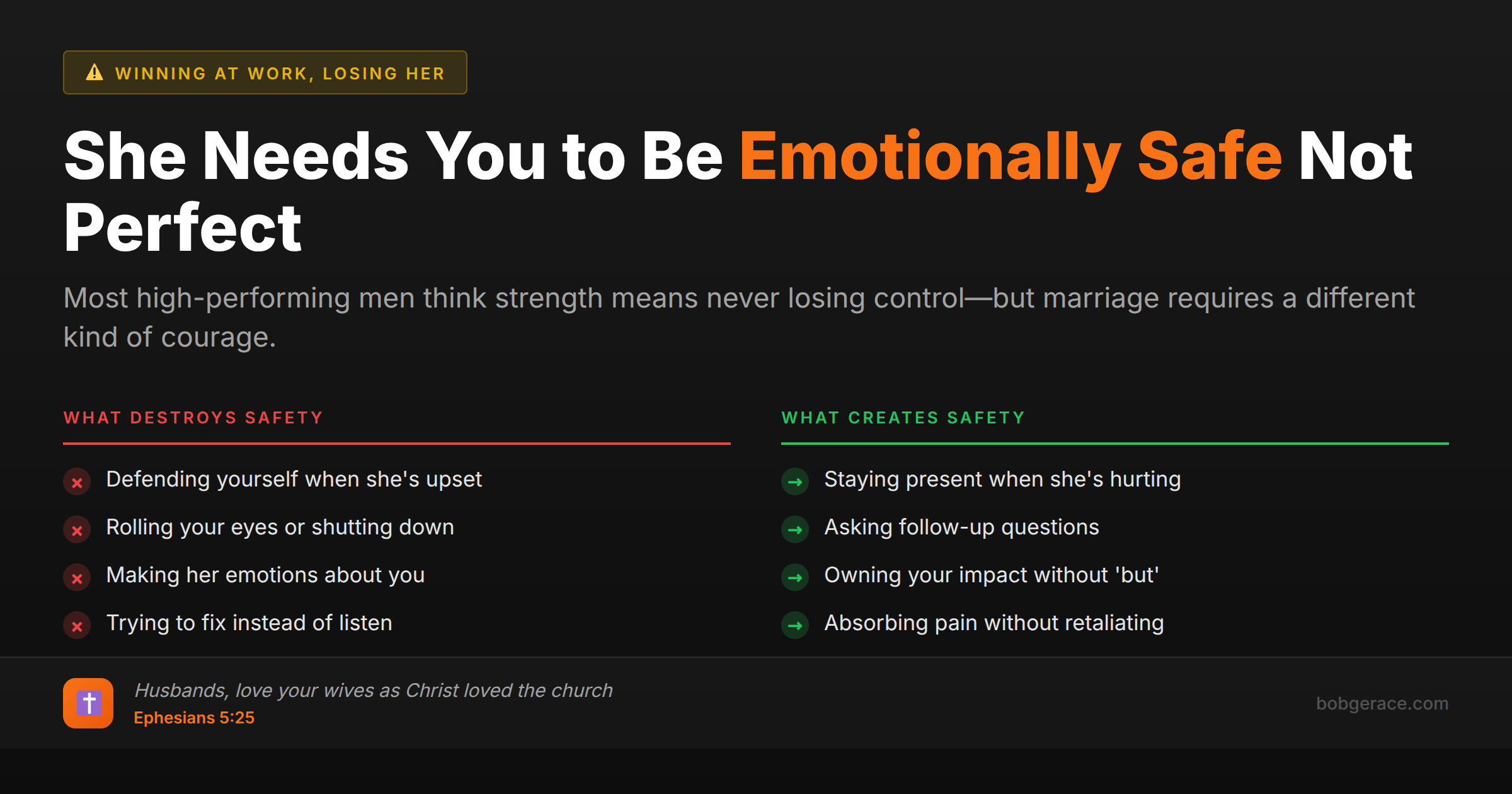
You become emotionally safe for your wife by learning to stay present when she's upset, hurt, or disappointed—without defending, fixing, or shutting down. Emotional safety means she can bring you her pain, frustration, or fear and know you won't punish her for it, dismiss it, or make it about you. It's not about never making mistakes. It's about how you respond when she's vulnerable. This isn't a technique. It's a shift in how you lead. Most high-performing men have spent decades learning to solve problems, manage risk, and avoid failure. But marriage requires a different kind of strength: the ability to stay calm in emotional turbulence, to listen without needing to win, and to own your impact even when your intent was good. Emotional safety is built in the small moments—when you don't roll your eyes, when you ask a follow-up question, when you apologize without a 'but.' That's where trust rebuilds.
Why Emotional Safety Breaks Down in High-Performing Marriages
Most successful men don't set out to make their wives feel unsafe. You work hard, provide well, and care deeply. But somewhere along the way, your wife stopped bringing you her heart. She learned that when she's sad, you try to fix it. When she's angry, you defend yourself. When she's scared, you minimize it or tell her it's not that bad. Over time, she stopped risking vulnerability with you.
Emotional safety breaks down when a man treats his wife's emotions like problems to solve or threats to manage. You're wired to perform, execute, and win. That works at the office. But at home, your wife doesn't need a consultant. She needs a man who can sit with her in the tension without needing to make it go away. When you can't do that, she learns to protect herself. She stops sharing. She goes flat. She finds connection elsewhere—with friends, her mom, or inside her own head.
Here's what happens in your nervous system: when she's upset, your body reads it as danger. Your heart rate spikes. You feel criticized, blamed, or inadequate. Your instinct is to defend, explain, or exit. That's a normal stress response. But it's also what makes you unsafe. Because when you react from that place, she learns that her feelings destabilize you. And if you can't handle her emotions, she can't trust you with her heart.
This dynamic often accelerates after years of success. You've built a career, a reputation, a life. You're used to being competent. But in your marriage, you feel like you're failing, and you don't know why. So you either work harder (flowers, date nights, compliments) or you withdraw (late nights, phone scrolling, emotional distance). Neither works. Because the issue isn't effort. It's presence.
The Nervous System Science of Emotional Safety
Emotional safety is a nervous system experience, not a cognitive one. Your wife's brain is constantly scanning for cues: Is he safe? Will he stay? Can I trust him with my pain? This happens below conscious thought, in the limbic system. When you react defensively, interrupt, or go cold, her nervous system registers threat. It doesn't matter what you intended. Her body responds to what it perceives.
Most high-performing men live in a state of chronic sympathetic activation—always on, always scanning for the next problem, always managing risk. That's adaptive at work. But at home, it makes you reactive. When your wife expresses disappointment, your nervous system interprets it as failure or attack. You move into fight (defend, explain, counterattack) or flight (shut down, leave the room, go numb). Neither response creates safety.
Becoming emotionally safe requires you to regulate your own nervous system first. That means noticing when you're activated—tight chest, clenched jaw, racing thoughts, urge to interrupt. It means learning to pause, breathe, and stay in the room even when it's uncomfortable. This is not weakness. It's the hardest work you'll do. Because it requires you to feel your own fear, shame, or inadequacy without offloading it onto her.
Attachment research shows that emotional safety is built through consistent repair. Your wife doesn't need you to be perfect. She needs to know that when you miss her, hurt her, or let her down, you'll come back, own it, and stay connected. That's what secure attachment looks like. It's not the absence of conflict. It's the presence of a man who doesn't abandon her—physically or emotionally—when things get hard.
Leading Like Christ: Strength in Gentleness
Ephesians 5 calls husbands to love their wives as Christ loved the church. That's not a call to dominate, control, or always be right. It's a call to sacrificial, self-giving love. Christ didn't defend Himself when accused. He didn't shut down when misunderstood. He stayed present, even in suffering. That's the model.
Emotional safety is a form of laying down your life. It means dying to the need to be right, to win the argument, to protect your ego. It means absorbing her pain without retaliating. That doesn't mean you're a doormat. It means you're strong enough to stay grounded when she's not. Proverbs 15:1 says a gentle answer turns away wrath. Gentleness isn't weakness. It's power under control.
James 1:19 instructs us to be quick to listen, slow to speak, slow to anger. Most men reverse that order. We're quick to speak, slow to listen, and fast to defend. Becoming emotionally safe means reordering your responses. It means listening to understand, not to rebut. It means asking, 'What do you need from me right now?' instead of explaining why she's wrong.
This is spiritual formation. God is using your marriage to make you more like Christ. The discomfort you feel when your wife is upset? That's the refining fire. The urge to defend yourself? That's pride being exposed. The work of becoming emotionally safe is the work of becoming a man who leads with humility, patience, and love. That's the kind of man who changes a marriage.
Action Steps
-
1
Notice your body's reaction when your wife is upset. Where do you feel it? Chest, jaw, stomach? Name it: 'I'm activated right now.' That awareness is the first step to staying present.
-
2
Practice the pause. When she's sharing something hard, count to three before responding. Let her words land. Resist the urge to defend, fix, or explain. Just breathe.
-
3
Ask one follow-up question. 'Can you say more about that?' or 'What was that like for you?' This signals you're listening, not just waiting to talk.
-
4
Own your impact without defending your intent. 'I hear that I hurt you. I'm sorry.' No 'but.' No explanation. Just ownership. You can clarify later if needed, but lead with the apology.
-
5
Repair quickly. When you react poorly—interrupt, dismiss, shut down—come back within 24 hours. 'I didn't handle that well. I want to hear you. Can we try again?' That's how trust rebuilds.
Related Questions
Also find Bob on
Subscribe for weekly videos on Christian marriage.
Ready to Become the Man She Can Trust?
Becoming emotionally safe isn't something you figure out alone. It requires a guide who's been there and knows the path. If you're ready to lead your marriage differently, let's talk.
Talk to Bob →