What does real repair look like from a husband?
6 min read
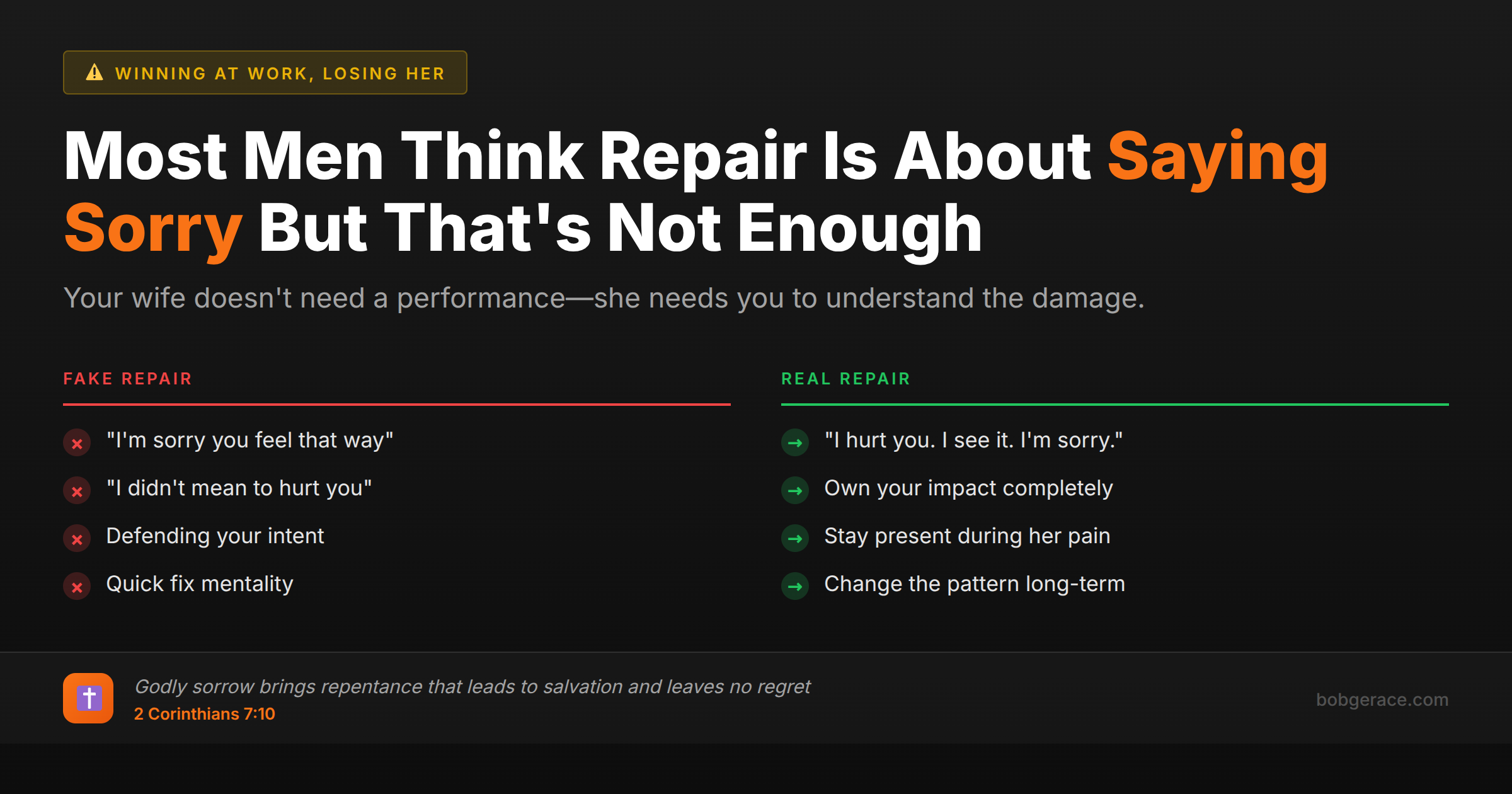
Real repair from a husband starts with owning your impact without defending your intent. It's not 'I'm sorry you feel that way' or 'I didn't mean to hurt you.' It's 'I hurt you. I see it. I'm sorry.' No 'but.' No explanation. Just ownership. Then you stay present while she processes the pain—without shutting down, getting defensive, or trying to make her feel better too quickly. Repair isn't a transaction. It's a process. Most men think repair is about saying the right words or doing something nice to make up for it. But your wife doesn't need a performance. She needs to know you understand what you did, why it hurt, and that you're committed to changing the pattern. Real repair requires you to slow down, listen deeply, and let her feel what she feels without making it about you. That's where trust rebuilds. Not in the apology, but in what you do after.
Why Most Repair Attempts Fail
You've tried to repair before. You apologized. You bought flowers. You promised to do better. But nothing changed. Or it changed for a week, then you fell back into the same pattern. And now your wife doesn't believe you anymore. She's heard the apologies. She's seen the effort. But she hasn't experienced lasting change. So she's protecting herself. She's not letting you back in.
Most repair attempts fail because they're focused on making the man feel better, not on healing the woman. You apologize because you feel guilty, not because you understand her pain. You explain your intent because you need her to know you're not a bad guy. You try to fix it quickly because you can't tolerate the tension. But none of that is repair. That's damage control. And she feels the difference.
Real repair requires you to sit in the discomfort of what you've done. It means listening to her pain without defending yourself. It means acknowledging not just what you did, but the impact it had on her—how it made her feel unseen, unimportant, unsafe, or alone. That's hard. Because it means facing your own failure, your own selfishness, your own blindness. But that's the only way through.
Here's what happens when repair fails: resentment builds. Every unrepaired hurt becomes a brick in the wall between you. She stops bringing you her pain because it's not safe. She stops trusting your apologies because they don't lead to change. She stops hoping you'll get it because you keep missing her. And eventually, she stops caring. That's when marriages end. Not in the big blowup, but in the slow accumulation of unrepaired wounds. Real repair stops that cycle. But it requires you to do the work.
The Neurobiology of Repair and Reconnection
Repair is a neurobiological process, not just an emotional one. When you hurt your wife—through neglect, harshness, betrayal, or emotional absence—her nervous system registers a rupture. Her brain's threat detection system (the amygdala) activates. She moves into a state of hypervigilance or shutdown. Her body is asking: Is he safe? Can I trust him? Will he do this again?
Repair is what signals to her nervous system that it's safe to reconnect. But here's the key: repair only works if it's authentic and consistent. Her brain is scanning for congruence. Do your words match your tone? Does your apology match your behavior? If you say you're sorry but your body language is defensive, or if you apologize but repeat the same behavior next week, her nervous system won't register safety. It will register threat. And the rupture deepens.
Attachment research shows that secure relationships are not defined by the absence of conflict or hurt. They're defined by the presence of effective repair. Dr. John Gottman's research found that successful couples repair quickly and often. They don't let wounds fester. They address them, own them, and move through them. That's what builds trust. Not perfection, but repair.
Real repair requires you to regulate your own nervous system first. When your wife is upset, your body wants to defend, explain, or escape. That's a normal stress response. But if you react from that place, you can't repair. You have to calm yourself down—breathe, ground, stay present—so you can attune to her. That's the neurobiological foundation of repair. You can't co-regulate with her if you're dysregulated yourself. So the work starts with you.
Repentance, Not Just Regret: The Biblical Model of Repair
The Bible distinguishes between worldly sorrow and godly sorrow. Worldly sorrow is regret—feeling bad about the consequences of your sin. Godly sorrow is repentance—a deep change of heart that leads to a change of behavior (2 Corinthians 7:10). Most men offer worldly sorrow. They feel bad. They apologize. But they don't repent. They don't change. And that's why repair fails.
Repentance means turning around. It's not just saying 'I'm sorry.' It's saying 'I was wrong. I see the harm I caused. And I'm committed to doing it differently.' That's what Zacchaeus did when he encountered Jesus. He didn't just apologize for cheating people. He made restitution. He changed his life. That's the model of repair. It's not words. It's transformation.
James 5:16 says to confess your sins to one another and pray for one another, that you may be healed. Confession is part of repair. But it's not just confessing what you did. It's confessing the deeper issue—the pride, the selfishness, the fear, the avoidance—that led to the behavior. That's what your wife needs to hear. Not just 'I'm sorry I yelled.' But 'I'm sorry I yelled. I was protecting my ego instead of listening to you. That was wrong. I'm working on it.'
Proverbs 28:13 says whoever conceals his sins will not prosper, but whoever confesses and forsakes them will obtain mercy. Real repair requires both confession and forsaking. You own what you did, and you commit to not doing it again. That's what rebuilds trust. Not the apology, but the change. And that change is the fruit of repentance. It's the evidence that your sorrow is godly, not just worldly.
Action Steps
-
1
Own your impact without defending your intent. Say: 'I hurt you when I [specific behavior]. I see that now. I'm sorry.' Stop there. No 'but I didn't mean to' or 'I was just trying to.' Just own it.
-
2
Ask her what it was like for her. 'What did that feel like for you?' or 'How did that land on you?' Listen without interrupting. Let her tell you. Don't correct her perception. Just hear it.
-
3
Validate her pain. 'That makes sense. I can see why that hurt.' You're not agreeing that you're a terrible person. You're acknowledging that your behavior had an impact. That's what she needs.
-
4
Name the pattern you're committed to changing. 'I see that I've been [dismissive, defensive, distant]. I'm working on that. Here's what I'm doing differently.' Be specific. She needs to see the plan, not just hear the promise.
-
5
Follow through consistently. Repair isn't one conversation. It's a series of actions over time. Show her through your behavior that you're serious. That's what rebuilds trust. Not the words, but the follow-through.
Related Questions
Also find Bob on
Subscribe for weekly videos on Christian marriage.
Ready to Repair What's Broken?
Real repair requires more than good intentions. It requires a guide who can help you see your blind spots and lead you through the process. If you're ready to do the work, let's talk.
Talk to Bob →