Can I rebuild trust before she makes a final decision?
5 min read
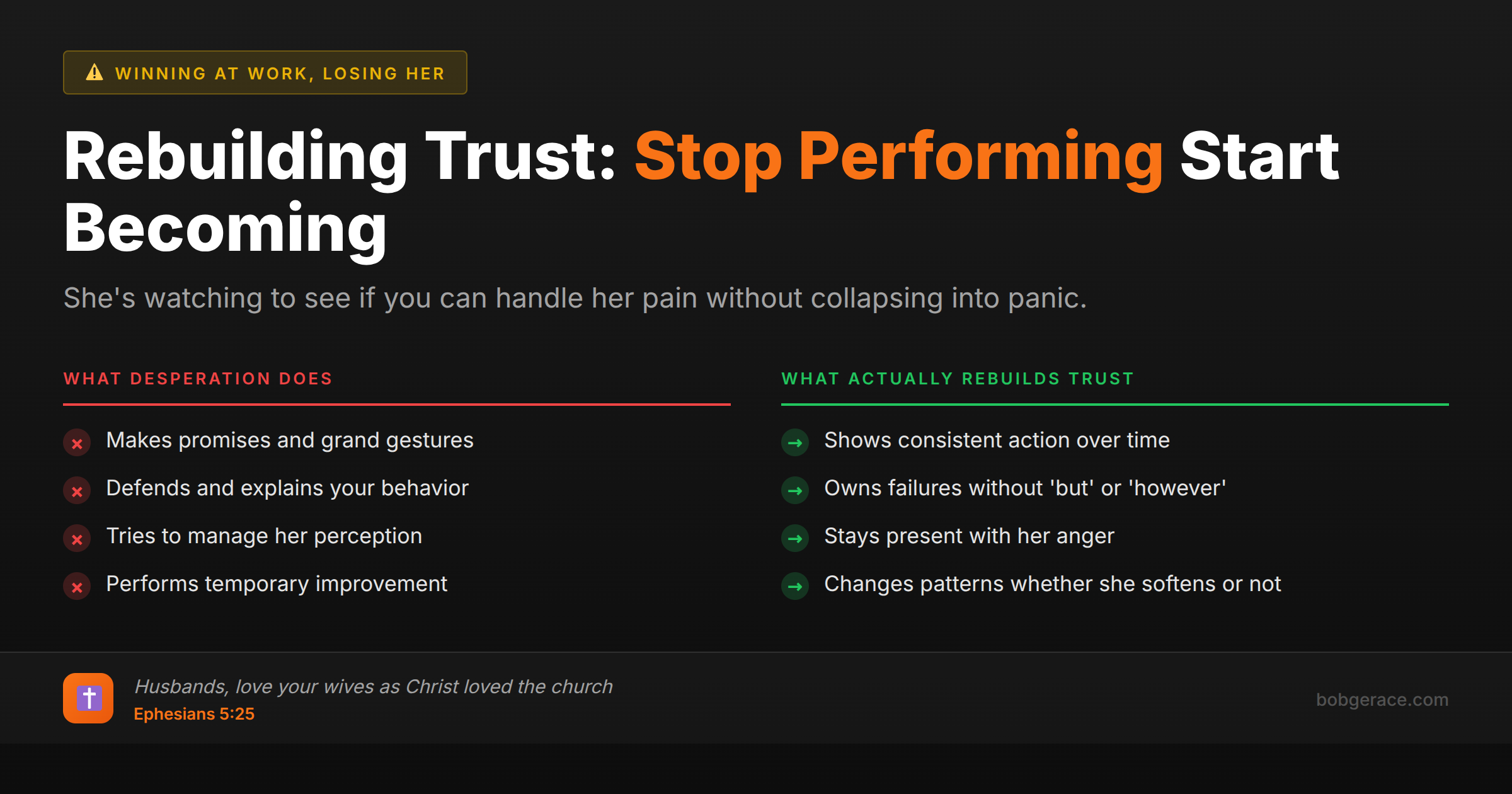
Yes, you can rebuild trust before she makes a final decision—but only if you stop trying to manage her perception and start becoming trustworthy. Trust is not rebuilt through promises, flowers, or sudden attention. It is rebuilt through consistent, grounded action over time. She is watching to see if you can handle her pain without defensiveness, if you can stay present without collapsing into panic, and if you can own your patterns without excusing them. The window is narrow. If she is evaluating whether to stay, she is also evaluating whether you are capable of real change or just performing temporary improvement. Your job is not to convince her. Your job is to become clear, steady, emotionally available, and truthful—whether she stays or not. That posture is what rebuilds trust.
What Rebuilding Trust Actually Requires
Most men in this moment operate from fear. They sense the clock ticking. They feel her distance. They know she is weighing options. So they try to fix it fast—more compliments, more help around the house, more promises that things will be different. But she has heard promises before. She has seen temporary improvement followed by regression. She is not looking for performance. She is looking for evidence that you understand what broke and that you are willing to do the deeper work.
Rebuilding trust requires three things: ownership, consistency, and emotional availability. Ownership means you stop defending, minimizing, or explaining away the pain you caused. You name it clearly. You do not add 'but' or 'however.' You do not make her comfort you through your shame. Consistency means your behavior matches your words for weeks and months, not just days. She needs to see that your changes are not driven by fear of losing her but by a decision to become a different man. Emotional availability means you can stay present with her hurt, her anger, her doubt, and her silence without shutting down, retaliating, or collapsing into self-pity.
If she is still in the house, still talking, still evaluating, you have a window. But the window closes the moment you return to the patterns that broke her trust in the first place—defensiveness, distraction, emotional absence, or the belief that your effort at work substitutes for presence at home. She is not asking you to be perfect. She is asking you to be real, steady, and willing to change at the level that matters.
Why Trust Breaks and How It Rebuilds
Trust in marriage is not primarily about fidelity or honesty, though those matter. Trust is about predictability and safety. When your wife trusts you, she believes that you will see her, stay present with her emotions, and prioritize the relationship even when it is inconvenient. When that trust breaks, it is usually not because of one event. It is because of a pattern—years of emotional unavailability, defensiveness when she brought up pain, prioritizing work over connection, or treating her like a problem to solve rather than a person to know.
From a nervous system perspective, her body has learned that you are not safe. She has experienced repeated moments where she reached for you and you were not there—not physically absent, but emotionally defended or distracted. Her nervous system adapted. She stopped reaching. She built walls. She began to plan for a life without you. Rebuilding trust means helping her nervous system learn a new pattern. That does not happen through words. It happens through repeated experiences of you staying present, non-defensive, and emotionally regulated when she is hurt, angry, or distant.
This is where most men fail. They can handle her when she is calm. They cannot handle her when she is activated. They shut down, get defensive, or try to fix her feelings. But her nervous system is testing you. She needs to know: can you stay steady when I am not okay? Can you hold space for my pain without making it about you? If you can, trust begins to rebuild. If you cannot, she concludes that you have not actually changed—you have just gotten better at managing her perception.
The Call to Faithful Presence
Scripture calls husbands to love their wives as Christ loved the church—sacrificially, steadily, without condition (Ephesians 5:25). That love is not transactional. It does not say, 'I will love you if you respond well.' It says, 'I will love you even when it costs me something.' Rebuilding trust is costly. It requires you to stay present when she is angry, to own your failures without defensiveness, and to change your patterns even when she does not immediately soften.
Proverbs 20:6 says, 'Many a man proclaims his own steadfast love, but a faithful man who can find?' Your wife does not need more proclamations. She needs faithfulness—the kind that shows up day after day, that does not collapse under pressure, that does not require her approval to keep going. Jesus did not wait for the church to get her act together before He gave Himself up for her. He moved first. He stayed. He did the work that needed doing, whether it was received well or not.
Your job right now is not to control her decision. Your job is to become the man God is calling you to be—clear, grounded, emotionally present, and willing to lead through repentance and change. If you do that, you give your marriage the best chance. But even if she still chooses to leave, you will have become a man of integrity. That is not a consolation prize. That is the actual goal.
Action Steps
-
1
Stop defending and start owning. Write down the specific ways you have been emotionally unavailable, dismissive, or absent. Name them clearly to her without adding 'but' or 'however.'
-
2
Stay present with her pain. When she expresses hurt or anger, do not fix, defend, or shut down. Say, 'I hear you. That makes sense. I am sorry.' Then be quiet.
-
3
Show up consistently for 90 days. Do not wait for her to soften. Be emotionally available, non-defensive, and present whether she responds warmly or stays distant.
-
4
Get help. Work with a coach or counselor who understands attachment, nervous system regulation, and the specific dynamics of high-performing men who have neglected their marriages.
-
5
Pray for humility and endurance. Ask God to help you stay steady, to see your wife clearly, and to love her well whether she decides to stay or go.
Related Questions
Also find Bob on
Subscribe for weekly videos on Christian marriage.
You Don't Have to Figure This Out Alone
If your wife is evaluating whether to stay and you know the clock is ticking, you need clarity and a plan now. I help men rebuild trust, regulate their nervous systems, and become the husbands their wives can trust again—before it's too late.
Talk to Bob →