What if my wife says she is done but has not filed?
5 min read
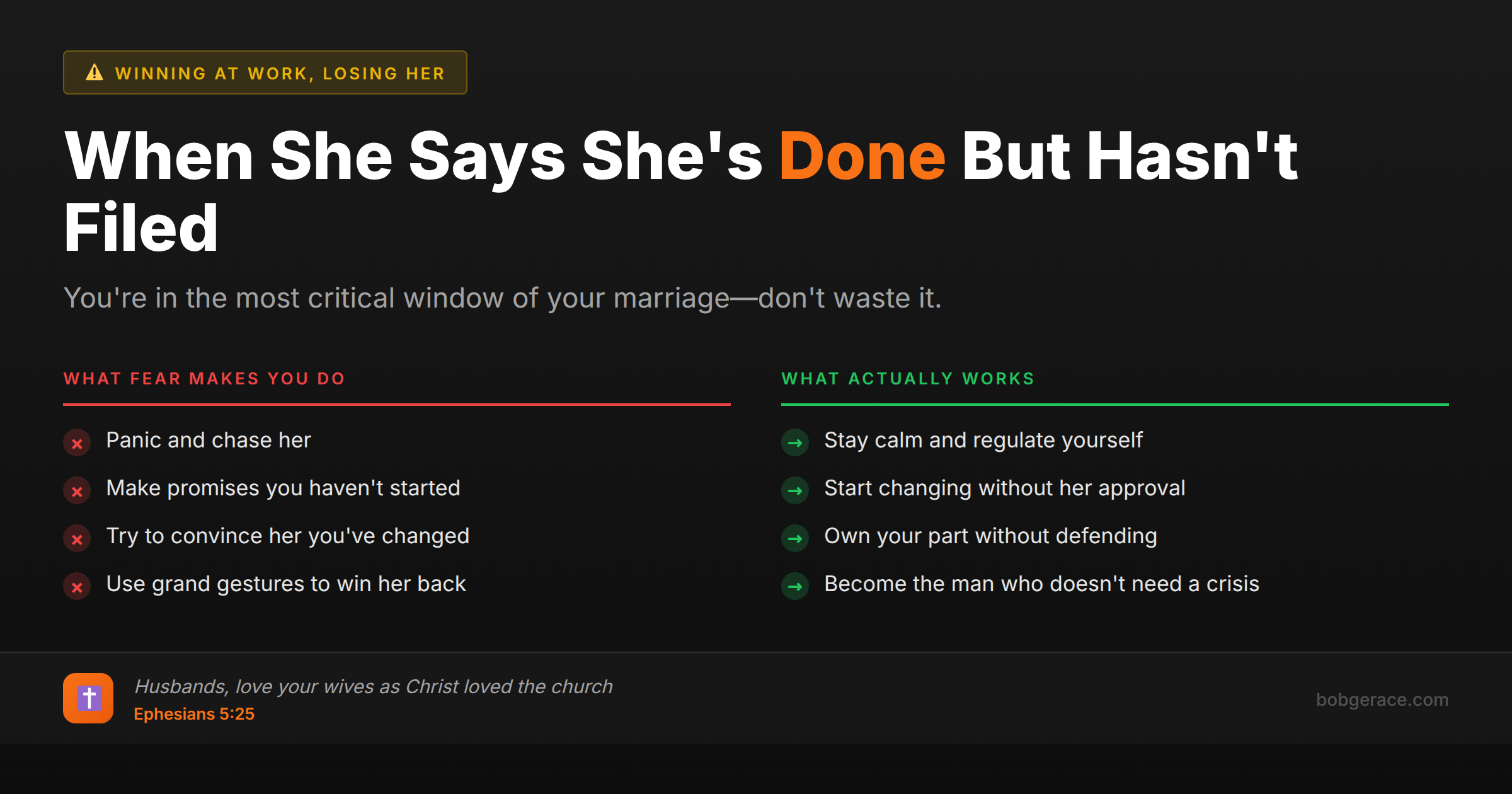
When your wife says she's done but hasn't filed, you're in the most critical window of your marriage. She's emotionally exhausted but hasn't made the legal move yet. This gap is not permission to fix her or win her back with grand gestures. It's your chance to become a different man—steady, truthful, emotionally available, and grounded—before fear turns you into exactly the husband she can't trust. Don't panic. Don't chase. Don't promise change you haven't started. She's watching to see if you'll finally own your part without defensiveness, if you'll regulate yourself when she's cold, and if you can lead yourself even when she's not responding. This is not about her filing or not filing. It's about whether you'll become the man who doesn't need a crisis to grow.
What 'Done But Not Filed' Really Means
Your wife saying she's done is not a negotiation tactic. It's the result of months or years of feeling unseen, unheard, or emotionally abandoned. She's likely been signaling for a long time—through criticism, withdrawal, or asking for the same things repeatedly. You missed it or minimized it because you were winning at work, managing logistics, or assuming provision equaled presence.
Now she's emotionally flat. She's not angry anymore. She's tired. The fact that she hasn't filed means there's still a thread of hope, obligation, or fear holding her in place. Maybe it's the kids. Maybe it's her faith. Maybe it's the life you built. But that thread is fraying, and it won't hold if you keep doing what you've been doing.
Most men in your position make one of two mistakes. They either go into fix-it mode—flowers, date nights, love letters—or they shut down and wait for her to 'get over it.' Both approaches fail because neither addresses the core issue: she doesn't trust that you see her, that you can handle her emotions, or that you'll stay engaged when it's hard. She's done with the version of you that shows up only when the marriage is on fire.
The window you're in is not about convincing her to stay. It's about becoming a man she'd want to stay with—whether she does or not. That shift in focus is everything.
The Nervous System and Attachment Dynamics at Play
When your wife says she's done, her nervous system has likely moved into dorsal vagal shutdown. She's not in fight mode anymore. She's in collapse. Her attachment system has shifted from protest (anger, criticism, pursuit) to despair (withdrawal, numbness, detachment). This is the body's way of protecting itself from chronic relational threat.
You, on the other hand, are likely in sympathetic overdrive—panic, hypervigilance, urgency. Your nervous system is screaming 'fix this now,' which makes you either controlling or pleading. Both states push her further away because they confirm her belief that you can't regulate yourself, that you need her to be okay, and that your emotional stability depends on her response.
The dynamic that got you here is often pursuer-distancer, but with a twist. You pursued success, control, or performance. She pursued connection. When she stopped pursuing, you didn't notice until she went silent. Now you're pursuing her, and she's distancing because your pursuit feels like need, not strength.
Resentment has also built a wall. Every time she asked for emotional presence and you gave logistics, every time she wanted to be seen and you offered solutions, every time she needed you to stay in hard conversations and you left or deflected—those moments stacked. Resentment is the residue of unmet longing. It doesn't dissolve with apologies. It dissolves with sustained, embodied change.
Your job now is to regulate your own nervous system, to become safe and steady regardless of her temperature, and to stop outsourcing your emotional stability to her responsiveness.
Covenant, Character, and the Call to Lead Yourself
Marriage is a covenant, not a contract. Contracts are conditional: 'I'll do this if you do that.' Covenants are unconditional commitments to become who God calls you to be, regardless of the other person's response. Right now, you're being called to live out Ephesians 5 not as a tool to control her, but as a standard for your own character.
'Husbands, love your wives, as Christ loved the church and gave himself up for her' (Ephesians 5:25). Christ didn't wait for the church to get it right before He laid down His life. He led with sacrificial, self-giving love. That doesn't mean being a doormat. It means becoming a man who can stay present, truthful, and grounded even when she's cold, distant, or done.
Proverbs 4:23 says, 'Above all else, guard your heart, for everything you do flows from it.' Your heart right now is likely full of fear, shame, or anger. If you don't guard it—if you don't bring it to God, to trusted men, to truth—you'll act out of that fear. You'll manipulate, withdraw, or perform. None of that is love.
This is also a Romans 12:18 moment: 'If it is possible, as far as it depends on you, live at peace with everyone.' You can't control whether she files. You can control whether you become a man of peace, integrity, and emotional health. That's your assignment.
Action Steps
-
1
Stop trying to convince her you've changed. Start changing. Get into coaching, therapy, or a men's group this week. Let her see you do the work without needing her approval.
-
2
Regulate your nervous system daily. Breathe, pray, move your body, sleep. You can't lead her if you're in panic mode. Calm yourself first.
-
3
Own your part without defending or explaining. Say it once, clearly: 'I see how I've hurt you. I'm working on becoming a different man.' Then live it.
-
4
Stop pursuing her emotionally. Give her space. Be present, kind, and steady, but don't chase her for validation or reassurance. Let your actions speak.
-
5
Get brutally honest with a trusted man or coach about your patterns—porn, workaholism, emotional avoidance, control. You can't change what you won't name.
Related Questions
- Can I rebuild trust before she makes a final decision?
- How do I become trustworthy after years of not showing up?
- What if my wife says she loves me but is not in love?
- What should I change before my wife leaves?
- What is the difference between protecting and controlling?
- What kind of masculinity makes a wife feel safe?
Also find Bob on
Subscribe for weekly videos on Christian marriage.
This Window Won't Stay Open
You're in the gap between her words and her actions. That gap is your opportunity, but it's closing. I work with men in exactly this moment—helping them become steady, clear, and grounded before fear makes them small.
Talk to Bob →