What is the difference between protecting and controlling?
5 min read
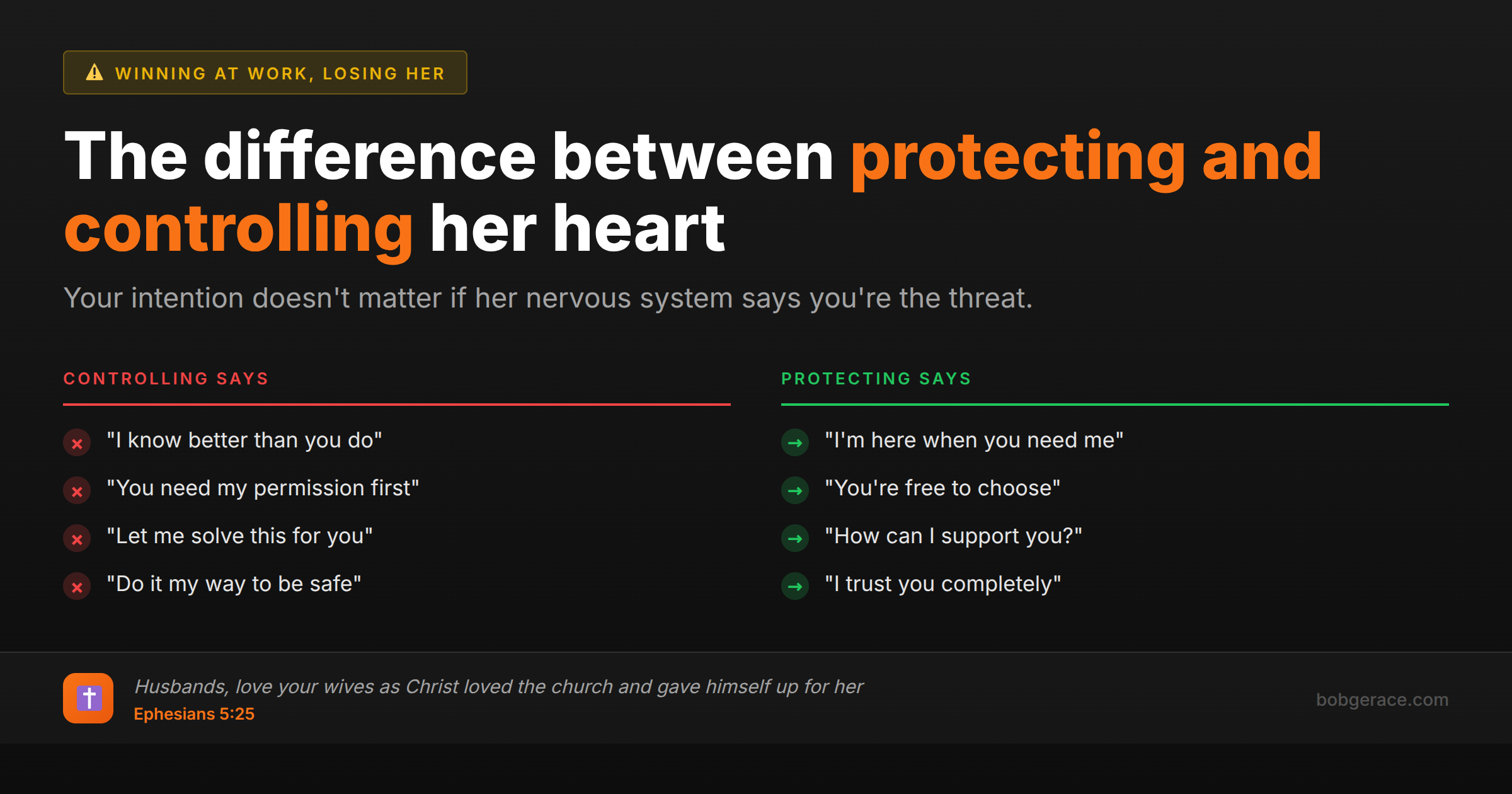
Protecting invites. Controlling demands. A man who protects creates space for his wife to feel safe, seen, and free. A man who controls shrinks that space until she can barely breathe. The difference is not in your intention—it's in her nervous system. You may believe you're protecting her by managing money, vetting decisions, or solving her problems before she asks. But if she feels monitored, second-guessed, or like a child who needs permission, you're controlling. Protection says, "I'm here. You're safe with me." Control says, "I know better. Do it my way." One builds trust. The other builds resentment. And resentment doesn't care how hard you work or how good your reasons are.
Why High-Performing Men Confuse the Two
You built a business, led a team, closed deals, managed risk. You learned to anticipate problems, control variables, optimize outcomes. That skill set made you successful. It also taught you that leadership means having the answer, making the call, and ensuring compliance.
At work, that works. At home, it destroys intimacy.
Your wife doesn't need you to manage her like an employee or a project. She needs you to be with her like a partner. But if you've spent twenty years in performance mode, you may not know the difference anymore. You see her stress and jump to fix it. You see her decision and correct it. You see her emotion and try to solve it. All of it feels like love to you. All of it feels like control to her.
She doesn't feel protected when you take over her problem without asking. She feels dismissed. She doesn't feel safe when you override her choice. She feels small. And after years of this, she stops bringing you her heart. She learns that being close to you means being managed by you. So she pulls back. You feel rejected. She feels alone. And neither of you understands why.
The pattern is invisible until it's not. By the time she says, "I can't do this anymore," she's been suffocating for years. You thought you were being a good husband. She thought she was losing herself.
The Nervous System Truth About Control
Control activates the threat response. When your wife feels controlled, her nervous system reads you as unsafe—even if you're trying to help. Her body doesn't care about your logic. It cares about autonomy, agency, and whether she can breathe in your presence.
Men who control often have anxious attachment or avoidant attachment patterns underneath. Anxious controllers manage their own fear by managing everything around them. Avoidant controllers create distance by staying in charge, keeping emotion at arm's length, and solving instead of connecting. Both patterns come from the same place: a nervous system that never learned to be calm in uncertainty.
Protection, by contrast, is regulated presence. It's the ability to stay grounded when she's upset, without fixing or fleeing. It's creating safety by being safe—not by eliminating all risk. A protected woman can make her own choices, feel her own feelings, and know you won't abandon or override her. A controlled woman learns to perform, comply, or hide.
Here's the test: Does she feel more free or less free in your presence? Does she relax or brace? Can she disagree without fear of your mood, your withdrawal, or your lecture? If not, you're controlling. And it doesn't matter if you're doing it out of love. The impact is the same.
Christ-Like Leadership Is Not Domination
Ephesians 5 tells husbands to love their wives as Christ loved the church. That's the verse men quote when they want to talk about leadership. But they skip the part where Christ gave Himself up. He didn't control the church into submission. He laid down His life so she could flourish.
Christ-like protection is sacrificial, not authoritarian. It's washing feet, not issuing orders. It's creating conditions for growth, not compliance. Jesus didn't manipulate, guilt, or manage the disciples into maturity. He loved them, challenged them, and let them choose. Even when they failed.
Proverbs 31 describes a woman of valor whose husband trusts her. He doesn't micromanage her decisions or second-guess her judgment. He honors her strength. That's protection. Control would have kept her small, dependent, and silent. Trust set her free to become who God made her to be.
You're called to lead, yes. But leadership in a marriage is not about being right or being in charge. It's about being safe. A man who protects makes his wife safer, braver, and more alive. A man who controls makes her smaller, quieter, and more alone. One reflects the heart of God. The other reflects the fear of man.
Action Steps
-
1
Ask her: "Do you feel free to disagree with me, or do you feel like you have to manage my reaction?" Then listen without defending.
-
2
Notice when you jump to fix, correct, or solve her problem without being asked. Pause and ask, "Do you want my input, or do you just need me to listen?"
-
3
Identify one area where you've been controlling (money, parenting, schedule, her choices) and release it. Tell her, "I trust you with this. I'm sorry I made you feel like I didn't."
-
4
Work with a coach or therapist to understand your own anxiety or avoidance patterns. Control is a symptom. The root is in your nervous system.
-
5
Practice staying calm when she's upset, without fixing or leaving. Your regulated presence is the deepest form of protection you can offer.
Related Questions
- I make six figures, so why is my wife still unhappy?
- Am I a workaholic husband or just a responsible provider?
- Can a good provider still be an emotionally unavailable husband?
- Why do successful men miss the warning signs at home?
- What if she only touches me out of habit?
- How do high-performing men rebuild connection at home?
Also find Bob on
Subscribe for weekly videos on Christian marriage.
You Can Learn to Lead Without Controlling
If you've been confusing control with care, you're not alone. Most high-performing men do. But you can learn a different way—one that makes your wife feel safe instead of small. Let's talk.
Talk to Bob →