Can a good provider still be an emotionally unavailable husband?
6 min read
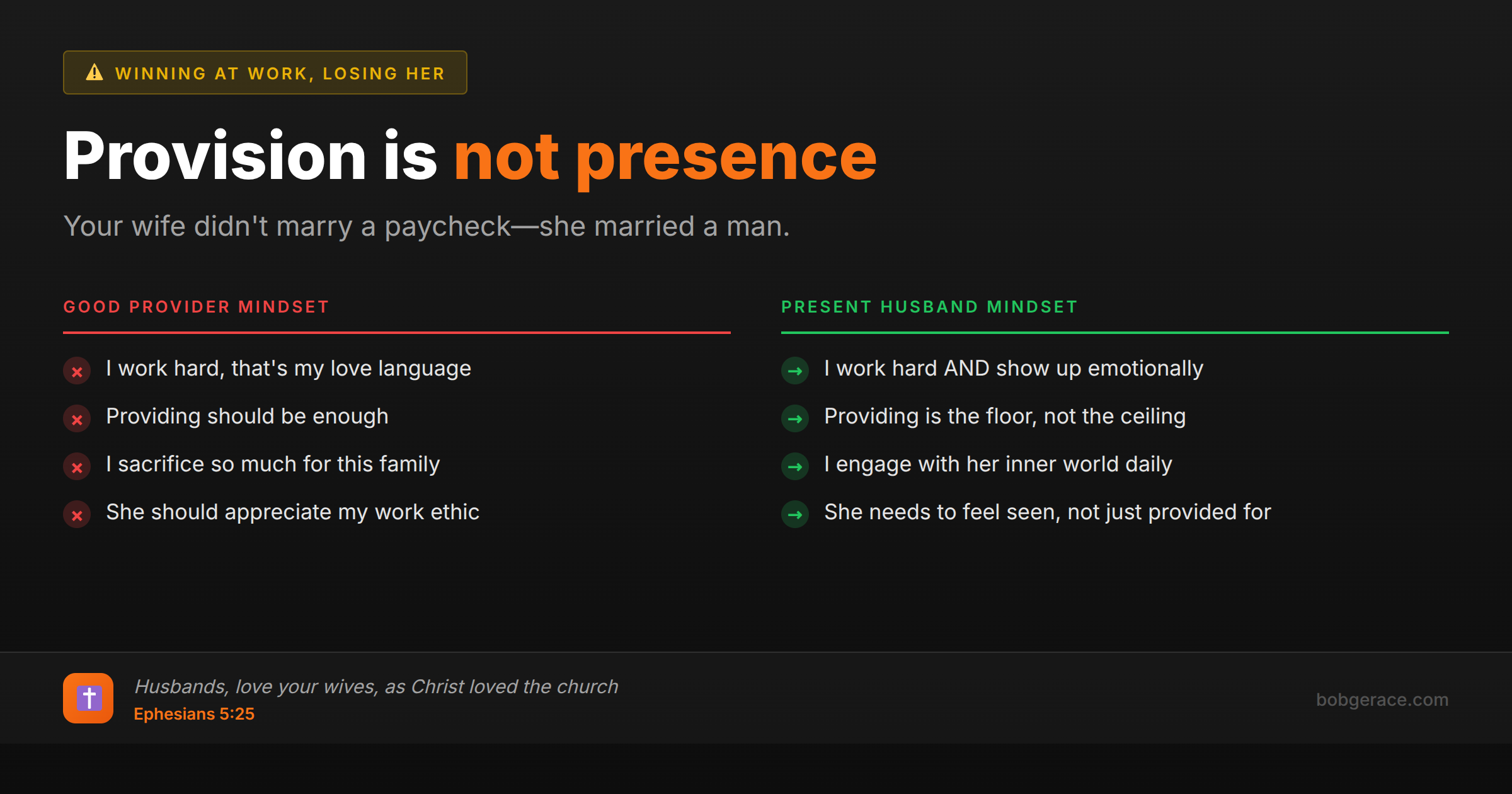
Yes. You can be an excellent provider and a deeply unavailable husband at the same time. Provision is not presence. Your wife doesn't doubt your work ethic or your ability to earn—she doubts whether you see her, whether you feel with her, whether she matters beyond the role she plays in the life you built. Many successful Christian men operate under an unspoken contract: I sacrifice my time and energy to provide, and that sacrifice should be recognized as love. But your wife didn't marry a paycheck. She married a man. When you're emotionally absent—distracted, defended, or just too tired to engage—she experiences loneliness inside the marriage. That loneliness doesn't care how hard you work or how much you earn. It just grows.
The Provider Trap: When Sacrifice Becomes Substitution
You work long hours. You close deals. You lead teams. You solve problems. You carry financial pressure most men never touch. And you do it, in part, because you love your family. That's real. That matters. But here's what happens: the same intensity that makes you successful at work can make you unavailable at home.
You come home depleted. You've spent your emotional bandwidth managing conflict, making decisions, staying composed under pressure. By the time you walk through the door, you have little left. So you go quiet. You scroll. You default to logistics. You touch her only when you want sex. You're present in body but absent in spirit.
Your wife feels it. She sees you light up on a work call and go flat when she talks. She watches you solve problems for clients while dismissing her concerns as overreactions. She initiates conversation and gets one-word answers. She reaches for connection and finds a man who's already checked out. Over time, she stops reaching. She stops expecting. She builds a life that doesn't require you emotionally—and you don't notice until she says she's done.
This isn't about working less or earning less. It's about recognizing that provision without presence creates a transactional marriage. She doesn't feel loved—she feels managed. You're not her husband in those moments. You're her business partner. And business partners don't sustain a marriage.
Why High Performers Struggle with Emotional Availability
Emotional unavailability in successful men often stems from nervous system dysregulation and avoidant attachment patterns. At work, you're rewarded for staying calm, suppressing emotion, and driving toward outcomes. Your nervous system learns to stay in a controlled, task-focused state. That same state—helpful in a boardroom—becomes relational shutdown at home.
When your wife brings emotion, need, or conflict, your system perceives threat. You don't feel danger consciously, but your body responds as if you do. You go logical. You problem-solve. You minimize. You withdraw. This is dorsal vagal shutdown or sympathetic defensiveness—not intentional cruelty, but a nervous system that hasn't learned to stay regulated in the presence of emotional intensity.
Avoidant attachment adds another layer. Many high-performing men learned early that emotions are inconvenient, that needs are weaknesses, that independence is strength. You built a life on self-reliance. But marriage requires interdependence. It requires you to let your wife in, to be affected by her, to stay present when she's upset or needy or disappointed. If you learned to equate emotional engagement with loss of control, you'll instinctively create distance.
Your wife isn't asking you to become soft or weak. She's asking you to be emotionally honest and available. That requires you to do the hardest work most men avoid: learning to feel without fixing, to listen without defending, to stay close when every instinct says to pull away.
Provision Is Obedience, Presence Is Love
Scripture calls you to provide. "If anyone does not provide for his relatives, and especially for members of his household, he has denied the faith and is worse than an unbeliever" (1 Timothy 5:8). That's non-negotiable. But provision is the floor, not the ceiling. It's obedience, not intimacy.
Ephesians 5:25 says, "Husbands, love your wives, as Christ loved the church and gave himself up for her." Christ didn't just provide for the church from a distance. He entered into her suffering. He was present in her pain. He gave himself—not just His resources, but His very life. That's the standard. Sacrificial presence, not just sacrificial income.
Your wife needs you to see her, know her, feel with her. She needs you to be curious about her inner world, to notice when she's struggling, to pursue her heart the way you pursue success. Proverbs 31 celebrates a capable wife, but it also assumes a husband who trusts her, praises her, and is present enough to see her worth. You can't see her worth if you're never looking.
God didn't design marriage as a business arrangement. He designed it as a covenant of intimate knowing. Providing is part of that. But if you're providing without presence, you're obeying half the command and missing the heart of it.
Action Steps
-
1
Ask your wife this week: 'Do you feel like I see you, or do you feel like I just see what you do?' Then listen without defending.
-
2
Identify one recurring moment when you go emotionally flat at home—dinner, bedtime, her venting—and commit to staying engaged in that moment for two minutes longer than feels comfortable.
-
3
Schedule 20 minutes twice a week where you're fully present with her—no phone, no problem-solving, just listening and asking questions about her inner world.
-
4
Notice your body's response when she brings emotion or need. Do you tense up? Go logical? Withdraw? Name the pattern out loud to her: 'I notice I shut down when you're upset. I'm working on staying with you.'
-
5
Read 'The Body Keeps the Score' by Bessel van der Kolk or 'Attached' by Amir Levine to understand how your nervous system and attachment style shape your relational patterns.
Related Questions
- I make six figures, so why is my wife still unhappy?
- Am I a workaholic husband or just a responsible provider?
- Why do successful men miss the warning signs at home?
- How do I slow down without losing my edge?
- How can my wife feel neglected when I work so hard for her?
- How do I know if I am an emotionally unavailable husband?
Also find Bob on
Subscribe for weekly videos on Christian marriage.
You Can Provide and Be Present
You don't have to choose between success and connection. But you do have to learn how to bring your full self home. If you're ready to stop losing her while you're winning at work, let's talk.
Talk to Bob →