How can my wife feel neglected when I work so hard for her?
6 min read
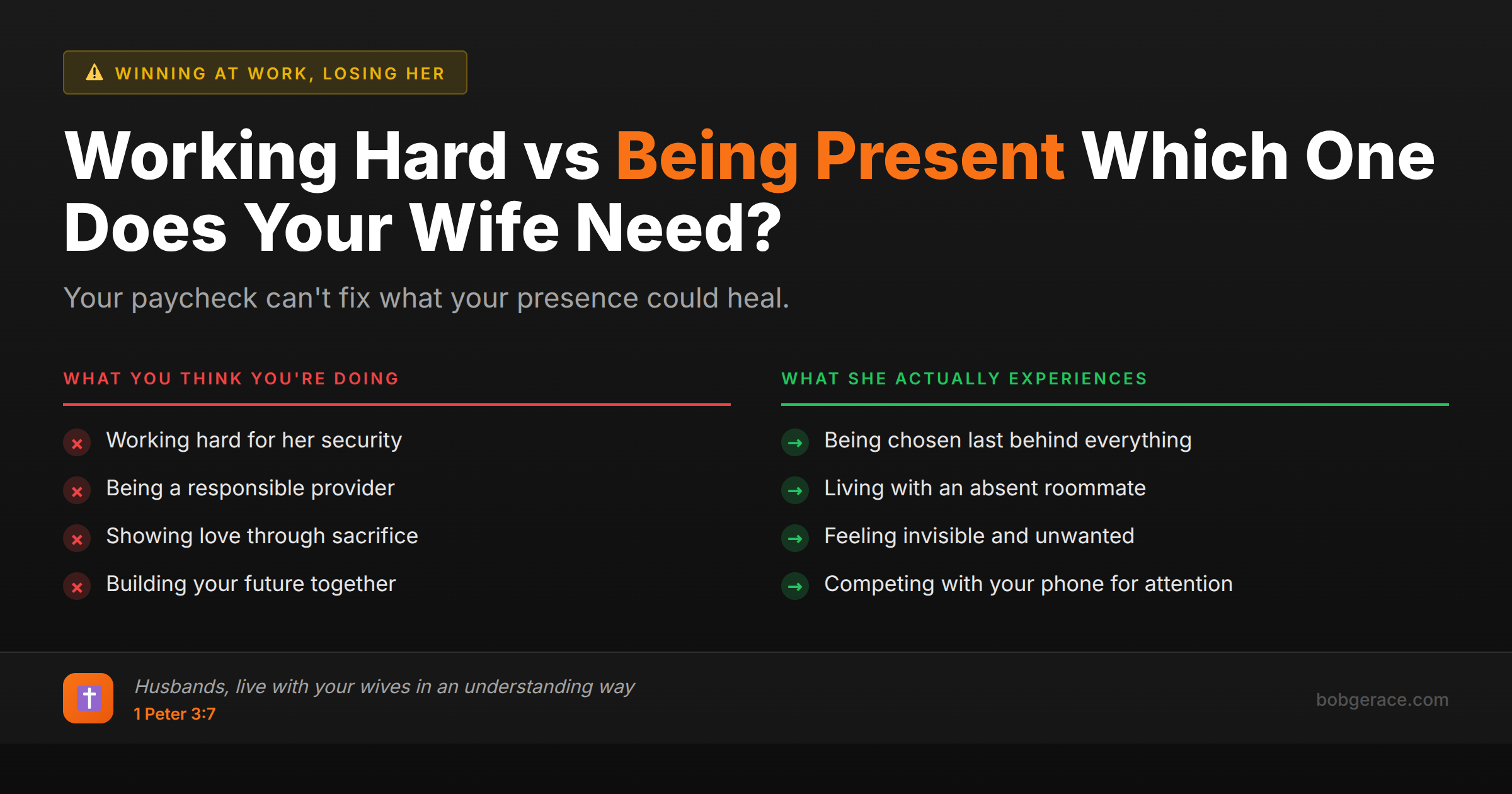
Because emotional neglect is not about how hard you work. It is about whether you are emotionally present when you are home. Your wife does not feel neglected because you have a job. She feels neglected because when you are with her, you are not actually with her. You are distracted, defended, or checked out. She experiences you as unavailable—not because you are cruel, but because you are absent even when your body is in the room. You believe your hard work is for her. She experiences your hard work as choosing everything else over her. You think you are being responsible. She feels invisible. This is not about effort. It is about attention. It is about whether she feels seen, wanted, and prioritized. Right now, she does not. And no amount of work will fix that.
The Difference Between Effort and Presence
You work long hours. You handle the finances. You solve problems. You show up for your responsibilities. You believe you are doing this for your family, and in one sense, you are. But your wife does not experience your work as love. She experiences it as absence. She sees you give your best energy, your sharpest focus, and your most patient attention to your job, your clients, your team. Then you come home depleted, distracted, and distant.
When she tries to talk to you, you are on your phone. When she shares something that matters to her, you half-listen or offer a quick fix. When she is hurt or overwhelmed, you problem-solve instead of staying with her in the emotion. You are not mean. You are not angry. You are just not there. She feels it in her body. She feels it when you touch her only when you want sex. She feels it when you walk past her without eye contact. She feels it when you are more engaged with your screen than with her face.
This is emotional neglect. It is not one dramatic failure. It is the slow accumulation of moments where she reached for you and you were unavailable. It is the pattern where she learned that her emotions are inconvenient, her needs are too much, and her presence is secondary to your productivity. You did not intend this. But intent does not erase impact. She has been alone inside your hard work for years, and now her nervous system has adapted to your absence.
You hear 'neglect' and think she is accusing you of not caring. She is not. She is telling you that she does not feel cared for. Those are not the same thing. You can care deeply and still be emotionally unavailable. You can work hard for her and still neglect her. The question is not whether you are trying. The question is whether she feels seen, safe, and wanted. Right now, she does not.
Emotional Availability and Nervous System Disconnection
Emotional availability is not about being soft or emotional. It is about being present and attuned when your wife needs you. It means you can stay with her in her emotion without shutting down, fixing, or withdrawing. It means she feels safe bringing her hurt, her fear, her joy, or her frustration to you because she knows you will not dismiss her or make it about you.
Most high-performing men have trained themselves to suppress emotion in order to execute. You have learned to stay calm under pressure, to compartmentalize stress, to delay gratification. That is a survival skill in business. In marriage, it becomes a disconnection pattern. Your wife shares something vulnerable, and your nervous system reads it as a problem to solve or a threat to manage. You go into fix-it mode or shut down. She does not feel met. She feels managed.
Over time, this creates an attachment injury. She stops bringing her emotions to you because she has learned you will not stay with her. She stops reaching for you because reaching has only led to disappointment. Her nervous system moves from protest ('Why won't you listen to me?') to despair ('He will never see me'). That despair looks like coldness, distance, or contempt. You experience it as rejection, so you withdraw further. The cycle deepens.
The clinical term for this is 'stonewalling' or 'emotional unavailability,' but the lived experience is simpler: your wife feels alone. She does not feel alone because you are a bad man. She feels alone because you are not emotionally present. You are there in body, but your attention, your curiosity, your warmth—those are elsewhere. She has learned not to expect you, and that learned helplessness is what kills marriages.
Love Is Presence, Not Just Provision
Jesus did not love from a distance. He was Emmanuel—God with us. He entered into human suffering, sat with the broken, wept with the grieving, and stayed present in the mess. That is the model for how you are called to love your wife. Not from across the room. Not through a paycheck. Not by solving her problems. By being with her.
Peter writes, 'Husbands, live with your wives in an understanding way, showing honor to the woman as the weaker vessel, since they are heirs with you of the grace of life' (1 Peter 3:7). Live with her. Not near her. Not in the same house as her. With her. That requires presence, attention, and understanding. It requires you to know her—what she feels, what she fears, what she longs for. You cannot know her if you are not with her.
Consider the father in Psalm 103: 'As a father shows compassion to his children, so the Lord shows compassion to those who fear him.' Compassion is not pity. It is entering into someone's experience and staying there with them. It is presence in suffering. Your wife does not need you to fix everything. She needs you to be with her in it. That is what it means to love her as Christ loved the church.
If your work has become your excuse for emotional absence, you are not being responsible. You are being a coward. Responsibility includes showing up emotionally, not just financially. God does not call you to provide and disappear. He calls you to lead with presence, and that requires you to be available, not just productive.
Action Steps
-
1
Ask your wife, 'When do you feel most alone in our marriage?' Do not defend, explain, or fix. Just listen and write down what she says.
-
2
Identify one daily moment where you are physically present but emotionally absent—dinner, bedtime, morning coffee—and commit to being fully present during that time for two weeks. No phone. No mental task list. Just her.
-
3
Practice staying with her emotion instead of fixing it. Next time she is upset, say, 'That sounds really hard. Tell me more.' Then be quiet and listen.
-
4
Confess to her one specific way you have been emotionally unavailable. Name it clearly. 'I have been more focused on work than on you, and I see how that has hurt you. I am sorry.'
-
5
Get honest with another man or a coach about your pattern of emotional withdrawal. You need external accountability to see what you cannot see and change what you have normalized.
Related Questions
- How do I know if I am an emotionally unavailable husband?
- Why does my success not make her feel secure?
- What is emotional neglect in marriage?
- Can emotional neglect happen in a good-looking marriage?
- I make six figures, so why is my wife still unhappy?
- Am I a workaholic husband or just a responsible provider?
Also find Bob on
Subscribe for weekly videos on Christian marriage.
She Does Not Need You to Work Harder. She Needs You Present.
If your wife feels neglected despite all your effort, the problem is not your work ethic. It is your emotional availability. I help men learn to show up in the ways that actually matter.
Talk to Bob →