Why does my success not make her feel secure?
5 min read
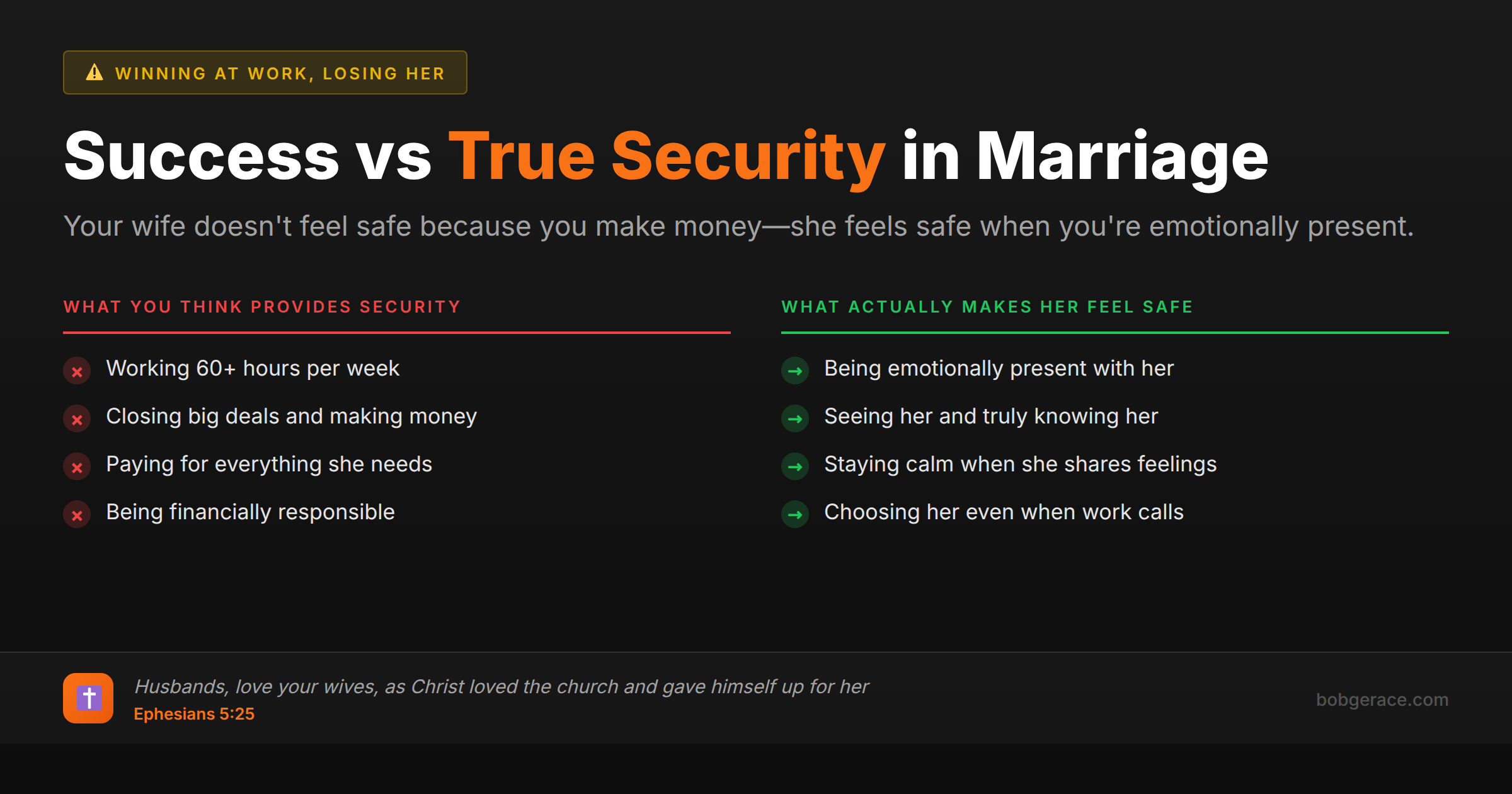
Your success provides financial stability, but it does not provide emotional security. Your wife does not feel safe because you make money. She feels safe when you are emotionally present, when you see her, when you can handle her feelings without shutting down or fixing, when she knows you will not abandon her emotionally when things get hard. Most successful men confuse provision with presence. You believe that working 60 hours a week, closing deals, and paying for everything is how you love her. But she experiences your work as the thing that takes you away from her. She does not doubt your responsibility. She doubts whether you actually want to be with her, whether you see her, whether you would choose her if the money was not on the line.
The Provider Trap: When Your Strength Becomes Your Distance
You are doing what you were taught. Provide. Protect. Perform. You work hard because you believe that is how a man loves his family. You sacrifice time, energy, and presence because you think the outcome—financial security, a nice home, good schools—is what matters most.
But here is what is happening in her nervous system. When you come home late, when you are distracted at dinner, when you touch her only when you want sex, when you cannot handle her emotions without defensiveness or solutions, her body registers abandonment. Not the dramatic kind. The slow kind. The kind where she is technically married but functionally alone.
She does not feel secure because security is not a bank account. Security is knowing that when she is scared, sad, or overwhelmed, you will not disappear emotionally. Security is knowing you can stay present when she cries, when she is angry, when she says hard things about the marriage. Security is knowing that she matters more than your phone, your deals, your reputation, or your need to be right.
You may feel like you are giving everything. But if she cannot access you emotionally, she does not experience your sacrifice as love. She experiences it as abandonment with a paycheck. And over time, resentment builds. She stops reaching for you. She stops initiating. She pulls back sexually, emotionally, relationally. You feel rejected and confused. She feels invisible and alone. This is the cycle that ends in separation, affairs, or decades of quiet despair.
Attachment, Nervous System Regulation, and the Illusion of Control
From an attachment perspective, your wife's sense of security is built on emotional accessibility, responsiveness, and engagement. These are the three pillars of a secure bond. When you are emotionally unavailable—even if you are physically present and financially generous—her attachment system registers threat. She begins to protest (criticism, pursuit, emotion). When that does not work, she moves toward despair (withdrawal, silence, numbness).
Your nervous system, shaped by years of performance and achievement, is wired for control and competence. You solve problems. You manage risk. You optimize outcomes. But intimacy is not a problem to solve. It is a dance of vulnerability, presence, and co-regulation. When she brings emotion, your system often interprets it as chaos or failure. You move to fix, dismiss, or withdraw. She feels unseen. The cycle deepens.
Many high-performing men also carry an avoidant attachment style. You learned early that your value comes from what you do, not who you are. You learned to manage your own emotions alone, to not need others, to stay in control. This worked in business. It is killing your marriage.
Her need for emotional connection is not weakness or neediness. It is how human beings are wired. When you dismiss her bids for connection, when you stay in your head instead of your heart, when you cannot tolerate her dysregulation without shutting down, you are signaling to her nervous system that she is not safe with you. No amount of money changes that.
Provision Without Presence Is Not Biblical Love
Scripture is clear that a man must provide for his family. "If anyone does not provide for his relatives, and especially for his own household, he has denied the faith and is worse than an unbeliever" (1 Timothy 5:8). You take this seriously. You should.
But provision is not the whole picture. Ephesians 5:25 says, "Husbands, love your wives, as Christ loved the church and gave himself up for her." Christ did not love the church from a distance. He entered into our mess. He was present in our pain. He gave himself, not just his resources.
Peter writes, "Husbands, live with your wives in an understanding way, showing honor to the woman as the weaker vessel, since they are heirs with you of the grace of life, so that your prayers may not be hindered" (1 Peter 3:7). Live with her. Understand her. Honor her. This requires presence, attention, and emotional engagement, not just a paycheck.
Your wife is not asking you to stop working or to become weak. She is asking you to see her, to be with her, to let her matter more than your mission. That is not unbiblical. That is the call of covenant love. When you love her well, you image Christ to her and to your children. When you provide without presence, you teach them that love is transactional and that women do not really matter.
Action Steps
-
1
Ask her this week: 'When do you feel most alone in our marriage?' Then listen without defending, fixing, or explaining. Just listen.
-
2
Identify one recurring moment where you go into work mode or shut down emotionally at home (dinner, bedtime, conflict). Practice staying present for 60 seconds longer than feels comfortable.
-
3
Put your phone in another room for one hour every evening. Be fully available. No email, no Slack, no scrolling.
-
4
When she shares emotion (fear, sadness, frustration), say 'Tell me more' instead of offering a solution. Let her feel heard before you try to help.
-
5
Schedule a weekly 20-minute check-in where you ask about her inner world—not logistics, not kids, not calendar. Her heart.
Related Questions
- How can my wife feel neglected when I work so hard for her?
- How do I know if I am an emotionally unavailable husband?
- What is emotional neglect in marriage?
- Can emotional neglect happen in a good-looking marriage?
- Can a good provider still be an emotionally unavailable husband?
- What does roommate marriage mean?
Also find Bob on
Subscribe for weekly videos on Christian marriage.
You Can't Fix This Alone
Most men wait until she says she is done. By then, the damage is deep and the window is narrow. If you are reading this, you still have time—but not forever. Let's talk about what is actually happening in your marriage and what it will take to turn this around.
Talk to Bob →