What is emotional neglect in marriage?
5 min read
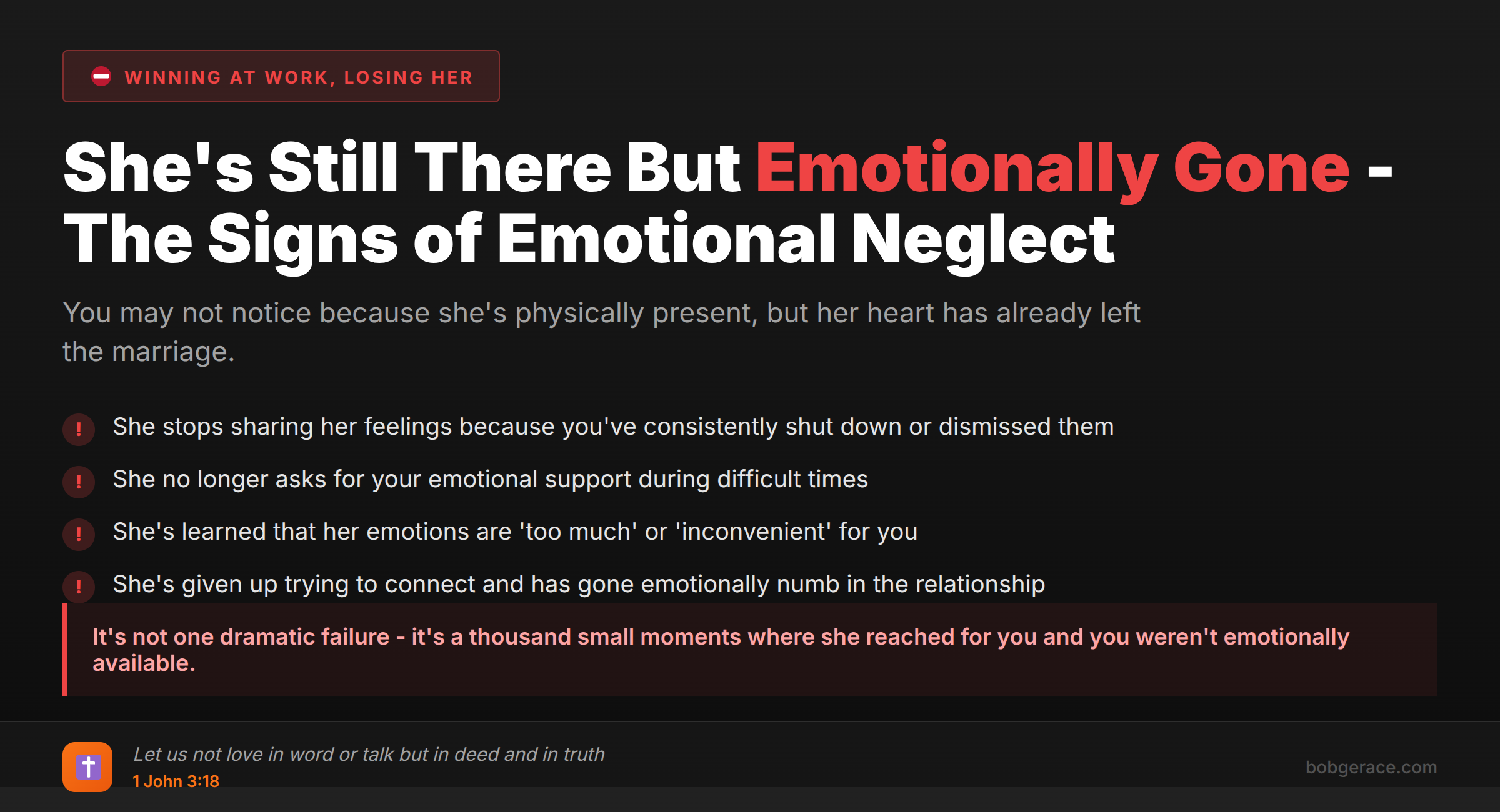
Emotional neglect in marriage is the ongoing pattern where your wife's emotional needs, bids for connection, and inner world are consistently unmet, dismissed, or ignored. It is not one dramatic failure. It is the accumulation of a thousand small moments where she reached for you and you were not there—not because you were gone, but because you were unavailable, defended, distracted, or unable to meet her emotionally. She does not feel seen. She does not feel safe bringing her heart to you. She has learned that her emotions are too much, that her needs are inconvenient, that you will shut down, fix, or dismiss her when she is vulnerable. Over time, she stops trying. She pulls back. She goes numb. You may not notice because she is still there physically. But emotionally, she has left the marriage. That is emotional neglect.
The Slow Death of Connection
Emotional neglect does not look like abuse. It looks like a good man who works hard, provides well, and does not understand why his wife is unhappy. It looks like a husband who is home for dinner but emotionally absent. It looks like a man who loves his wife but cannot handle her feelings, so he avoids, minimizes, or fixes instead of staying present.
Here is what it looks like in real life. She tells you she had a hard day, and you offer a solution instead of listening. She tries to talk about something that hurt her, and you get defensive or tell her she is overreacting. She reaches for you physically, and you are only available when you want sex. She cries, and you leave the room or go silent because you do not know what to do with her emotion. She says she feels alone, and you point to everything you do for her as proof that she is wrong.
Each moment alone is small. But over months and years, these moments accumulate. She learns that you are not safe. She learns that her emotions are a problem. She learns that she cannot bring her full self to you. So she stops. She manages her own emotions. She finds connection elsewhere—friends, kids, work, sometimes another man. She stays married, but she is no longer with you.
You may feel like you are doing everything right. You are faithful. You provide. You do not yell or cheat. But emotional neglect is not about what you do wrong. It is about what you do not do. You do not see her. You do not stay present when things are hard. You do not create safety for her heart. And she is dying inside the marriage because of it.
Attachment Injury, Nervous System Shutdown, and the Cycle of Pursuit-Withdrawal
Emotional neglect creates what attachment researchers call an attachment injury. Your wife's nervous system is wired for connection. When she reaches for you and you are not available, her system registers threat. She protests—through emotion, criticism, or pursuit. If that does not work, she moves toward despair—withdrawal, numbness, shutdown.
Most emotionally neglectful husbands are not cruel. They are avoidant. You learned early in life to manage your own emotions, to not need others, to stay in control. This is often rooted in your own attachment history—parents who were not emotionally available, a culture that taught you emotions are weak, or a life that rewarded performance over presence. You are not trying to hurt her. You are doing what you were trained to do: stay calm, stay rational, stay in control.
But when she brings emotion and you shut down, dismiss, or go into fix-it mode, her nervous system interprets this as abandonment. She feels alone even when you are in the room. Over time, this creates a pursue-withdraw cycle. She pursues (criticism, emotion, requests for connection). You withdraw (defensiveness, silence, distraction). She escalates. You shut down further. The cycle deepens until both of you are living in chronic dysregulation.
Emotional neglect is also cumulative trauma. It is not one event. It is the repeated experience of being unseen, unheard, and emotionally abandoned by the person who is supposed to be your safe place. This creates what psychologists call complex relational trauma. She may not have the language for it, but her body knows. And her body is pulling away from you because it no longer feels safe.
Love Is Not Just Provision—It Is Presence
The Bible is clear that love is action. First John 3:18 says, "Let us not love in word or talk but in deed and in truth." But the deeds God calls you to are not just financial provision or physical presence. They are emotional presence, spiritual leadership, and sacrificial attention.
Ephesians 5:28-29 says, "Husbands should love their wives as their own bodies. He who loves his wife loves himself. For no one ever hated his own flesh, but nourishes and cherishes it, just as Christ does the church." Nourish. Cherish. These are not passive words. They require attention, care, and presence. You cannot nourish what you do not see. You cannot cherish what you ignore.
Peter commands husbands to live with their wives "in an understanding way" (1 Peter 3:7). Understanding requires that you know her—not just her schedule or her preferences, but her heart. It requires that you are emotionally available, that you can handle her feelings, that you create a safe place for her to be fully herself. When you fail to do this, you are not just failing as a husband. You are failing to image Christ to her.
Jesus did not love the church from a distance. He entered into our mess. He was present in our pain. He gave himself fully. Emotional neglect is the opposite of Christlike love. It is self-protection disguised as responsibility. And it is killing your marriage.
Action Steps
-
1
Ask your wife: 'When do you feel most unseen or unheard by me?' Do not defend. Do not explain. Just listen and write down what she says.
-
2
Identify one recurring moment where you shut down, dismiss, or avoid her emotions (conflict, her sadness, her frustration). Practice staying present for 60 seconds longer than feels comfortable.
-
3
This week, when she shares something emotional, say 'Tell me more about that' instead of offering advice or changing the subject. Let her feel heard.
-
4
Put your phone away for one full hour every evening. Be fully present—no email, no scrolling, no distraction. Just be with her.
-
5
Schedule a weekly 20-minute check-in where you ask about her inner world—not logistics, not tasks, her heart. Make it non-negotiable.
Related Questions
- How can my wife feel neglected when I work so hard for her?
- How do I know if I am an emotionally unavailable husband?
- Why does my success not make her feel secure?
- Can emotional neglect happen in a good-looking marriage?
- Why does she light up for everyone but me?
- Why do successful men miss the warning signs at home?
Also find Bob on
Subscribe for weekly videos on Christian marriage.
This Pattern Can Change—But Not Alone
Emotional neglect is not fixed by trying harder or being nicer. It requires that you see the pattern, understand what is driving it, and learn how to show up differently. Let's talk about what is actually happening in your marriage and what it will take to rebuild connection.
Talk to Bob →