How do I know if I am an emotionally unavailable husband?
6 min read
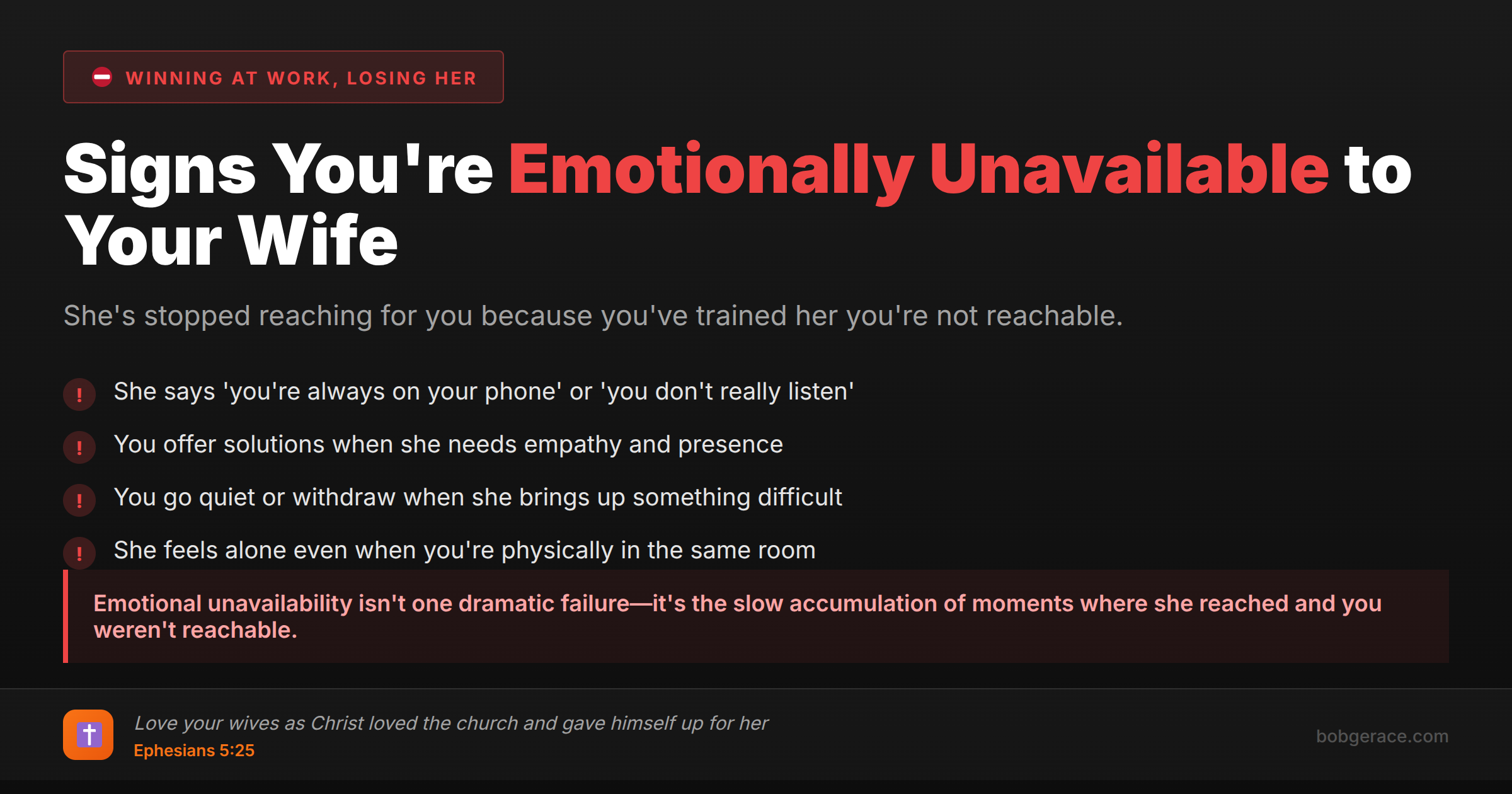
You are emotionally unavailable if your wife regularly experiences you as defended, distracted, or absent even when you are physically present. The pattern shows up when she stops bringing you her heart because you have trained her that it will not be met. She may have said things like "you're always on your phone," "you don't really listen," "I feel alone even when you're here," or "you only touch me when you want sex." These are not complaints about your schedule. They are reports about your nervous system's habit of staying in task mode, problem-solving mode, or shutdown mode instead of relational presence. Emotional unavailability is not usually one dramatic failure. It is the slow accumulation of moments where she reached and you were not reachable. You were thinking about work during dinner. You offered a solution when she needed empathy. You went quiet when she brought up something hard. You turned toward your phone instead of her face. Over time, she stopped reaching. That is when you became emotionally unavailable, not because you intended harm, but because you never learned how to stay open under relational stress.
What Emotional Unavailability Actually Looks Like in Your Marriage
Emotional unavailability is not about whether you love your wife or whether you are a good man. It is about whether your nervous system knows how to stay regulated and present when she brings you her inner world. Most successful men were never taught this. You learned to perform, solve, produce, and stay composed under pressure. Those skills built your career. They destroy intimacy.
Your wife does not experience you as unavailable because you work long hours, though that can be part of it. She experiences you as unavailable because when she is in front of you, you are still not with her. You are in your head. You are defending against her emotion. You are waiting for her to finish so you can fix it or move on. You are present in body but absent in attention, curiosity, and emotional range. She feels it in her nervous system before she can name it in words.
The pattern usually includes these dynamics: You minimize her concerns or reframe them as overreactions. You stay calm while she escalates, which makes you feel reasonable and her feel crazy. You offer logic when she needs empathy. You avoid conflict until it is unavoidable, then you engage with frustration or shutdown. You do not ask questions about her inner life. You do not share yours. You interpret her bids for connection as complaints or demands. You are more comfortable with your phone, your work, or your hobbies than with open-ended emotional conversation. You touch her mostly when you want sex, and she feels it.
This does not make you a bad husband. It makes you a man who never learned relational capacity. The problem is not your intent. The problem is your nervous system's default setting, which is to stay in control, stay task-focused, or stay numb rather than stay open and available to another person's emotional reality.
The Nervous System Pattern Behind Emotional Unavailability
Emotional unavailability is a nervous system strategy, not a character flaw. Most men who struggle with this grew up in environments where emotional expression was unsafe, ignored, or punished. You learned early that your feelings did not matter or that showing them made you weak. So you developed a shutdown response. You learned to stay in your head, not your body. You learned to solve instead of feel. You learned to perform instead of connect. That worked in childhood. It is killing your marriage now.
When your wife brings you her emotion, your nervous system reads it as a threat. Not consciously. But your body responds as if something is wrong that you need to fix, defend against, or escape. You go into problem-solving mode, which is a dorsal vagal shutdown disguised as competence. Or you go into frustration, which is sympathetic activation disguised as strength. Either way, you are not present. You are defended. She feels it as rejection, even if you are sitting right next to her.
This is compounded by attachment wounding. If you had a mother who was emotionally unpredictable, invasive, or cold, your nervous system learned that women's emotions are dangerous or suffocating. If you had a father who was absent, critical, or emotionally shut down, you never saw a model for how to stay grounded and open at the same time. So you repeat the pattern. You become the man who is reliable in every way except the one that matters most: emotional presence.
The other piece is resentment. Many emotionally unavailable men are actually carrying years of unspoken resentment toward their wife. You feel criticized, unappreciated, or controlled. You have withdrawn as a passive form of protest. You are present enough to avoid conflict but not present enough to be truly vulnerable. This creates a cycle: she pursues, you withdraw, she criticizes, you shut down further, and the distance grows.
Presence as a Reflection of Christ's Love
Ephesians 5:25 tells husbands to love their wives as Christ loved the church and gave Himself up for her. Most men read that as sacrifice, and they are not wrong. But the sacrifice Christ modeled was not just dying. It was being fully present to the people He loved, even when it was costly, even when they misunderstood Him, even when it would have been easier to withdraw.
Jesus did not offer solutions from a distance. He entered into people's pain. He wept with those who wept. He asked questions. He made Himself available. He was not controlled by others' emotions, but He was also not defended against them. That is the model. Presence without reactivity. Strength without shutdown. Love that stays open even under relational stress.
Emotional unavailability is a failure to lay down your life in the way that actually matters to your wife. You may be working hard to provide. You may be sacrificing your time, your energy, your comfort. But if you are not offering her your presence, your attention, your emotional availability, you are withholding the part of you she actually needs. Provision is important. Presence is irreplaceable.
First Peter 3:7 calls husbands to live with their wives in an understanding way, showing them honor. You cannot understand your wife from behind a wall of defensiveness or distraction. Understanding requires presence. It requires curiosity. It requires the willingness to let her affect you, to let her matter, to let her emotions land in your body without you needing to fix, manage, or escape them. That is what it means to honor her as a co-heir of the grace of life.
Action Steps
-
1
Ask your wife this question and do not defend: 'When do you feel like I am not really present with you?' Write down what she says without explaining yourself.
-
2
Notice your body's response when she brings you emotion. Do you tense up? Go into your head? Reach for your phone? Start problem-solving? That is your nervous system defending. Name it.
-
3
Practice 60 seconds of full presence once a day. Put your phone down. Turn your body toward her. Make eye contact. Ask one curious question about her day and listen without fixing.
-
4
Identify one area where you have been withdrawing as a form of passive protest. Resentment about sex, money, her tone, feeling unappreciated. Bring it to her directly instead of punishing her with distance.
-
5
Get help. Emotional unavailability does not fix itself with effort. It requires nervous system work, attachment repair, and learning how to stay open under stress. Work with a coach or therapist who understands this.
Related Questions
- How can my wife feel neglected when I work so hard for her?
- Why does my success not make her feel secure?
- What is emotional neglect in marriage?
- Can emotional neglect happen in a good-looking marriage?
- I make six figures, so why is my wife still unhappy?
- Am I a workaholic husband or just a responsible provider?
Also find Bob on
Subscribe for weekly videos on Christian marriage.
You Can Learn to Be Present
Emotional availability is not about trying harder. It is about rewiring the nervous system patterns that keep you defended. I help men do this work without the therapy-speak or the shame.
Talk to Bob →