I make six figures, so why is my wife still unhappy?
6 min read
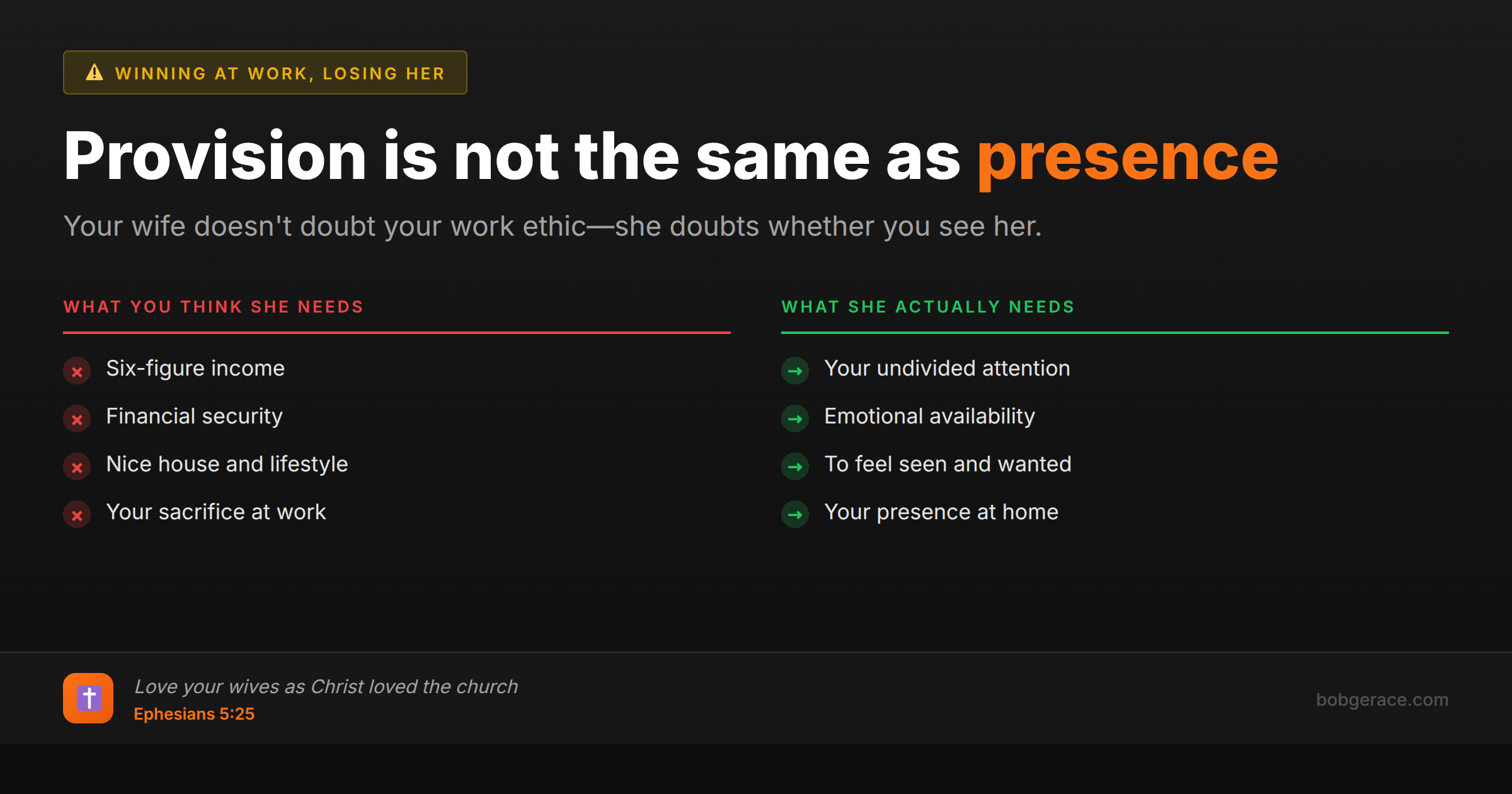
Because provision is not the same as presence. You have confused your sacrifice at work with intimacy at home. Your wife does not doubt your work ethic or your ability to provide. She doubts whether you see her, whether you want her beyond what she does for you, and whether you are emotionally available when she needs you. The money proves you can execute. It does not prove you love her. Most successful men hear this as ingratitude. It is not. It is grief. She married a man, not a paycheck. Somewhere along the way, you started believing that working hard for her was the same as being with her. It is not. She has been alone inside your provision for longer than you realize, and now her nervous system has learned not to expect you.
The Provider Trap: When Success Becomes Distance
You built the career. You handle the mortgage, the cars, the vacations, the kids' schools. You solve problems. You close deals. You show up at work with clarity and confidence. Then you come home and your wife is cold, distant, or quietly resentful. You think, 'I am doing everything right. Why is this not enough?'
Here is what is happening. You have spent years training yourself to suppress emotion, delay gratification, and stay focused on outcomes. That is how you win at work. But you brought that same operating system home. Your wife does not experience you as a man who loves her. She experiences you as a man who manages her. You listen to solve, not to connect. You touch her when you want sex, not because you want her. You are present in body but defended in heart.
She has tried to tell you. Maybe she said she feels alone. Maybe she said you are always on your phone. Maybe she said she wants more than a roommate. You heard it as complaining or nagging, so you worked harder, provided more, or withdrew further. Now she has stopped trying. Her nervous system has moved from protest to despair. She no longer expects you to show up emotionally, so she has started to detach. That detachment feels like rejection to you, so you double down on work, where you still feel competent.
This is the provider trap. You are winning at work and losing her. The income is not the problem. The income is the cover story for emotional absence. You have made provision your primary love language, and she has been starving for presence the entire time.
Nervous System Patterns and Attachment Injury
Your wife's nervous system has been shaped by years of reaching for you and finding you unavailable. Early in the marriage, when she felt hurt or disconnected, she likely pursued you—asked questions, initiated conversation, sought reassurance. You were busy, distracted, or dismissive. Her nervous system registered that as rejection. Over time, she stopped pursuing. This is not a conscious decision. It is a protective adaptation. Her system learned that reaching for you is not safe.
You, meanwhile, operate in a dorsal vagal shutdown pattern at home. You are not angry or cruel. You are just not there. You have trained yourself to stay calm, controlled, and task-focused. That works in business. In marriage, it reads as emotional unavailability. Your wife does not feel your anger. She feels your absence. She does not need you to be perfect. She needs you to be present, and presence requires vulnerability.
This dynamic creates a pursue-withdraw cycle that becomes self-reinforcing. She feels alone, so she criticizes or distances. You feel attacked or unappreciated, so you withdraw into work. She feels more alone. You feel more criticized. The loop tightens. Meanwhile, resentment builds on both sides. She resents that you are never truly with her. You resent that your hard work is never enough. Both of you are right, and both of you are stuck.
The clinical reality is this: your marriage is not failing because you are a bad man. It is failing because you have outsourced intimacy to provision. You have made your work your primary attachment relationship, and your wife has become a secondary stakeholder in your life. She feels it. Her body knows it. And no amount of income will fix it.
Provision Without Presence Is Not Love
Scripture is clear that a man is called to provide for his household. 'If anyone does not provide for his relatives, and especially for his own household, he has denied the faith and is worse than an unbeliever' (1 Timothy 5:8). You have not failed that command. But provision is not the whole command. You are also called to love your wife as Christ loved the church—sacrificially, intimately, with presence and attention (Ephesians 5:25).
Christ did not love the church from a distance. He did not send resources and call it relationship. He gave Himself. He was present in suffering, present in joy, present in the ordinary and the crisis. That is the model. Provision matters, but it is not a substitute for incarnational love. Your wife needs you to show up, not just pay up.
Consider the father in Luke 15. The prodigal son returns, and the father does not lecture him or remind him of all he has provided. He runs to him. He embraces him. He celebrates his return. That is presence. That is the posture of a man whose love is not conditional on performance or productivity. Your wife is not asking you to stop working. She is asking you to stop hiding behind your work.
God does not call you to be successful and distant. He calls you to be faithful and present. If your work has become your identity and your marriage has become your obligation, you have inverted the order. Repentance here is not about guilt. It is about reorientation. It is about remembering that your wife is not a project to manage. She is a person to love.
Action Steps
-
1
Admit to yourself that provision is not the same as presence. Write down three specific ways your wife has asked for your attention in the past year that you dismissed or delayed.
-
2
Schedule two non-negotiable hours per week with your wife where your phone is off, work is not discussed, and you are fully present. Protect this time like you protect a client meeting.
-
3
Ask her this question and do not defend: 'What does it feel like to be married to me?' Listen without fixing, explaining, or justifying. Just listen.
-
4
Identify one area where you have been emotionally unavailable—sex, conflict, her emotions, spiritual leadership—and tell her you see it and want to change. Be specific.
-
5
Get into a men's group or coaching relationship where you can be honest about your marriage and your patterns. You cannot fix what you cannot see, and you cannot see it alone.
Related Questions
- Am I a workaholic husband or just a responsible provider?
- Can a good provider still be an emotionally unavailable husband?
- Why do successful men miss the warning signs at home?
- How do I slow down without losing my edge?
- How can my wife feel neglected when I work so hard for her?
- How do I know if I am an emotionally unavailable husband?
Also find Bob on
Subscribe for weekly videos on Christian marriage.
You Built the Life. Now Save the Marriage.
If your wife feels alone despite everything you provide, you are not failing at effort. You are missing the real problem. I help men like you see what you cannot see and do what you have not known how to do.
Talk to Bob →