Am I a workaholic husband or just a responsible provider?
7 min read
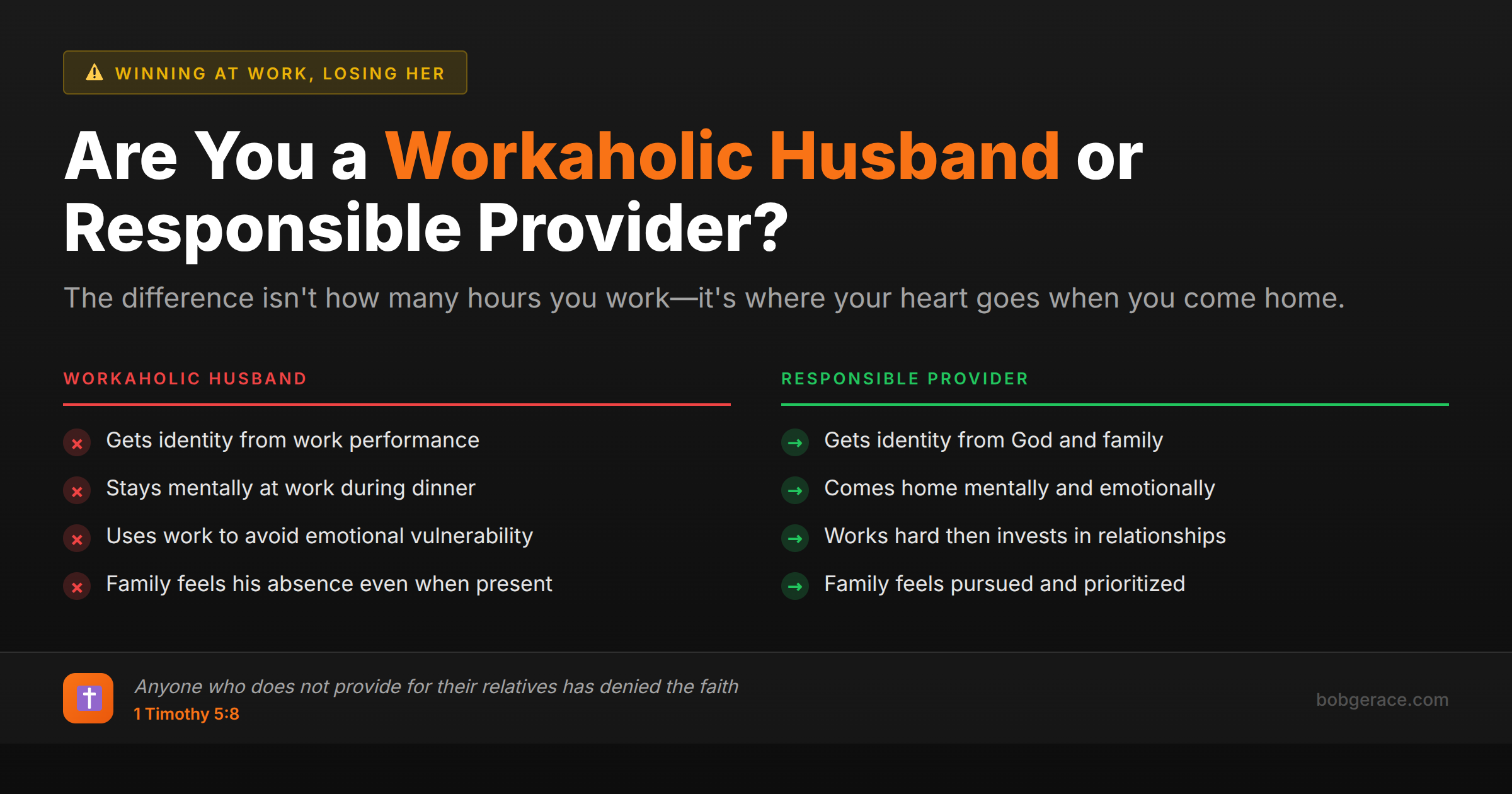
You cross from responsible provider into workaholic when work becomes your primary source of identity, validation, or emotional regulation, and when your family consistently experiences your absence even when you are home. The difference is not just hours worked. It is whether work has become the place you feel most competent, most valued, and most alive, while home has become the place you feel criticized, inadequate, or drained. A responsible provider works hard and comes home present. A workaholic works hard and stays emotionally at work even when his body is at the dinner table. Your wife is not asking you to stop providing. She is asking you to stop hiding behind provision. If she has said things like "you care more about work than us," "you're always on your phone," "I feel like a single parent," or "we never see you," she is not complaining about your paycheck. She is naming the relational cost of your absence. The question is not whether you work hard. The question is whether work has become the way you avoid the harder work of being emotionally present, vulnerable, and available at home.
The Provider Trap: When Sacrifice Becomes Avoidance
Most successful men do not set out to become workaholics. You set out to build a good life. You wanted to provide security, opportunity, and comfort for your family. You believed that working hard was the most loving thing you could do. And in part, you were right. Provision matters. Your wife and children benefit from your work. The problem is not that you provide. The problem is that you have made provision a substitute for presence.
Here is the pattern: You work long hours, travel for business, check email at night, take calls on weekends, and stay mentally engaged with work even during family time. You tell yourself it is temporary. You tell yourself it is necessary. You tell yourself you are doing it for them. And you believe it. But your wife experiences something different. She experiences a man who is more engaged with his phone than her face. A man who has energy for clients but is exhausted at home. A man who solves problems at work but avoids emotional conversations with her. A man who is physically present but emotionally elsewhere.
The trap deepens because work actually feels good. At work, you know the rules. You know how to win. You get clear feedback. You feel competent. You are respected. You do not get criticized for how you load the dishwasher or your tone or forgetting something she told you last week. Work is where you feel like a man. Home is where you feel like you are failing. So you spend more time at work. You tell yourself it is responsibility. It is actually avoidance.
Meanwhile, your wife is alone. She is managing the kids, the house, the emotional labor, the logistics. She is doing it without you, and she is starting to resent you for it. She does not care that you are building a business or closing deals or providing a great life. She cares that you are not there. And when you are there, you are distracted, defensive, or too tired to engage. She is not asking for a smaller house or a cheaper car. She is asking for you. The man she married. Not the shell of him who shows up after work has taken the best of him.
Why High-Performing Men Use Work to Regulate Their Nervous System
Workaholism is not about laziness or irresponsibility. It is about nervous system regulation. For many high-performing men, work is the place where your nervous system feels most safe. You know how to perform. You know how to win. You know how to stay in control. Work gives you a dopamine hit, a sense of purpose, and a clear scoreboard. Home does not. Home is unpredictable. Your wife's emotions are unpredictable. Your kids' needs are unpredictable. You cannot control it, and that makes your nervous system uncomfortable.
So you stay at work. Not because you do not love your family. But because work is where you feel competent, and home is where you feel inadequate. This is especially true if you grew up in a home where your worth was tied to performance, where love was conditional on achievement, or where emotional needs were ignored. You learned early that your value comes from what you produce, not who you are. So you produce. And you produce. And you produce. And it is never enough, because the hole you are trying to fill is not about money or success. It is about worth.
The other dynamic is avoidance. Many men use work to avoid the discomfort of intimacy. Intimacy requires vulnerability. It requires you to be seen, to be wrong, to not have the answers, to sit with your wife's disappointment or pain without fixing it. That is deeply uncomfortable for a man whose identity is built on competence and control. So you avoid it. You stay late at the office. You check email during dinner. You schedule calls on Saturday. You are not doing it consciously. But your nervous system is choosing the discomfort it knows (work stress) over the discomfort it fears (relational vulnerability).
This creates a vicious cycle. The more you avoid home, the more tension builds. The more tension builds, the less safe home feels. The less safe home feels, the more you retreat to work. Your wife pursues, you withdraw. She criticizes, you defend by pointing to how hard you work. She feels more alone. You feel more misunderstood. The distance grows. And underneath it all, you are both lonely.
Provision Without Presence Is Not Biblical Manhood
First Timothy 5:8 says that a man who does not provide for his family is worse than an unbeliever. Many men stop reading there. They take that verse as permission to pour everything into work and call it faithfulness. But provision is not the whole picture. The Bible also calls men to love their wives as their own bodies, to not be harsh with them, to live with them in an understanding way, to raise their children in the discipline and instruction of the Lord. You cannot do any of that from a distance.
Jesus modeled a life of mission and presence. He had work to do. He had a kingdom to build. He was under constant pressure and demand. But He also withdrew to pray. He made time for the people in front of Him. He was fully present to the woman at the well, to the children, to His disciples. He did not sacrifice relationship on the altar of productivity. He integrated both. That is the model. Not work-life balance as if they are opposing forces. But a life where your work flows from your identity in Christ, not the other way around.
The danger for the workaholic husband is that work becomes an idol. It becomes the place you find your worth, your identity, your sense of control. You are not working to provide. You are working to prove. To prove you are enough. To prove you matter. To prove you are not a failure. And no amount of success will ever be enough, because you are asking work to do something only God can do: tell you who you are.
Proverbs 23:4 warns against wearing yourself out to get rich. Ecclesiastes 4:6 says better is a handful of quietness than two hands full of toil and striving after wind. The Bible does not celebrate the man who sacrifices his family on the altar of ambition. It calls that foolishness. Your wife and your children do not need a richer version of you. They need a present version of you.
Action Steps
-
1
Ask your wife: 'Do you feel like work comes before you and the kids?' Listen to her answer without defending or explaining. Write down what she says.
-
2
Track your actual hours for one week. Include work time, email time, phone time, mental work time at home. Be honest about what you are giving to work versus what is left for your family.
-
3
Identify what you get from work that you do not get at home. Respect? Competence? Control? Validation? That is what you are actually chasing. Name it.
-
4
Set one non-negotiable boundary with work for the sake of your family. No phone at dinner. No email after 8pm. No work on Saturday morning. Pick one and keep it for 30 days.
-
5
Get honest about what you are avoiding at home. Is it conflict? Vulnerability? Your wife's disappointment? Your own sense of inadequacy? You cannot fix what you will not name.
Related Questions
- I make six figures, so why is my wife still unhappy?
- Can a good provider still be an emotionally unavailable husband?
- Why do successful men miss the warning signs at home?
- How do I slow down without losing my edge?
- How can my wife feel neglected when I work so hard for her?
- How do I know if I am an emotionally unavailable husband?
Also find Bob on
Subscribe for weekly videos on Christian marriage.
You Can Provide and Be Present
The goal is not to work less. It is to stop using work to avoid the life you are building. I help men untangle this without guilt or gimmicks.
Talk to Bob →