How do I slow down without losing my edge?
5 min read
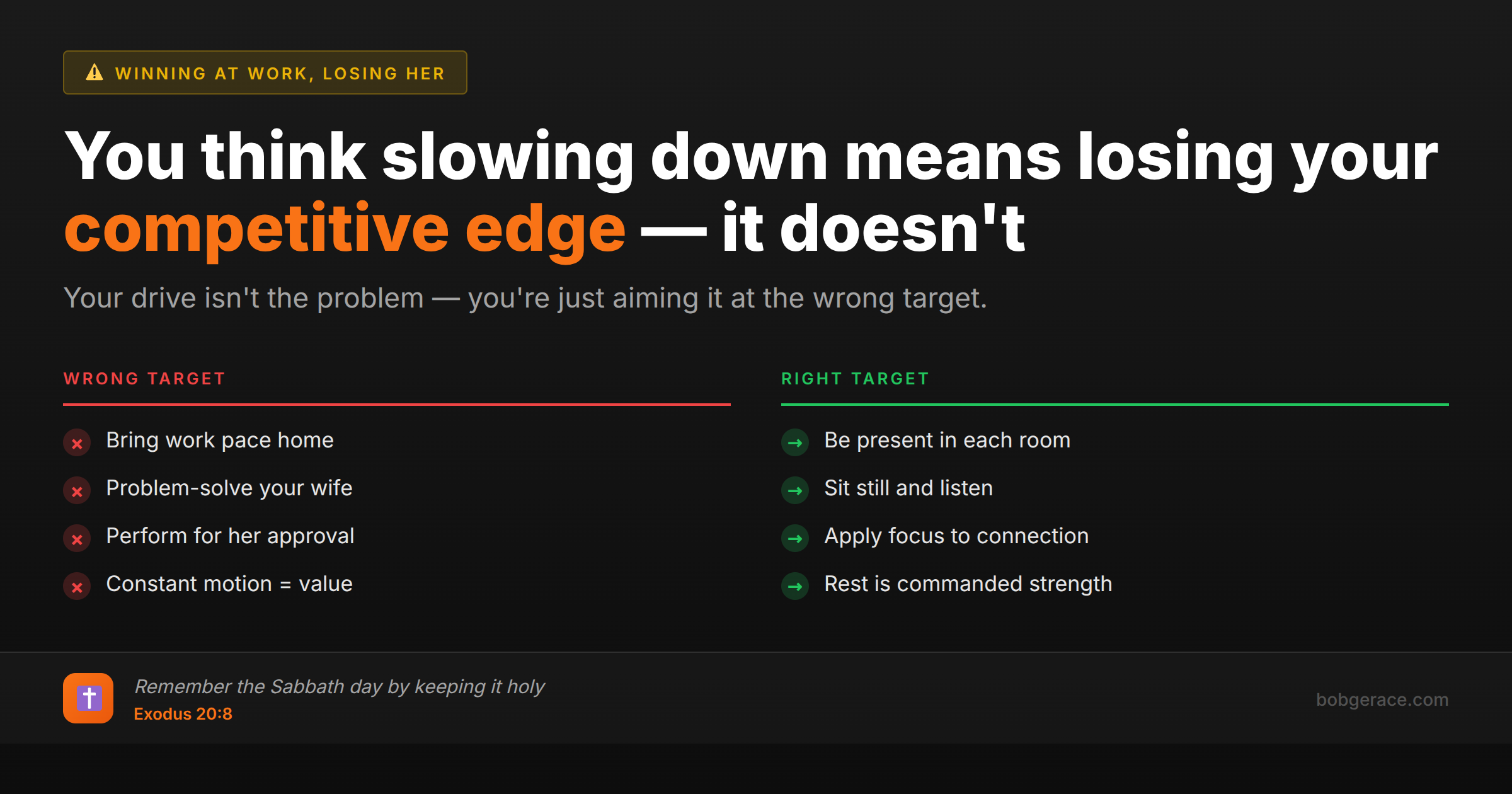
You slow down without losing your edge by realizing that presence at home is not the opposite of performance at work—it is a different kind of strength. Your edge comes from focus, discipline, and intensity. Those same qualities, when applied to your marriage, make you a better husband. The problem is not your drive. It is that you have been aiming it at the wrong target. Slowing down does not mean becoming passive, soft, or less ambitious. It means being fully present in the room you are in. When you are at work, work hard. When you are home, be home. The issue is not how much you work. It is that you bring the pace, the problem-solving, and the performance mindset into your marriage, where your wife does not need a CEO—she needs a man who can sit still and be with her.
The Cost of Constant Motion
You have built a life most men envy. You provide well. You solve problems. You execute. You win. But your wife does not feel like she has you. She has your effort, your income, your problem-solving—but not your presence. You are always moving, always thinking three steps ahead, always optimizing. That intensity built your career. It is eroding your marriage.
Here is what she experiences: You walk in the door, but your mind is still at work. You sit at dinner, but you are checking your phone. You are in bed, but you are mentally running tomorrow's meeting. She talks to you, and you are half-listening, waiting for her to get to the point so you can solve it and move on. You think you are being efficient. She feels like a task on your list.
The fear is that if you slow down, you will lose your edge. You will get soft. You will fall behind. But that fear is based on a lie: that your value is tied to your output. You have confused your identity with your performance. You believe that if you stop moving, you stop mattering. So you stay in motion, and your wife stays alone.
The truth is that slowing down at home does not weaken you. It strengthens you. Presence requires more discipline than distraction. Listening requires more strength than solving. Being emotionally available requires more courage than staying busy. You are not afraid of losing your edge. You are afraid of being still long enough to feel what you have been avoiding.
Why High Performers Struggle to Be Present
Your nervous system is wired for performance. You have been rewarded your entire life for speed, execution, and results. Your brain has learned that value comes from output. Rest feels like failure. Stillness feels like weakness. So you stay in motion, even when motion is not what is needed.
This is not a character flaw. It is a nervous system pattern. High performers often have an overactive sympathetic nervous system—always in fight-or-flight, always scanning for the next problem, always optimizing. That state is useful at work. It is toxic at home. Your wife does not need you to solve her. She needs you to be with her. But being with her requires you to downregulate, to move from doing to being. That feels uncomfortable because your body interprets stillness as danger.
Here is the pattern: You come home activated. Your wife reaches for connection. You experience her need as one more demand. You solve, dismiss, or distract. She feels unseen. You feel unappreciated. Both of you retreat. The loop repeats. Over time, she stops reaching. You stay busy. The marriage becomes a logistics partnership, not an intimate relationship.
Slowing down is not about working less. It is about learning to shift states. You need to be able to move from performance mode to presence mode. That requires you to develop the capacity to regulate your nervous system, to tolerate stillness, to be with your wife without an agenda. That is not soft. That is advanced emotional fitness. Most men never develop it because they mistake busyness for strength.
The Discipline of Sabbath
God commanded rest. Not suggested it. Commanded it. Exodus 20:8 says, "Remember the Sabbath day by keeping it holy." That is not about religion. It is about rhythm. God built rest into the fabric of creation because He knows that humans are not designed for constant motion. Rest is not weakness. It is obedience. It is trust. It is the declaration that your value is not tied to your output.
Jesus was the most purposeful man who ever lived, and He regularly withdrew to be still, to pray, to be with the Father. He did not hustle. He did not perform. He moved with intention, and He rested with intention. That is the model. Presence is not the opposite of purpose. It is the foundation of it.
Proverbs 23:4 says, "Do not wear yourself out to get rich; do not trust your own cleverness." You are wearing yourself out. You are trusting your own effort to secure your family, your future, your worth. But your wife does not need more of your effort. She needs more of you. She needs the man, not the machine.
Slowing down is an act of faith. It is trusting that your worth is not tied to your productivity. It is believing that God is sovereign over your career, your income, your future. It is choosing to be present with your wife because you know that intimacy matters more than achievement. That is not losing your edge. That is finding your center.
Action Steps
-
1
Create a shutdown ritual: When you leave work, take five minutes in your car to breathe, pray, and mentally close the work day before walking in the door.
-
2
Set a daily 20-minute window where you are fully present with your wife—no phone, no problem-solving, no agenda. Just sit with her and ask, "How are you?"
-
3
Identify one evening a week where you do not work, check email, or think about business. Protect that time like you would a client meeting.
-
4
Practice stillness: Sit for five minutes each morning without your phone, without a plan, without doing. Just be. Notice how uncomfortable it feels. That discomfort is what you have been avoiding.
-
5
Ask your wife: "When do you feel like you have me, and when do you feel like you are competing with work?" Listen without defending. Let her answer guide where you need to slow down.
Related Questions
- I make six figures, so why is my wife still unhappy?
- Am I a workaholic husband or just a responsible provider?
- Can a good provider still be an emotionally unavailable husband?
- Why do successful men miss the warning signs at home?
- How do I listen without fixing, defending, or explaining?
- What is the first step out of emotional neglect?
Also find Bob on
Subscribe for weekly videos on Christian marriage.
You Can Be Driven and Present
Slowing down for your wife does not mean losing your edge. It means learning to shift gears. If you are stuck in performance mode and your marriage is suffering, let's talk.
Talk to Bob →