What is the first step out of emotional neglect?
5 min read
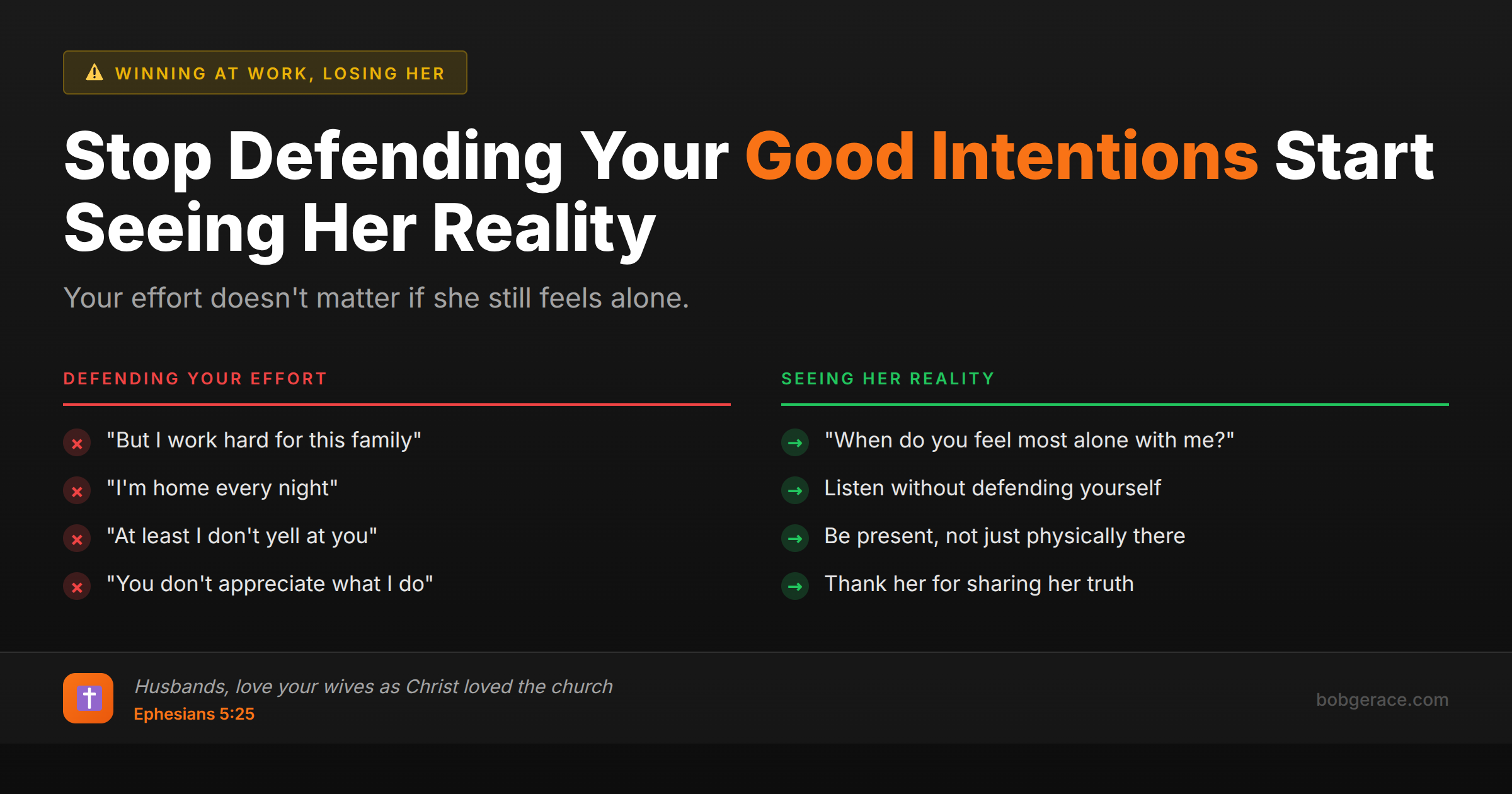
The first step out of emotional neglect is admitting that your wife's experience of you matters more than your intentions. You may believe you are present because you are home, working hard, or not yelling. But if she experiences you as distracted, defended, or emotionally unavailable, that is the reality of your marriage. The step is not a technique. It is a posture shift: stop defending your effort and start getting curious about her loneliness. Ask her one question without fixing, explaining, or justifying: "When do you feel most alone with me?" Then listen. Do not correct her. Do not list what you have done. Just hear her. That is the beginning.
The Pattern You Did Not See Building
Emotional neglect does not announce itself. It accumulates in a thousand small moments where your wife reached for you and found you elsewhere. You were on your phone during dinner. You solved her problem when she wanted empathy. You touched her only when you wanted sex. You listened while mentally drafting your response. You were home, but not present.
She stopped sharing the small things first. Then the hard things. Then anything that required you to feel with her instead of fix for her. You did not notice because you were still performing responsibility—earning, providing, protecting. You thought those things proved love. She experienced them as substitutes for intimacy.
Most men do not see this pattern until their wife says she is done, or numb, or interested in someone else. By then, resentment has calcified. She has told herself a story about who you are, and that story now includes the belief that you will not change because you do not see the problem. The good news: you are reading this, which means part of you knows something is wrong. That awareness is the soil where change begins.
Emotional neglect is not about being a bad man. It is about being an absent one. You can be responsible, moral, and hardworking and still be emotionally unavailable. The question is not whether you are trying. The question is whether your wife feels seen, safe, and connected to you. If the answer is no, your effort is aimed at the wrong target.
Why You Defend Instead of Listen
When your wife says she feels alone, your nervous system hears threat. You are wired to solve, protect, and perform. Her pain feels like failure, so you defend: "I am here every night. I work for this family. What more do you want?" That defense is not logic. It is self-protection. You are trying to regulate your own shame by proving you are enough.
But her loneliness is not an accusation. It is information. She is telling you that the way you show up does not reach her. When you defend, you confirm her fear: that you care more about being right than about her experience. This is the loop that builds resentment. She feels unseen. You feel unappreciated. Both of you retreat.
Emotional availability requires you to stay present with discomfort without fixing or fleeing. That means letting her pain exist without needing to solve it, dismiss it, or make it about you. Most high-performing men struggle here because you have been rewarded your whole life for solving problems and avoiding feelings. But marriage is not a performance review. It is a relationship. She does not need you to be perfect. She needs you to be present.
The first step is not learning a new skill. It is unlearning an old reflex. Stop defending your intentions. Start getting curious about her experience. That shift—from "I am enough" to "Tell me more"—is where emotional availability begins.
The Call to See Her
Ephesians 5 tells husbands to love their wives as Christ loved the church. That love is not passive provision. It is active presence. Jesus did not love from a distance. He entered in. He wept with those who wept. He saw people others ignored. He made space for the broken, the lonely, the unseen. That is the model.
Emotional neglect is the failure to see. You can provide for your wife and still not know her. You can protect her and still not be present with her. The call is not just to sacrifice for her. It is to be with her—in her joy, her sorrow, her fear, her loneliness. That requires you to slow down, set aside your agenda, and enter her world.
Proverbs 20:5 says, "The purposes of a person's heart are deep waters, but one who has insight draws them out." Drawing out your wife's heart is not a one-time conversation. It is a daily posture of curiosity, attention, and presence. It is asking questions and listening without an agenda. It is making space for her to be known.
This is not soft. It is the hardest work you will do. It requires you to face your own discomfort, your own fear of inadequacy, your own need to be right. But it is the work Christ calls you to. Not because you are failing. Because you are being refined.
Action Steps
-
1
Ask your wife: "When do you feel most alone with me?" Do not defend, explain, or fix. Just listen and say, "Thank you for telling me."
-
2
Identify one daily moment where you are physically present but mentally elsewhere—dinner, bedtime, morning coffee. Commit to being fully present in that moment for one week.
-
3
Set a phone boundary: no phone for the first 30 minutes after you get home. Be available to connect, not just coexist.
-
4
When your wife shares something hard, resist the urge to solve. Say, "That sounds really hard. Tell me more." Let her talk without interruption.
-
5
Journal for five minutes each night: "Where was I emotionally unavailable today? What was I protecting myself from?" Bring that awareness to God in prayer.
Related Questions
- How can my wife feel neglected when I work so hard for her?
- How do I know if I am an emotionally unavailable husband?
- Why does my success not make her feel secure?
- What is emotional neglect in marriage?
- What are the six-month warning signs before she leaves?
- Can emotional neglect happen in a good-looking marriage?
Also find Bob on
Subscribe for weekly videos on Christian marriage.
You Can Learn to Be Present
Emotional availability is not a personality trait. It is a skill you can develop. If your wife feels alone and you do not know how to reach her, let's talk.
Talk to Bob →