What are the six-month warning signs before she leaves?
6 min read
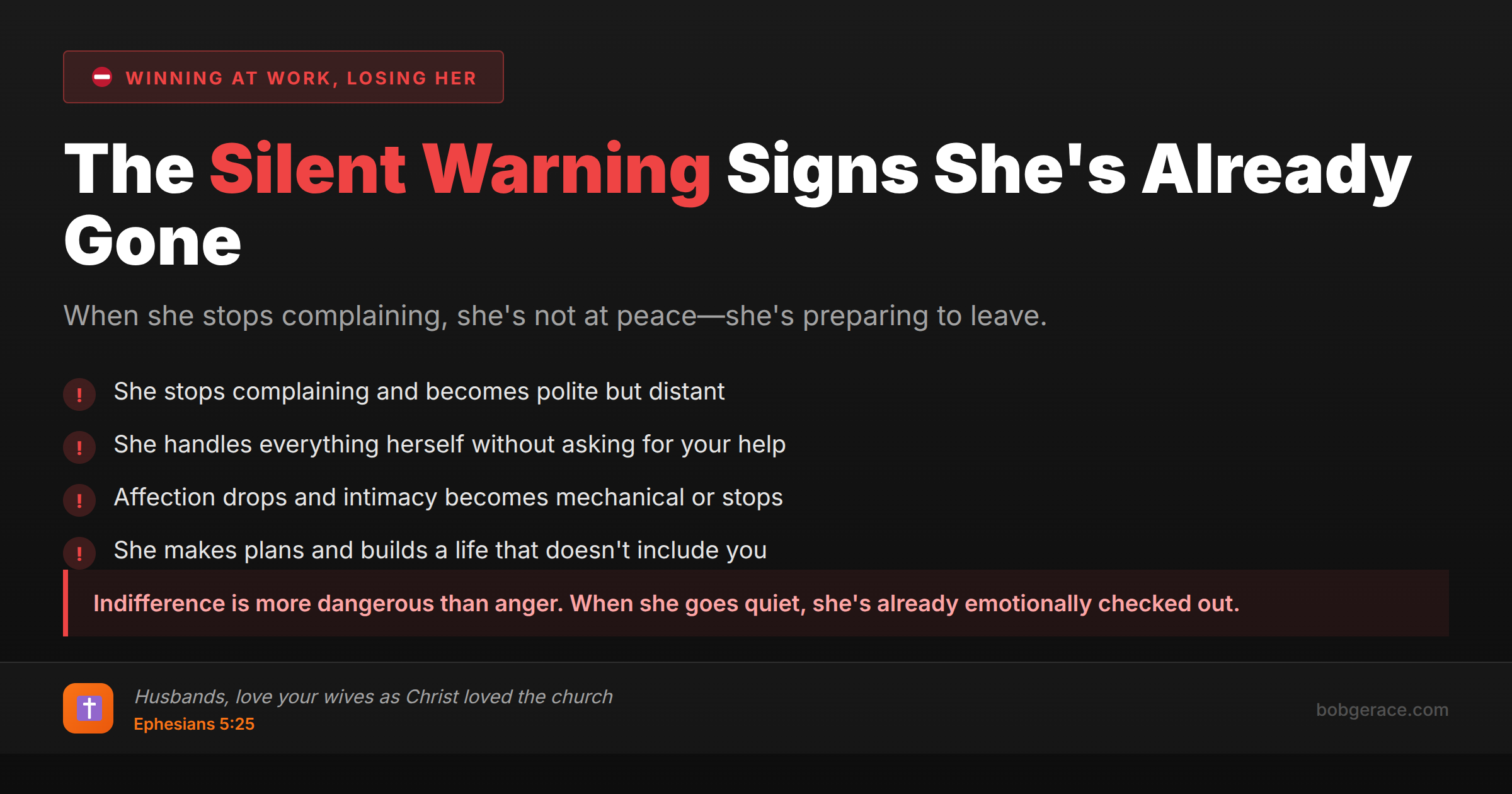
The six-month warning signs are usually quiet, not loud. Your wife stops complaining as much. She becomes more independent—handling things herself, making plans without you, building a life that doesn't require your input. Affection drops. Sex becomes mechanical or stops. She is polite but distant. She stops expecting you to respond emotionally, so she stops trying. You may feel relief that the tension has eased, but what you are seeing is not peace—it is detachment. Indifference is more dangerous than anger. Anger means she still cares enough to fight. When she goes quiet, when she stops asking you to notice her, when she starts planning her own happiness without you in it—that is the sign. Most men wake up when she says she is done. The truth is, she has been preparing to leave for months. You just were not paying attention.
What Emotional Withdrawal Actually Looks Like
Most men miss the early signs because they are looking for drama. They expect yelling, ultimatums, or threats. But a wife who is preparing to leave does not usually announce it six months in advance. She withdraws. She stops complaining about your work hours because she has accepted you will not change. She stops asking you to talk because she has learned you will not engage. She stops initiating affection because she is tired of feeling rejected or invisible.
You may notice she is busier—more time with friends, new hobbies, more focus on the kids or her own goals. You may feel relieved. The house is calmer. She is not upset as often. But what you are experiencing is not improvement. It is her nervous system deciding you are not safe to depend on. She is not less hurt. She is less hopeful.
Sex often becomes a clear indicator. If she is still having sex with you but it feels mechanical, obligatory, or disconnected, that is a sign. If sex has stopped altogether and she is not fighting about it, that is a bigger sign. A wife who has emotionally left the marriage may still be physically present, but her heart is already planning the exit. She may not have a lawyer yet. She may not have told anyone. But she has started imagining life without you, and that imagination is becoming more appealing than the reality of staying.
The Neurobiology of Detachment and Resentment
When your wife stops complaining, her nervous system has likely shifted from protest to despair. In attachment terms, protest is when she fights for connection—she gets angry, she criticizes, she demands your attention. Despair is when she stops fighting because she no longer believes you will respond. Her brain has recategorized you from 'safe attachment figure' to 'unavailable,' and she begins to regulate her emotions without you.
Resentment builds in the gap between expectation and experience. Every time she needed you emotionally and you were not there, a small deposit was made in her resentment account. Every time she tried to tell you she was lonely and you defended yourself or minimized her feelings, another deposit. Over months and years, that account compounds. By the time she goes quiet, the balance is so high that she does not believe you can ever pay it back.
This is why her silence is more dangerous than her anger. Anger is the nervous system still trying to get your attention. Silence is the nervous system giving up. She is no longer looking to you for co-regulation. She is finding stability elsewhere—friends, work, her own internal world, or in some cases, the attention of another man. Her brain is solving the problem of your emotional absence by making you irrelevant. That is the clinical reality of what is happening six months before she leaves.
Husbands, Love Your Wives as Christ Loved the Church
Ephesians 5:25 does not say, 'Husbands, provide for your wives.' It says, 'Husbands, love your wives, just as Christ loved the church and gave himself up for her.' Provision is part of love, but it is not the whole of it. Christ did not love the church from a distance. He was present. He was attentive. He laid down his life, which means he laid down his agenda, his comfort, his defensiveness.
When your wife withdraws, it is often because she has experienced your love as conditional—present when she is pleasant, absent when she is needy. That is not how Christ loves. He does not turn away when we are hard to deal with. He moves toward us. He does not defend himself when we are hurt. He listens. He does not wait for us to be perfect before he engages. He pursues.
The six-month warning signs are not just relational—they are spiritual. They reveal whether you are leading your home with Christlike love or with self-protection. If your wife is detaching, the question is not, 'Why is she being distant?' The question is, 'Have I been present, or have I been absent while calling it leadership?' God is not calling you to fix her. He is calling you to examine whether you have loved her the way He loves you—sacrificially, attentively, without condition.
Action Steps
-
1
Ask her directly: 'Do you feel like I am emotionally present with you, or do you feel alone in this marriage?' Then listen without defending.
-
2
Track your own behavior for one week: How many times did you initiate non-sexual affection? How many times did you ask about her inner world and actually listen?
-
3
Identify one recurring complaint she has made in the past year. Assume it is true. What would change if you took it seriously?
-
4
Stop waiting for her to be warm before you engage. Initiate connection even when she is distant. Detachment is often a test to see if you will pursue.
-
5
If she has gone quiet and you sense real danger, do not wait. Get help now—coaching, counseling, or a trusted mentor who will tell you the truth about your part.
Related Questions
Also find Bob on
Subscribe for weekly videos on Christian marriage.
You Don't Have to Wait Until She's Gone
If you are seeing these signs and you are not sure what to do next, that is exactly what coaching is for. Bob works with men who are six months before crisis, not six months after. Let's talk before it is too late.
Talk to Bob →