Why does she light up for everyone but me?
6 min read
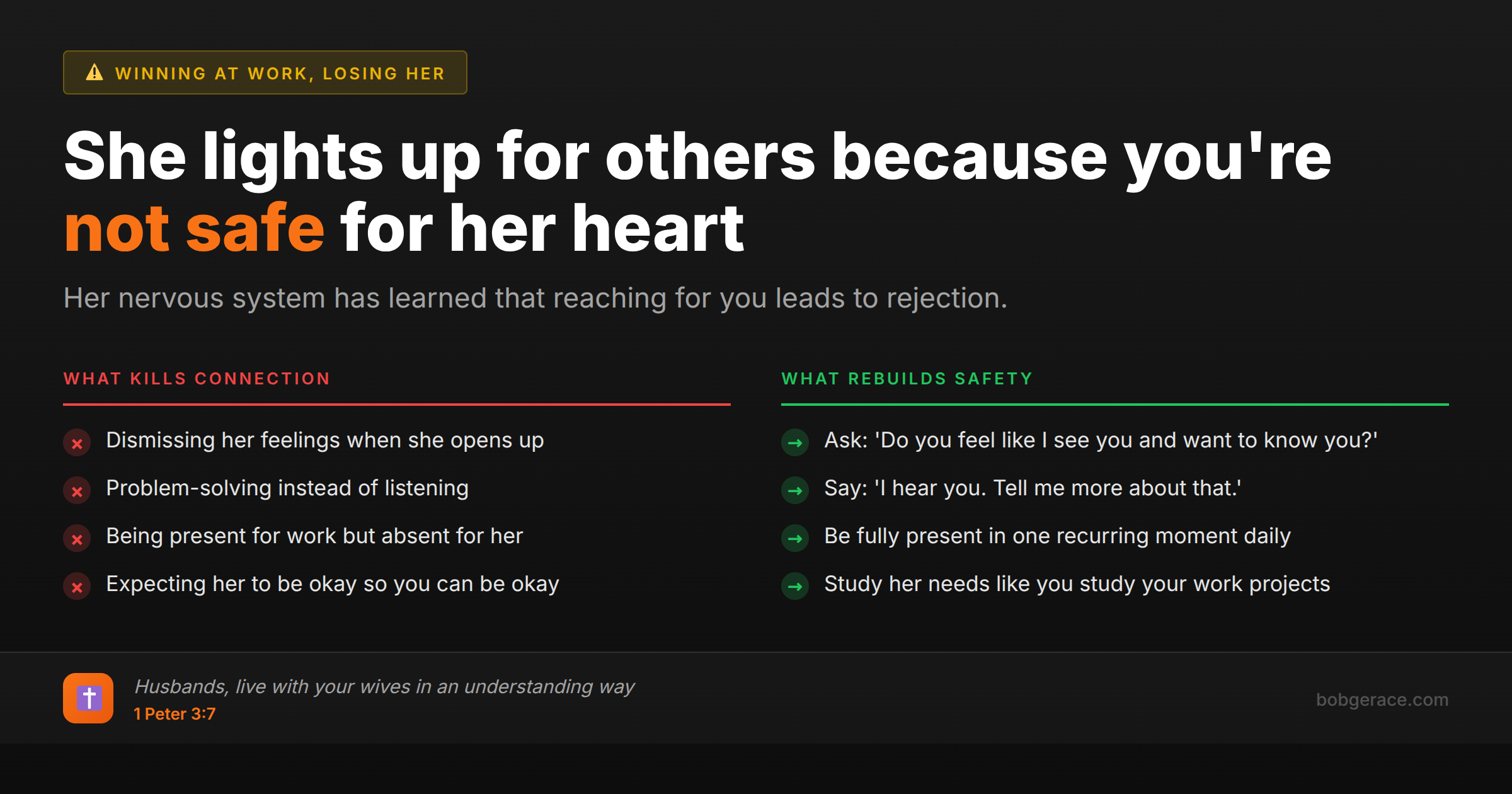
She lights up for everyone else because those relationships don't carry the weight of unmet expectations, unhealed wounds, and accumulated disappointment. With friends, coworkers, or even strangers, she can be herself without the fear of being dismissed, minimized, or ignored. With you, she's learned that reaching for connection often leads to rejection—so she's stopped reaching. This isn't about her being fake with others or withholding from you out of spite. It's a protective response. Her nervous system has learned that you're not safe for her emotional world. She's warm with others because she hasn't been hurt by them the way she's been hurt by you. The good news: this pattern is reversible if you're willing to own your part and rebuild safety.
The Sting of Watching Her Be Alive with Everyone Else
You see her at a party, laughing with friends. She's animated, playful, fully present. Then she turns to you and the light goes out. Her face flattens. Her tone shifts. She's polite, functional, distant. You feel the contrast like a punch to the gut. You think: She has energy for everyone else. Why not me?
Or you watch her on the phone with her sister, talking for an hour, fully engaged. But when you try to talk to her, you get one-word answers, distracted glances, or a sigh that says she'd rather be anywhere else. You feel rejected, confused, even angry. You're her husband. You're supposed to be the one she lights up for. Instead, you feel like the one person she can't stand to be around.
Here's what's happening: she's not withholding warmth to punish you. She's protecting herself. Over months or years, she's reached for you—emotionally, physically, relationally—and been met with distraction, defensiveness, dismissal, or silence. She's tried to tell you she's lonely, and you've told her she's overreacting. She's asked for your presence, and you've given her your paycheck. She's brought you her heart, and you've offered solutions or sex.
Eventually, she stopped trying. Not because she stopped caring, but because the repeated disappointment became unbearable. With everyone else, she doesn't have that history. She can be light, open, unguarded. With you, every interaction is loaded with the memory of being unseen. So she shuts down. She goes flat. She saves her emotional energy for people who don't hurt her.
Resentment, Learned Helplessness, and Protective Shutdown
What you're witnessing is a combination of resentment, learned helplessness, and nervous system shutdown. Resentment builds when your wife's bids for connection are repeatedly ignored or rejected. Every time she reaches for you and you don't respond, her brain registers: He doesn't care. I don't matter. Over time, those micro-rejections accumulate into a pervasive sense of being unseen and unloved.
Learned helplessness occurs when she realizes that nothing she does changes your behavior. She's told you she's lonely. She's asked you to put down your phone. She's initiated sex and been turned down or met with mechanical duty. She's tried being direct, being patient, being angry, being silent—and none of it worked. So she stops trying. Her system learns: My efforts don't matter. I'm powerless here.
From a nervous system perspective, she's in chronic dorsal vagal shutdown around you. Her body has learned that you are not a source of safety or co-regulation. When she's with others, her ventral vagal system can come online—she feels safe, seen, connected. But when she's with you, her system braces for disappointment. She goes numb, flat, distant. It's not a conscious choice. It's a survival response.
This dynamic is especially painful for high-performing men because you're used to being respected, valued, and effective. At work, people light up when you walk in the room. At home, your wife shuts down. That contrast feels like rejection. But it's not about your worth. It's about the relational pattern you've co-created. She's not the problem. The pattern is.
The Call to See Her, Not Just Be Seen by Her
Scripture calls you to know your wife, not just be known by her. 1 Peter 3:7 says, 'Husbands, live with your wives in an understanding way, showing honor to the woman as the weaker vessel, since they are heirs with you of the grace of life, so that your prayers may not be hindered.' Understanding requires attention. It requires you to study her, to notice her, to see what she needs and how she's doing.
Many men read that verse and focus on 'weaker vessel,' interpreting it as a call to provide and protect. But the verse starts with understanding. You can't honor what you don't see. You can't love what you don't know. If your wife lights up for everyone else, it's often because everyone else is paying attention—and you're not.
Jesus modeled this with the woman at the well (John 4). He saw her. He asked her questions. He engaged her story. He didn't dismiss her, lecture her, or solve her problems from a distance. He was present. That presence unlocked her heart. Your wife doesn't need you to be perfect. She needs you to see her, to be curious about her inner world, to stay engaged when she's struggling.
Proverbs 20:5 says, 'The purpose in a man's heart is like deep water, but a man of understanding will draw it out.' That's your job as a husband—not to fix her, but to draw her out. If she's shut down with you, it's because you've stopped drawing. You've stopped asking. You've stopped being curious. And she's learned to keep her heart to herself.
Action Steps
-
1
Ask your wife: 'Do you feel like I see you and want to know you, or do you feel like I just want you to be okay so I can be okay?' Listen without defending.
-
2
Identify one recurring moment when she shuts down with you—when you come home, when she tries to talk, when you're in bed—and commit to being fully present in that moment for one week.
-
3
Notice when you dismiss, minimize, or problem-solve her feelings. Pause and say: 'I hear you. Tell me more about that.' Then listen for two minutes without offering solutions.
-
4
Rebuild small bids for connection: kiss her when you leave, ask one curious question about her day, touch her non-sexually, say something specific you appreciate about her. Do this daily.
-
5
Read 'The Seven Principles for Making Marriage Work' by John Gottman or 'Boundaries in Marriage' by Cloud and Townsend to understand how to rebuild trust and emotional safety.
Related Questions
- What does roommate marriage mean?
- What are the six-month warning signs before she leaves?
- How do I become her husband again, not her roommate?
- How do I get out of roommate mode with my wife?
- Am I a workaholic husband or just a responsible provider?
- Can a good provider still be an emotionally unavailable husband?
Also find Bob on
Subscribe for weekly videos on Christian marriage.
She's Not Gone Yet—But She's Protecting Her Heart
If your wife lights up for everyone but you, that's a warning sign, not a verdict. You can rebuild safety and connection, but you have to start now. Let's talk about how.
Talk to Bob →