How do I become her husband again, not her roommate?
5 min read
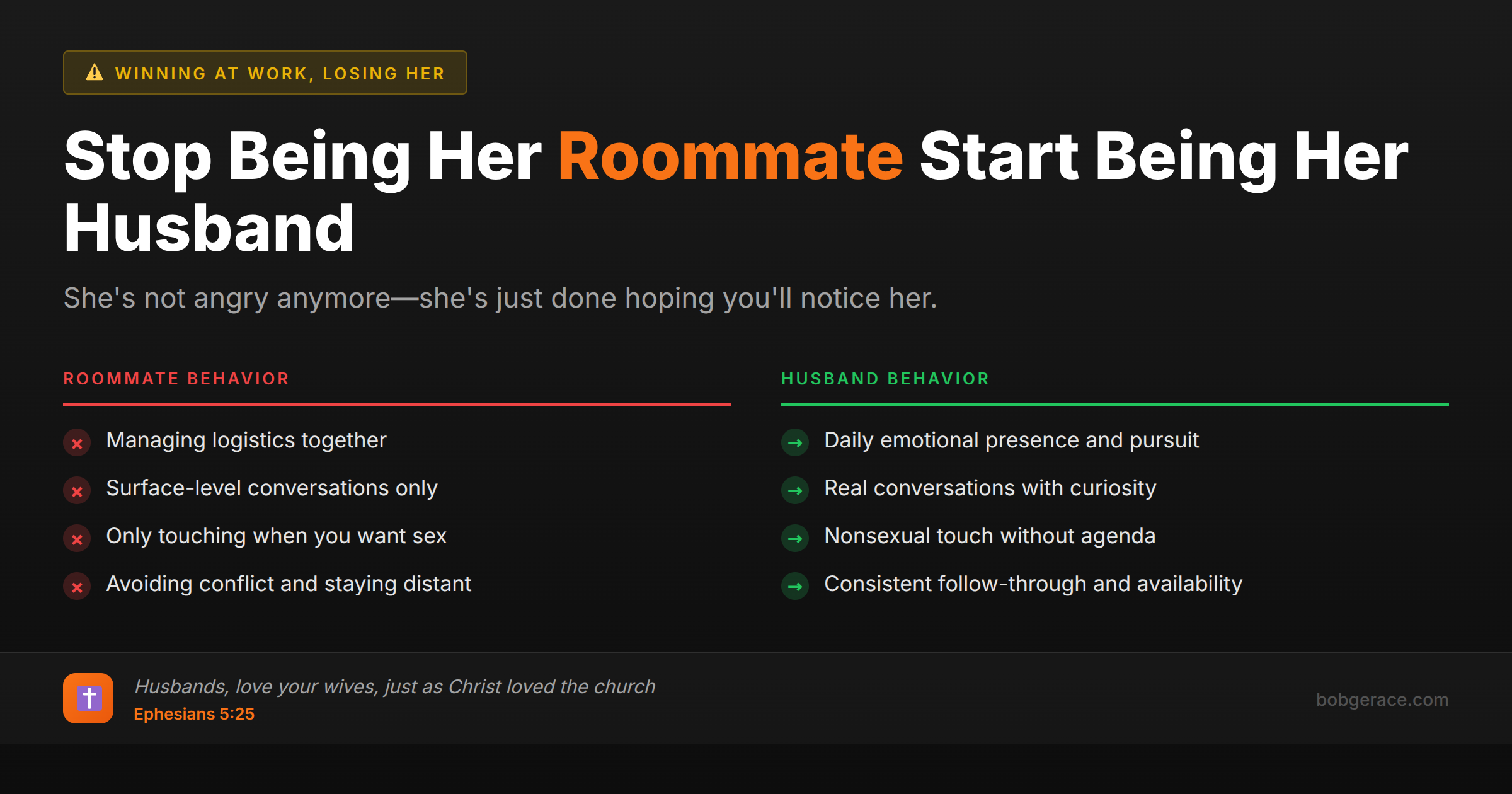
You become her husband again by rebuilding emotional presence, not just physical proximity. Roommate marriages happen when she stops expecting you to notice her, respond to her, or pursue her emotionally. You're managing logistics together—kids, bills, schedules—but the relational connection has flatlined. She's not angry anymore. She's just done hoping. This didn't happen overnight. It built slowly as you prioritized work, avoided conflict, stayed surface-level, or only touched her when you wanted sex. She adapted by becoming independent. Now you need to re-enter her world with consistency, curiosity, emotional availability, and follow-through. Not grand gestures. Daily presence.
What Roommate Marriage Actually Looks Like
Roommate marriage is not about lack of sex, though that's often a symptom. It's about emotional flatline. You live together. You coordinate. You function. But there's no pursuit, no curiosity, no emotional risk. She doesn't tell you about her day because you've proven you won't really listen. You don't initiate meaningful conversation because it feels awkward or you don't know what to say. Affection has become transactional or nonexistent. Touch only happens when you want something.
She used to complain. She used to ask for more. Now she's quiet. That's not peace—it's resignation. She's built a life that doesn't require your emotional participation. She has her friends, her routines, her coping mechanisms. You have your work, your hobbies, your phone. You pass each other in the hallway. You sleep in the same bed but live in different worlds.
This often happens to high-performing men who are crushing it at work but coasting at home. You're solving problems all day, leading teams, closing deals. You come home depleted and expect home to be low-effort. But she's not your employee or your project. She's your wife, and she's starving for emotional connection. The distance didn't start with her. It started when you stopped showing up emotionally, and she stopped believing you would.
Why Indifference Is More Dangerous Than Anger
From an attachment perspective, roommate marriage is avoidant-avoidant collapse or anxious-avoidant shutdown. If she was anxiously attached, she used to protest—complain, pursue, ask for more. When that didn't work, she moved into deactivation. She stopped expecting. That's not healing. That's hopelessness. If you're avoidantly attached, you've been in shutdown mode for years, mistaking emotional distance for peace.
Neurobiologically, her nervous system has learned that you are not a safe place to land. She doesn't come to you when she's stressed, hurt, or excited because past experience taught her you won't attune. You'll fix, minimize, or zone out. So she regulates elsewhere—friends, work, kids, wine, social media. Her system has adapted to your absence. That adaptation feels like independence, but it's actually protective detachment.
Resentment is the silent killer here. She's not keeping a list of your failures in her head to punish you. Resentment is what happens when repeated bids for connection go unanswered. Every time she tried to share and you stayed on your phone. Every time she asked for help and you said you were busy. Every time she wanted to be seen and you looked past her. The resentment didn't build because you're a bad guy. It built because she kept hoping and you kept missing her.
The good news: if she's still there, the bond isn't dead. But you're on borrowed time. Indifference is the last stop before she starts imagining life without you.
Husbands, Love Your Wives—Not Just Provide for Them
Ephesians 5:25 says, "Husbands, love your wives, just as Christ loved the church and gave himself up for her." You've probably heard that verse used to talk about sacrifice. But notice: Christ didn't just die for the church. He pursued her. He knows her. He speaks to her. He's present with her. Loving your wife like Christ means more than working hard and staying faithful. It means emotional presence, pursuit, and attentiveness.
Proverbs 5:18 says, "Rejoice in the wife of your youth." Not just stay married to her. Rejoice in her. Delight in her. Pursue her. You can be legally married and functionally abandoned. God's design for marriage is covenant intimacy—one flesh, emotionally and physically. Roommate marriage is a violation of that design, even if you're both still under the same roof.
Matthew 22:37-39 calls us to love God and love others. Your wife is not just "others"—she's your closest neighbor, your covenant partner, your one-flesh union. If you're pouring yourself out at work and showing up at home as a shell, you're not loving her. You're using her as infrastructure for your life. That's not biblical manhood. That's selfish comfort disguised as responsibility.
God calls you to lead your home, and leadership starts with presence. You can't lead someone you don't know. You can't love someone you're avoiding.
Action Steps
-
1
Initiate one real conversation per day where you ask her a question and actually listen to the answer without fixing or dismissing.
-
2
Touch her nonsexually every day—hand on her back, kiss on the forehead, hug without agenda—to rebuild safe physical connection.
-
3
Identify one recurring task or responsibility she carries and take it off her plate without being asked or needing praise.
-
4
Apologize specifically for one way you've been emotionally absent, without defending yourself or expecting her to forgive you immediately.
-
5
Schedule a weekly check-in where you ask her how she's feeling about the marriage and listen without getting defensive or shutting down.
Related Questions
- What does roommate marriage mean?
- Why does she light up for everyone but me?
- What are the six-month warning signs before she leaves?
- How do I get out of roommate mode with my wife?
- How do I repair emotional neglect without overpromising?
- How do I tell the difference between her criticism and her pain?
Also find Bob on
Subscribe for weekly videos on Christian marriage.
You Can't Fix This Alone
Roommate marriage doesn't fix itself with date nights or apologies. It requires you to change how you show up emotionally, and that's hard to do without a guide. I help men rebuild presence, safety, and pursuit before it's too late.
Talk to Bob →