How do I repair emotional neglect without overpromising?
6 min read
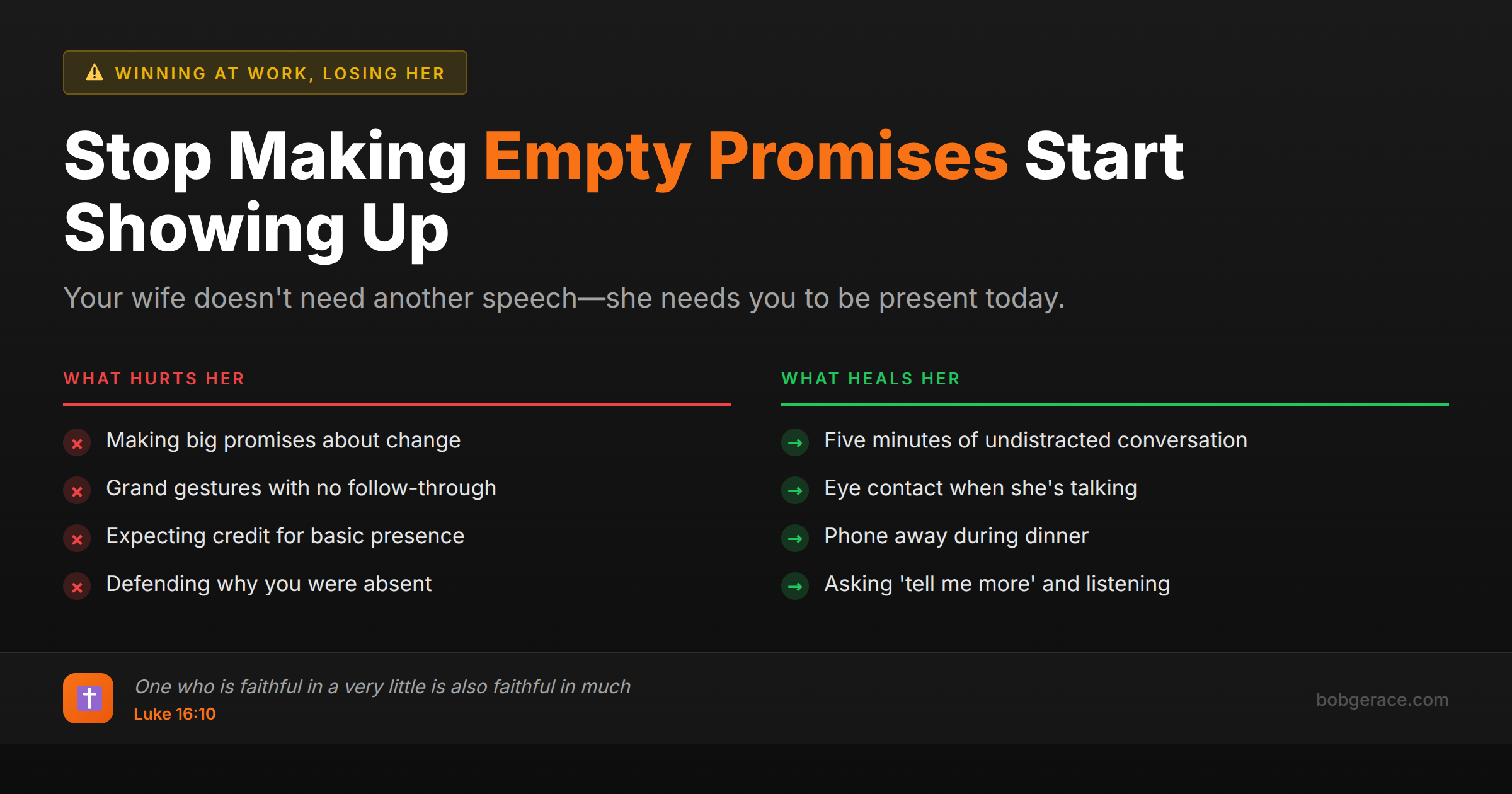
You repair emotional neglect by showing up consistently in small ways, not by making big promises you can't keep. Your wife doesn't need another speech about how things will be different. She needs you to be emotionally present today, tomorrow, and next week without fanfare or expectation of credit. Start with micro-commitments you can actually sustain: five minutes of undistracted conversation after work, eye contact when she talks, putting your phone away during dinner. The repair happens in repetition, not declaration. She's been hurt by your absence disguised as responsibility. More promises just add pressure and set up another cycle of disappointment. Instead, become a man who does what he says in the smallest things. Let her nervous system learn you're safe again through pattern, not performance.
The Pattern That Got You Here
Emotional neglect in marriage rarely announces itself. You didn't wake up one day and decide to abandon your wife emotionally. You built a career. You provided. You solved problems. You showed up to family events. From your perspective, you were doing what a man does—taking responsibility, carrying weight, making things work.
But she experienced something different. She experienced a man whose body was present but whose attention was always elsewhere. A man who touched her only when he wanted sex. A man who listened to her words but never asked about her heart. A man who could close a deal with full presence but couldn't stay in a conversation with her for ten minutes without checking his phone or solving her problem or changing the subject.
This is the gap that creates emotional neglect. You think you're being responsible. She feels invisible. You think you're providing stability. She feels alone in the marriage. You think you're avoiding drama by staying calm and logical. She feels like you don't care enough to feel anything about her pain. The neglect isn't in what you did wrong—it's in what you didn't do at all. You didn't attune. You didn't pursue. You didn't stay curious. You didn't let her matter enough to disrupt your equilibrium.
Now she's tired. Maybe she's told you. Maybe she's gone quiet. Maybe she's angry in ways that feel irrational to you. And your instinct is to fix it with a big promise: 'I'll change. I'll be better. I'll make this right.' But she's heard versions of that before, and it didn't hold. Overpromising is just another form of absence—it's you performing instead of being present.
Why Big Promises Backfire
When you overpromise, you're trying to manage her nervous system with your words. You want her to feel safe again, to stop being upset, to believe things will be different. But her nervous system doesn't trust words anymore. It trusts patterns. And the pattern she's learned is that you show up big when you're scared of losing her, then drift back to distraction once the crisis passes.
This is called intermittent reinforcement, and it's one of the most destabilizing relational dynamics. She gets just enough hope to stay, but not enough consistency to heal. Her attachment system stays activated—anxious, vigilant, scanning for signs that you're drifting again. She can't relax. She can't trust. And every time you make a big promise and then fail to sustain the small daily presence it requires, you deepen the wound.
Emotional neglect creates what trauma therapists call 'ambiguous loss.' She's married, but she's alone. You're there, but you're not available. Her nervous system is stuck in a chronic state of unmet need, and that produces resentment, shutdown, or hypervigilance. Overpromising adds another layer: now she has to manage her hope and brace for disappointment at the same time.
Repair requires something different. It requires you to become predictable in the smallest things. To let your nervous system regulate enough that you can stay present when she's upset instead of defending or fixing. To stop performing change and start living it in ways she can feel, not just hear.
Faithfulness in Little Things
Jesus said, 'One who is faithful in a very little is also faithful in much' (Luke 16:10). This isn't just about money or ministry. It's about the character of a man who does what he says, even when no one's watching, even when it's not impressive.
Your wife doesn't need a grand gesture. She needs a faithful man. Faithfulness isn't a one-time decision. It's a daily posture. It's putting your phone down when she walks in the room. It's asking how she's doing and actually waiting for the answer. It's remembering what she told you yesterday and bringing it up today. It's staying in the room when she's upset instead of escaping to work or the gym or your phone.
Proverbs 25:19 says, 'Trusting in a treacherous man in time of trouble is like a bad tooth or a foot that slips.' Overpromising makes you treacherous—not because you're malicious, but because you're unreliable. Your wife's trust has been worn down by years of small absences. You rebuild it with small acts of presence, repeated until they become the new pattern.
God doesn't call you to be perfect. He calls you to be faithful. And faithfulness in marriage looks like showing up today, and tomorrow, and the day after that, without needing credit or applause. It looks like dying to the part of you that wants to fix everything with one big move, and learning to love her in the unimpressive, daily, consistent ways that actually heal.
Action Steps
-
1
Stop making promises about the future. Instead, tell her one small thing you'll do today—then do it without reminding her you did it.
-
2
Identify one daily moment where you're physically present but emotionally absent (dinner, bedtime, morning). Commit to being fully present in that moment for two weeks.
-
3
When she shares something hard, resist the urge to fix or defend. Say, 'Tell me more,' and stay in the conversation for five minutes without offering solutions.
-
4
Put your phone in another room during your first 30 minutes home from work. Let your nervous system downshift before you engage with her.
-
5
At the end of each day, ask yourself: 'Did I show up today in a way she could feel?' Track it privately. Let the pattern build before you talk about it.
Related Questions
- How can my wife feel neglected when I work so hard for her?
- How do I know if I am an emotionally unavailable husband?
- Why does my success not make her feel secure?
- What is emotional neglect in marriage?
- What if I am great under pressure at work but shut down at home?
- Why does working hard feel like rejection to my wife?
Also find Bob on
Subscribe for weekly videos on Christian marriage.
You Don't Have to Figure This Out Alone
Repairing emotional neglect requires more than good intentions—it requires a clear plan and someone who can see your blind spots. I work with men who are ready to stop performing change and start living it.
Talk to Bob →