What if I am great under pressure at work but shut down at home?
5 min read
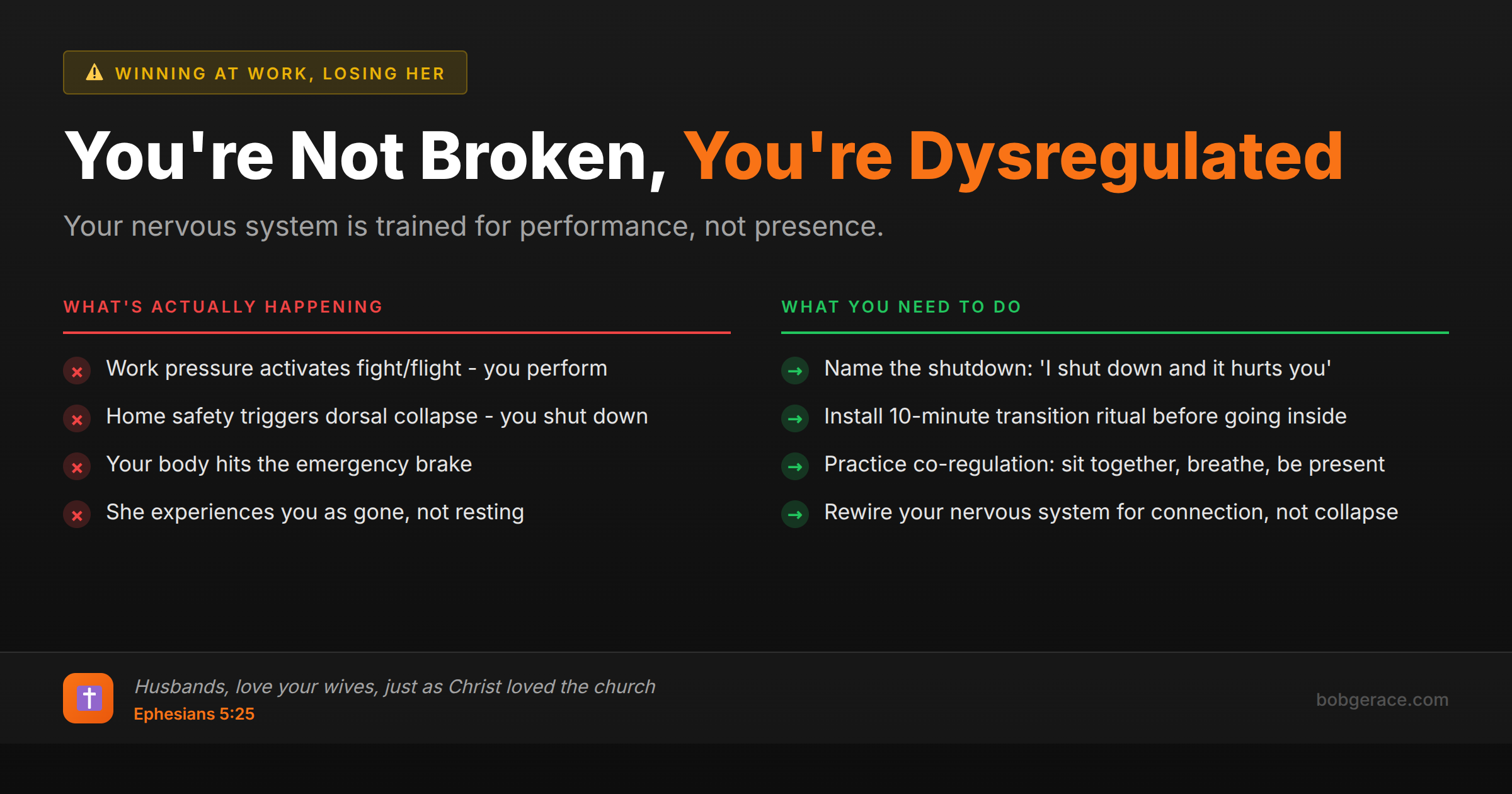
You are not broken. You are dysregulated. At work, pressure activates your sympathetic nervous system—fight or flight—and you perform. At home, your nervous system tries to recover, but instead of rest, you collapse into shutdown. That is dorsal vagal collapse: your body's emergency brake when it cannot fight and will not flee. Your wife does not experience you as resting. She experiences you as gone. This is not about effort or intention. It is about nervous system capacity. You have trained yourself to perform under threat and numb under safety. Your wife is not a threat, so your system disengages. She feels your absence as rejection. You feel her frustration as pressure. The loop tightens. This pattern will not fix itself with willpower. It requires nervous system rewiring and relational re-engagement.
The Full Picture: Why High Performers Collapse at Home
You close deals under deadline. You lead through chaos. You solve problems other men cannot touch. Then you walk through your front door and feel nothing. Not peace—numbness. Your wife asks how your day was, and the question feels like an interrogation. She reaches for connection, and your body treats it like one more demand.
This is not laziness. This is nervous system depletion. Your work environment keeps you in sympathetic activation—elevated heart rate, cortisol, adrenaline, sharp focus. You have become excellent at operating in that state. But you never learned to downregulate into calm, connected presence. So when the pressure drops, your system does not rest. It shuts down.
Your wife does not see a man recovering. She sees a man who is animated, engaged, and alive for everyone else—then flat, distracted, and defended with her. She does not feel chosen. She feels like the place you go to disappear. Over time, she stops reaching. She interprets your shutdown as disinterest, and her withdrawal feels like rejection to you. Now you are both alone.
Meanwhile, you are confused. You are working hard for her. You are not yelling, cheating, or abandoning the family. You are present—physically. But presence without emotional availability is not intimacy. It is cohabitation. And cohabitation does not sustain a marriage.
Clinical Insight: Shutdown Is Not Rest
Polyvagal theory explains this clearly. Your autonomic nervous system has three states: sympathetic (fight/flight), ventral vagal (safe and social), and dorsal vagal (shutdown/collapse). High performers spend most of their day in sympathetic activation. You are not wired to drop from sympathetic into ventral vagal rest. You drop into dorsal vagal shutdown.
Shutdown looks like scrolling, zoning out, short answers, physical presence with emotional absence. It is not intentional. It is automatic. Your nervous system is trying to protect you from overwhelm by pulling you offline. The problem is that your wife experiences this as emotional abandonment.
She is not overreacting. Attachment research shows that emotional unavailability creates the same neural pain response as physical injury. When you are unreachable, her nervous system registers threat. She may pursue you with questions, criticism, or requests for connection. That pursuit feels like pressure to you, which drives you deeper into shutdown. This is the pursue-withdraw cycle, and it is one of the strongest predictors of divorce.
You are not a bad man. You are a dysregulated man. The skills that make you successful at work—compartmentalization, emotional control, relentless focus—become liabilities at home. Your wife does not need you to perform. She needs you to be present. That requires a different nervous system state, and you have not trained for it.
Biblical Framework: Presence Is a Covenant Responsibility
Ephesians 5:25 says, "Husbands, love your wives, just as Christ loved the church and gave himself up for her." Giving yourself up is not just sacrifice. It is presence. Christ did not love the church from a distance. He entered in. He was fully present, fully engaged, fully available.
You cannot love your wife while emotionally checked out. Provision is part of love, but it is not the whole of it. Proverbs 5:18-19 calls you to rejoice in the wife of your youth, to be intoxicated with her love. That is not shutdown language. That is full-body, full-heart engagement.
Many Christian men reduce their role to provider and protector, then wonder why their wife feels alone. But 1 Peter 3:7 commands you to live with your wife in an understanding way, honoring her as a fellow heir of grace. Understanding requires attention. Honor requires presence. You cannot understand a woman you are not emotionally available to.
God designed marriage as a picture of Christ and the church. Christ is not emotionally unavailable. He is near to the brokenhearted. He does not shut down under pressure. He engages. Your shutdown is not a character flaw, but it is a discipleship issue. You are called to grow in your capacity to be present, and that growth is part of your sanctification as a husband.
Action Steps
-
1
Name your shutdown out loud to your wife: 'I shut down at home, and I know that hurts you. I am working on it.' No defense, no explanation. Just acknowledgment.
-
2
Install a 10-minute transition ritual when you get home: sit in your car, take five deep breaths, pray, or walk around the block. Do not go straight from work mode to home mode.
-
3
Practice co-regulation with your wife: sit together for five minutes without phones, hold her hand, breathe together. Do not talk. Just be present in your body with her.
-
4
Track your nervous system states in a notes app: write 'sympathetic,' 'shutdown,' or 'calm' three times a day. Awareness precedes change.
-
5
Work with a coach or therapist trained in somatic or polyvagal work. This is not a mindset problem. It is a nervous system problem, and it requires nervous system tools.
Related Questions
Also find Bob on
Subscribe for weekly videos on Christian marriage.
You Can Learn to Be Present
Shutdown is not permanent. It is a pattern, and patterns can change. I help men rewire their nervous systems and rebuild emotional availability without losing their edge at work.
Talk to Bob →