Why does working hard feel like rejection to my wife?
5 min read
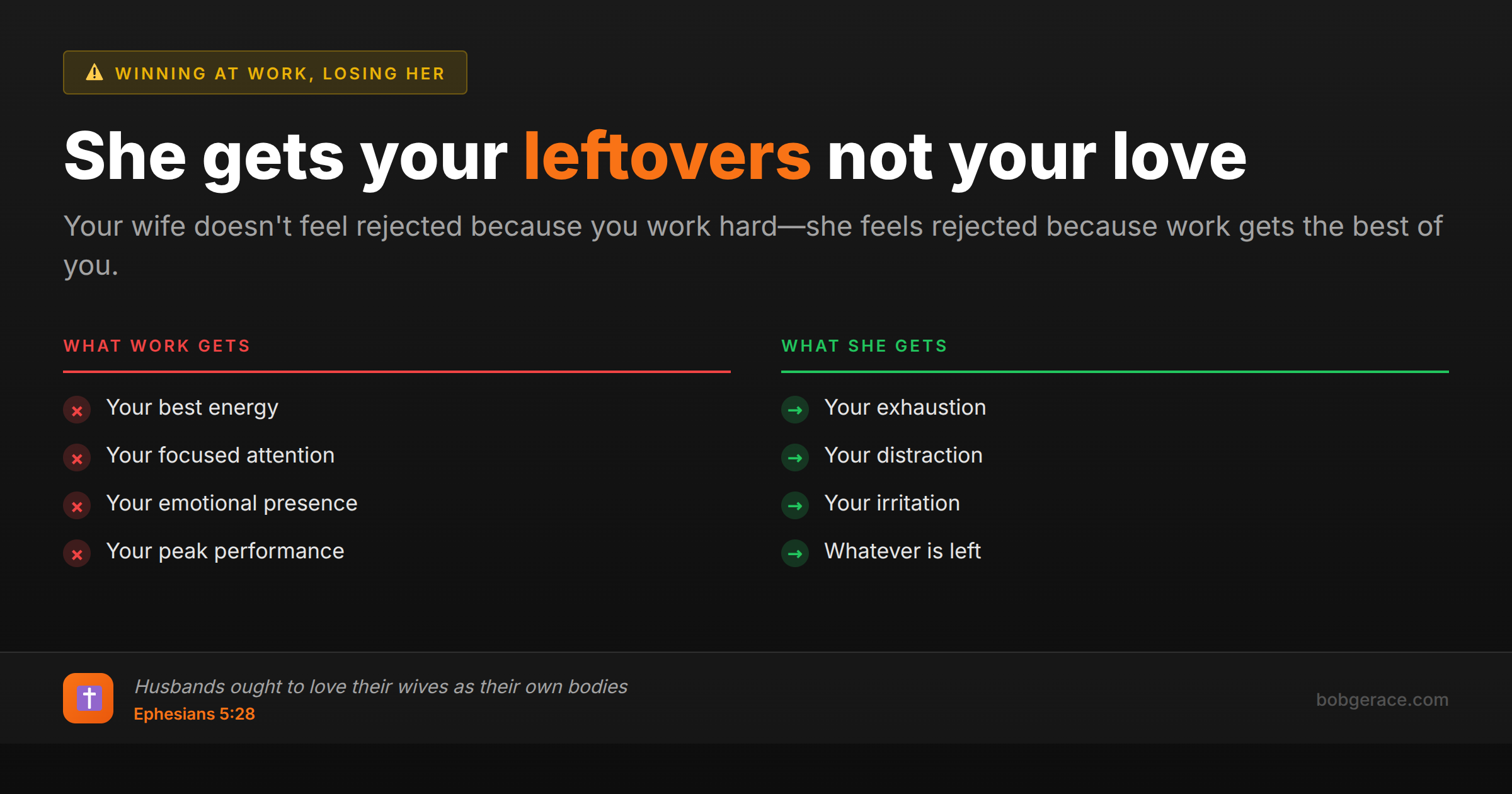
Your wife does not feel rejected because you work hard. She feels rejected because your work gets the best of you, and she gets what is left. You give your attention, energy, focus, and emotional presence to your career. She gets your exhaustion, distraction, and irritation. She does not doubt your effort. She doubts whether she matters to you as much as your work does. This is not about hours. It is about priority. You can work 60 hours a week and still make your wife feel chosen, or you can work 40 and make her feel invisible. The issue is not your workload. It is where your heart is engaged. She feels the difference between a man who works for his family and a man who hides in his work. Right now, she is not sure which one you are.
The Full Picture: Provision Without Presence Is Abandonment
You are not lazy. You are not selfish. You are grinding to build a life, provide security, and create opportunity. You believe your work is an act of love. And in one sense, it is. But your wife does not experience it that way. She experiences it as competition—and she is losing.
She sees you come alive in work conversations. She watches you solve problems, lead teams, close deals. She knows you have energy, focus, and creativity. Then you come home, and she gets silence, scrolling, and one-word answers. She does not feel like your partner. She feels like your roommate, your assistant, or the person who manages the life you are too busy to live.
Over time, she stops asking for your attention. She stops initiating conversation. She stops reaching for you physically. Not because she stopped loving you—because she is tired of feeling like a burden. You interpret her withdrawal as contentment or independence. It is not. It is resignation. She has decided that you have already chosen, and it was not her.
Meanwhile, you feel misunderstood. You are working for her. You are sacrificing for the family. You are doing what men are supposed to do. But sacrifice without connection is not intimacy. It is transaction. And transactional marriages do not survive. Your wife does not want your money. She wants you.
Clinical Insight: The Provider Trap and Avoidant Attachment
Many high-performing men fall into what I call the provider trap. You equate your value with your productivity. You believe that if you work hard enough, provide well enough, and solve enough problems, your wife will feel loved. But love is not a problem you solve. It is a presence you offer.
This pattern often has roots in avoidant attachment. Avoidantly attached men learned early that emotional needs are inconvenient, that self-reliance is safety, and that performance earns approval. Work becomes your primary attachment relationship because it is predictable, controllable, and rewarding. Your wife is not. She has needs you cannot fix, emotions you cannot manage, and expectations that feel like criticism.
So you retreat into work. It feels noble because you are providing. But emotionally, it is avoidance. You are using work to regulate your nervous system and escape the discomfort of intimacy. Your wife feels this. She does not experience your work as sacrifice. She experiences it as rejection.
Research on marital satisfaction shows that emotional availability predicts relationship health far more than financial provision. Your wife can respect your work ethic and still feel abandoned by you. The two are not contradictory. She is not asking you to quit your job. She is asking you to stop hiding in it.
Biblical Framework: You Are Called to More Than Provision
First Timothy 5:8 says, "If anyone does not provide for his relatives, and especially for members of his household, he has denied the faith and is worse than an unbeliever." Provision matters. But provision is the floor, not the ceiling. You are called to more than financial responsibility.
Ephesians 5:28-29 says, "Husbands ought to love their wives as their own bodies. He who loves his wife loves himself. For no one ever hated his own flesh, but nourishes and cherishes it." Nourish and cherish are not paycheck words. They are presence words. They require attention, affection, and emotional engagement.
Jesus worked. He had a mission. He carried the weight of the world. But He was never too busy for people. He noticed the woman in the crowd. He stopped for the blind man. He made time for children. He was fully present with those He loved, even under pressure. That is your model.
Many Christian men hide behind provision as if it were the whole of their calling. It is not. Colossians 3:19 says, "Husbands, love your wives, and do not be harsh with them." Harshness is not just anger. It is also absence. It is giving your best to your work and your leftovers to your wife. That is not biblical manhood. That is emotional neglect dressed up as responsibility.
Action Steps
-
1
Ask your wife this question and listen without defending: 'Do you feel like you matter to me as much as my work does?' Let her answer fully. Do not explain. Just listen.
-
2
Set one non-negotiable evening per week where work is off-limits—no laptop, no phone calls, no email. Protect that time like you would a board meeting.
-
3
When you get home, give your wife 10 minutes of undivided attention before you do anything else. No phone. No TV. Just her.
-
4
Identify one way you are using work to avoid emotional discomfort at home. Write it down. Confess it to a trusted friend or coach.
-
5
Schedule a weekly check-in with your wife where you ask, 'How did you feel about us this week?' and 'What is one thing I could do to help you feel more connected to me?'
Related Questions
- I make six figures, so why is my wife still unhappy?
- Am I a workaholic husband or just a responsible provider?
- Can a good provider still be an emotionally unavailable husband?
- Why do successful men miss the warning signs at home?
- Why did my wife stop telling me things?
- How do I slow down without losing my edge?
Also find Bob on
Subscribe for weekly videos on Christian marriage.
Provision Is Not Enough
You can be a great provider and still lose your wife. I help men break the provider trap and rebuild intimacy without sacrificing their career.
Talk to Bob →