How do I tell the difference between her criticism and her pain?
6 min read
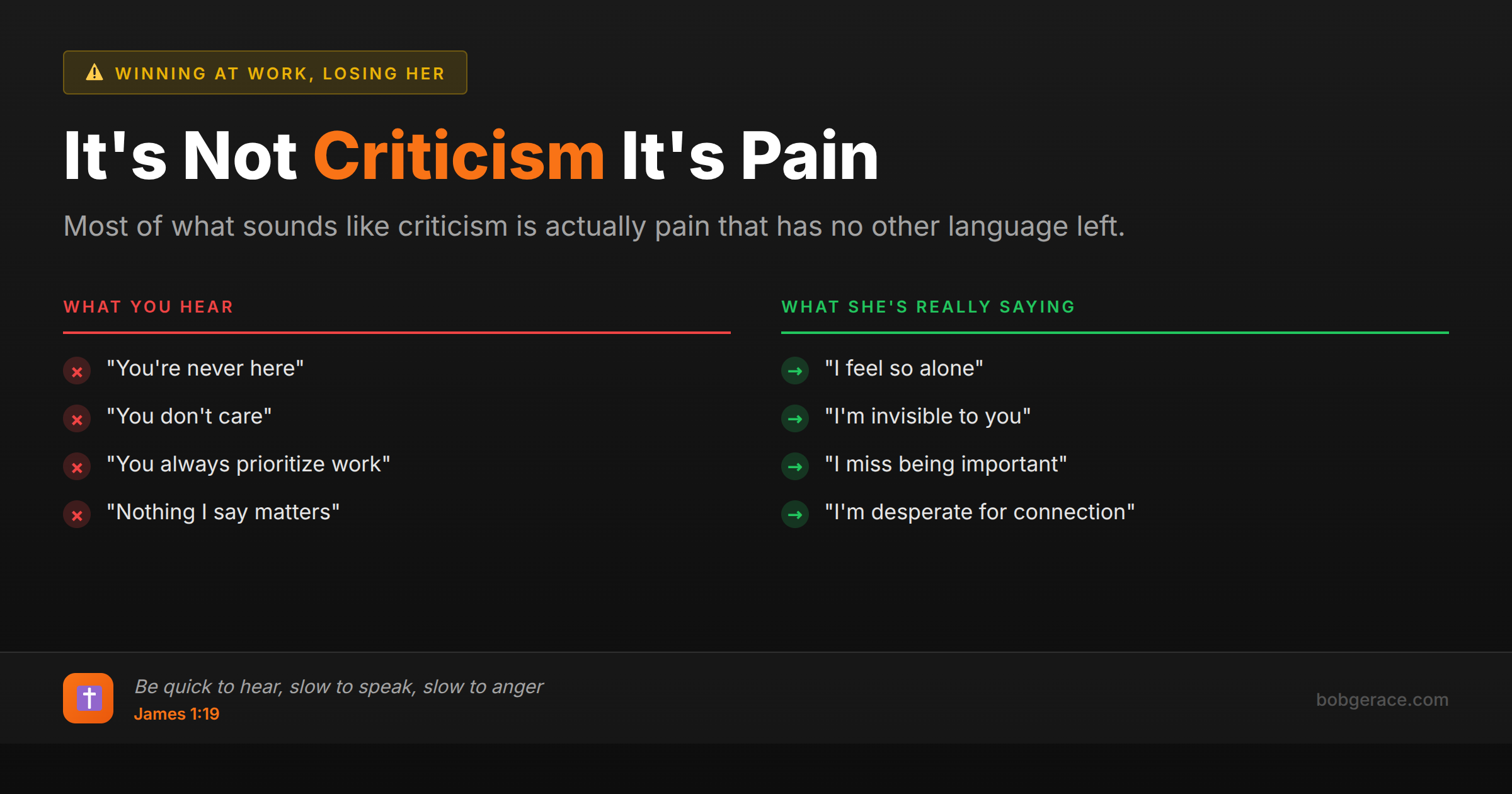
Most of what sounds like criticism is actually pain that has no other language left. When your wife says, 'You're never here,' she's not writing a performance review. She's telling you she feels alone. When she says, 'You don't care,' she's not attacking your character. She's describing her lived experience of emotional absence. The difference between criticism and pain is not in her words—it's in whether you can hear the longing underneath the frustration. You tell the difference by getting curious instead of defensive. Ask yourself: what would make her say this? What has she been feeling that I haven't noticed? What need has gone unmet long enough that it's coming out as anger? Her tone may be sharp, but the content is almost always about disconnection, invisibility, or loneliness. If you can hear that, you can respond to her heart instead of reacting to her words.
Why Her Pain Sounds Like Criticism
Your wife didn't start out critical. Early in your marriage, she probably asked for what she needed directly. She said, 'Can we talk tonight?' or 'I miss you,' or 'I need you to be more present.' And maybe you said yes but didn't follow through. Or you got defensive. Or you listened but didn't change. Over time, her requests turned into complaints. Her complaints turned into criticism. And her criticism turned into contempt or silence.
This is the predictable progression of unmet emotional need in marriage. She doesn't want to be the nagging wife. She doesn't enjoy feeling angry or disappointed. But when a woman feels emotionally neglected long enough, her pain has to go somewhere. It either comes out as anger, or it goes inward as depression and shutdown. Most of the time, anger is actually the healthier option—it means she still cares enough to fight for the marriage.
But here's what happens on your side. You hear her words as an attack on your character. 'You never listen' sounds like she's calling you a bad husband. 'You only touch me when you want sex' sounds like she's accusing you of being selfish. 'You care more about work than me' sounds like she doesn't respect what you do to provide. So you defend yourself. You list all the things you do. You explain why she's wrong. You shut down or walk away.
And in that moment, you prove her point. She's trying to tell you she feels unseen, and you respond by not seeing her. She's trying to tell you she feels unheard, and you respond by not hearing her. The content of her criticism is almost always about emotional disconnection. And your defensiveness deepens that disconnection.
The Protest Behavior Underneath Criticism
In attachment theory, criticism is what's called a 'protest behavior.' It's not the primary emotion—it's a secondary reaction to a primary need that isn't being met. The primary need is connection, safety, attunement, presence. When that need goes unmet, the nervous system protests. In adults, that protest often looks like anger, criticism, or blame.
Your wife's criticism is her attachment system trying to get your attention. It's saying, 'I'm here, I'm hurting, I need you to notice.' The problem is that protest behaviors trigger your own nervous system. You hear her tone, and your body reads it as threat. Your sympathetic nervous system activates. You go into fight (defend, counterattack) or flight (shut down, leave the room). Either way, you're not present. You're in survival mode.
This is the cycle that keeps you stuck. Her pain comes out as criticism. Your defensiveness confirms that you're not safe to be vulnerable with. She escalates or shuts down. You feel like nothing you do is good enough. The real issue—emotional disconnection—never gets addressed because you're both reacting instead of responding.
To break the cycle, you have to learn to regulate your own nervous system enough to stay present when she's upset. That doesn't mean you accept verbal abuse or contempt. It means you stop treating her pain as an attack and start treating it as information. She's telling you something important about her experience. If you can hear it without defending, you can actually respond to what she needs instead of what she said.
Listening Like Christ Listens
James 1:19 says, 'Let every person be quick to hear, slow to speak, slow to anger.' This is not just good advice—it's a description of how God listens to us. He doesn't get defensive when we cry out in pain. He doesn't correct our theology when we're hurting. He doesn't explain why we're wrong to feel what we feel. He listens. He draws near. He makes space for our pain.
Your wife needs you to listen like that. Not to fix her. Not to defend yourself. Not to explain why her perception is inaccurate. Just to hear her. Proverbs 18:13 says, 'If one gives an answer before he hears, it is his folly and shame.' Most of the time, you're answering before you've actually heard what she's trying to say underneath the words.
When Jesus encountered people in pain, He asked questions. 'What do you want me to do for you?' (Mark 10:51). He already knew the answer, but He made space for them to be seen and heard. That's what your wife needs. She needs you to be curious about her pain instead of defensive about your performance.
Ephesians 5 tells husbands to love their wives as Christ loved the church. Christ didn't love the church by defending Himself when she was messy or angry or confused. He gave Himself up for her. He made Himself present to her pain. That's the model. You don't have to agree with everything she says. But you do have to care enough to hear the hurt underneath the words and respond to that instead of the tone.
Action Steps
-
1
Next time she criticizes you, pause and ask yourself: 'What pain is she trying to express?' Don't answer out loud yet—just get curious internally.
-
2
Reflect back what you hear underneath her words: 'It sounds like you've been feeling really alone. Is that right?' Let her correct you if you're wrong.
-
3
Resist the urge to defend or explain for 60 seconds. Just listen. Breathe. Let her finish. Your defense can wait—her pain can't.
-
4
Write down the three criticisms you hear most often from her. Ask yourself: what unmet need is each one pointing to? Bring that list to a conversation with a coach or mentor.
-
5
Practice this sentence: 'I hear you. That makes sense. Tell me more.' Use it even when you don't fully agree. It buys you time to regulate and actually understand her.
Related Questions
- How can my wife feel neglected when I work so hard for her?
- How do I know if I am an emotionally unavailable husband?
- Why does my success not make her feel secure?
- What is emotional neglect in marriage?
- Why does working hard feel like rejection to my wife?
- How do I know if I am too busy for my wife?
Also find Bob on
Subscribe for weekly videos on Christian marriage.
Learn to Hear What She's Really Saying
Most men don't need to be told they're defensive—they need help learning how to stay present when their wife is in pain. That's exactly what I help men do.
Talk to Bob →