What does roommate marriage mean?
6 min read
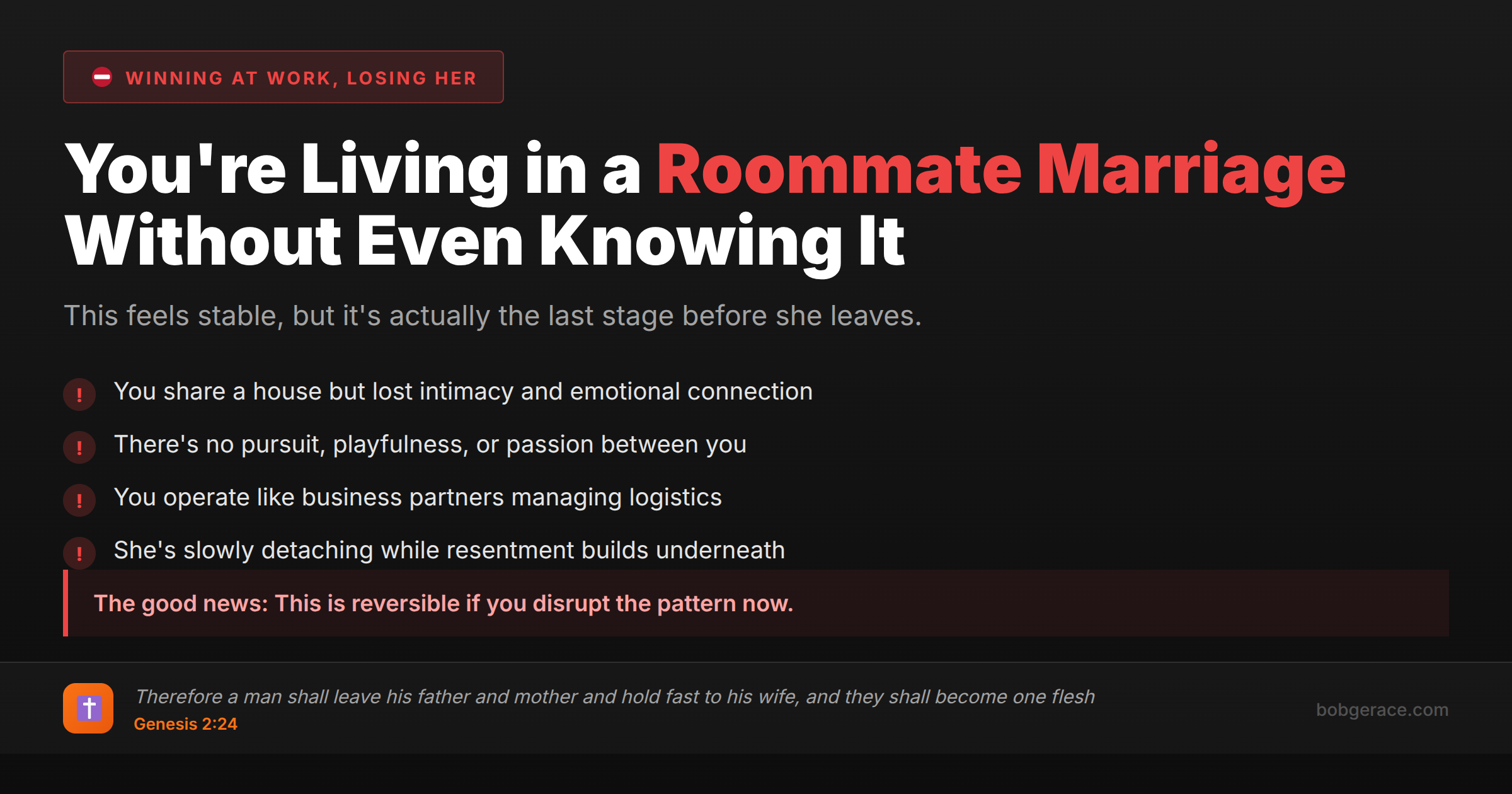
Roommate marriage means you and your wife share a home, manage logistics, and co-parent—but you've lost intimacy, affection, and emotional connection. You're civil. You're functional. But you're not close. There's no pursuit, no playfulness, no passion. You operate like business partners or housemates, not husband and wife. This stage is dangerous because it feels stable. There's no fighting, no drama, no crisis—so you assume everything's fine. But underneath the calm, resentment builds, hope fades, and your wife slowly detaches. Roommate marriage is often the last stage before separation, affair, or her telling you she's done. The good news: it's one of the most reversible stages if you're willing to disrupt the pattern now.
The Quiet Drift Into Roommate Marriage
Roommate marriage doesn't happen overnight. It's the result of a thousand small withdrawals. You stop kissing her when you leave for work. She stops asking about your day. You have sex occasionally, but it's mechanical—more release than connection. You talk about the kids, the schedule, the bills. But you don't talk about each other.
You're polite. You're cooperative. You're not mean. But you're also not present. You don't flirt. You don't pursue. You don't initiate non-sexual touch. You don't ask her how she's really doing or what she's feeling. And she's stopped asking you. She's stopped expecting you to notice her, to see her, to want her beyond what she does for the household.
From the outside, your marriage looks fine. You're not screaming at each other. You're not in crisis. But inside the house, there's a quiet, suffocating loneliness. Your wife feels more like a co-manager than a lover. You feel more like a provider than a husband. You're living parallel lives under the same roof.
Many men don't realize they're in a roommate marriage until their wife says, 'I love you, but I'm not in love with you,' or 'I've been unhappy for years.' That's when you look back and see the signs were everywhere: the separate bedrooms, the lack of laughter, the way she stopped complaining because she stopped expecting you to change. Indifference replaced anger. And indifference is far more dangerous.
Why Roommate Marriage Feels Safe but Isn't
Roommate marriage often develops as a mutual avoidance strategy. Both of you have learned that emotional engagement leads to conflict, disappointment, or feeling unseen—so you stop engaging. You retreat into roles: provider, manager, parent. The roles are clear, the expectations are low, and the system is stable. But stability isn't intimacy.
From a nervous system perspective, roommate marriage is a form of chronic dorsal vagal shutdown. You're not in active conflict (sympathetic), but you're also not in connection (ventral vagal). You're in a low-energy, emotionally flatlined state. It feels calm, but it's the calm of disengagement, not safety. Your wife's nervous system has learned that reaching for you leads to disappointment, so she stops reaching. Your system has learned that her needs feel like criticism, so you stop responding.
Attachment theory explains the drift. If you're avoidant, you experience relief when she stops pursuing—finally, space. If she's anxious, she eventually burns out from unreciprocated bids for connection and shifts into avoidant behavior herself. You both become avoidant, and the marriage becomes a low-conflict, low-connection arrangement.
The danger is that this stage feels sustainable. There's no crisis forcing change. But underneath, resentment accumulates. Your wife is often six months to two years ahead of you emotionally. She's been grieving the marriage while you've been assuming it's fine. By the time she tells you she's done, she's often already detached. That's why early intervention matters.
Marriage Is Covenant, Not Convenience
God designed marriage as a one-flesh union (Genesis 2:24)—not a one-roof arrangement. One flesh means intimacy, vulnerability, knowing and being known. It means your lives are woven together, not just running parallel. Roommate marriage is a functional arrangement that misses the entire purpose of covenant.
Ecclesiastes 4:9-12 says, 'Two are better than one... if either of them falls down, one can help the other up.' That assumes presence. It assumes you're close enough to notice when she's struggling, to reach for her when she's down, to be affected by her pain. You can't help someone up if you're in a different room, emotionally speaking.
Paul's command in Ephesians 5 to love your wife as Christ loved the church assumes active, sacrificial pursuit. Christ didn't maintain a polite distance from the church. He entered into her mess, pursued her heart, gave Himself fully. Roommate marriage is the opposite: it's self-protection disguised as peace.
Proverbs 5:18-19 celebrates delight in your wife—not just duty. 'Rejoice in the wife of your youth... may her breasts satisfy you always, may you ever be intoxicated with her love.' That's not roommate language. That's passion, pursuit, presence. If your marriage has become a logistics operation, you've lost the heart of what God intended.
Action Steps
-
1
Ask your wife: 'Do you feel like we're roommates or lovers?' Then listen to her answer without defending or explaining.
-
2
Identify three small daily connection points you've lost—morning kiss, asking about her day, non-sexual touch—and reinstate one this week.
-
3
Schedule a weekly 30-minute check-in where you talk about your marriage, not just logistics. Ask: 'How are we doing? What do you need from me?'
-
4
Notice when you default to logistics or problem-solving instead of emotional presence. Pause and ask her a feeling question: 'How did that make you feel?' or 'What was that like for you?'
-
5
Read 'The Meaning of Marriage' by Tim Keller or 'Hold Me Tight' by Sue Johnson to understand what covenant intimacy requires and how to rebuild it.
Related Questions
- Why does she light up for everyone but me?
- What are the six-month warning signs before she leaves?
- How do I become her husband again, not her roommate?
- How do I get out of roommate mode with my wife?
- How do I know if I am an emotionally unavailable husband?
- Am I a workaholic husband or just a responsible provider?
Also find Bob on
Subscribe for weekly videos on Christian marriage.
Don't Wait Until She's Done
Roommate marriage feels stable until it isn't. If you're sensing distance, indifference, or quiet resignation, that's your warning. Let's disrupt the pattern before she detaches completely.
Talk to Bob →