Can emotional neglect happen in a good-looking marriage?
6 min read
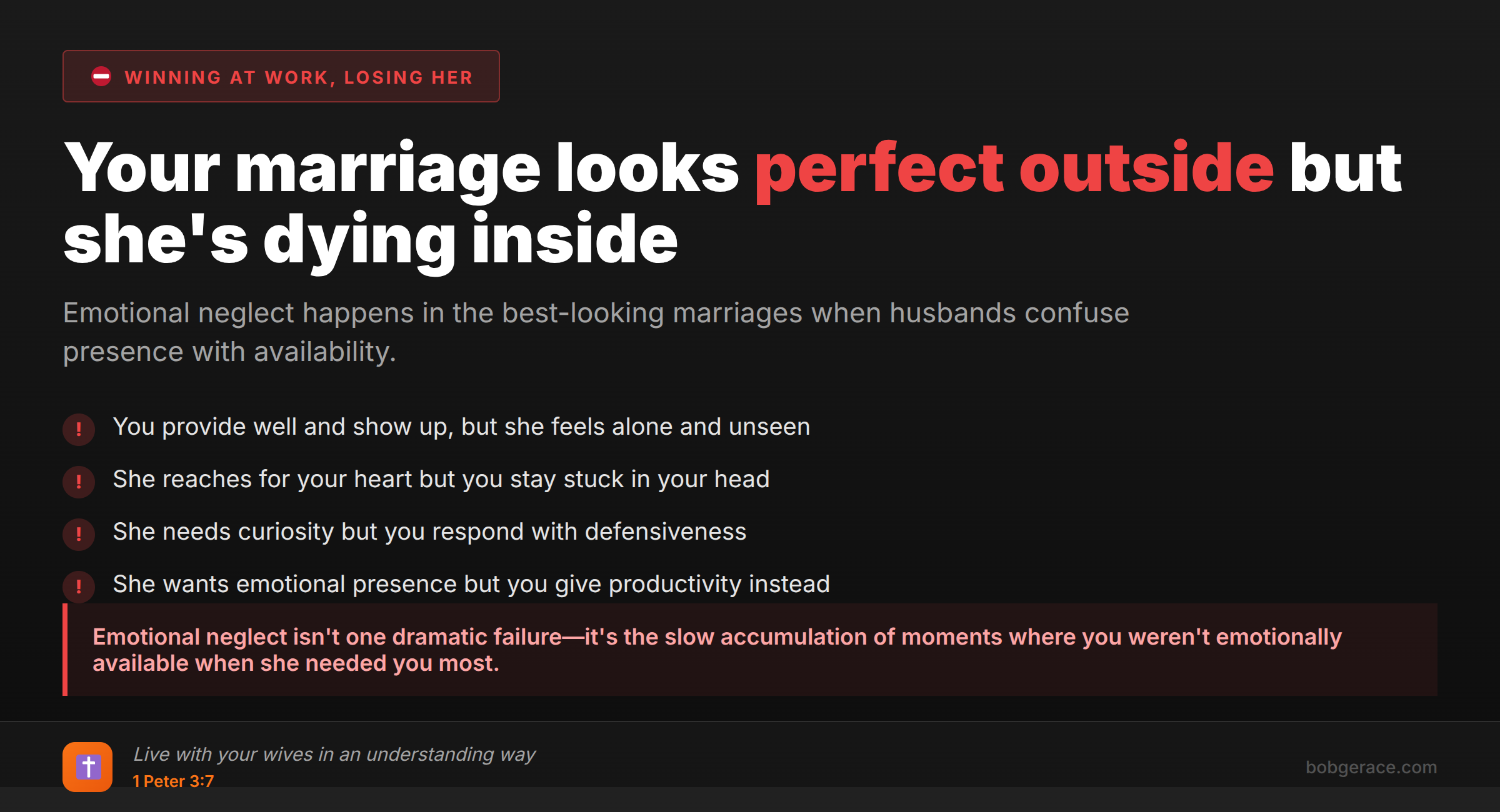
Yes. Emotional neglect happens all the time in marriages that look successful from the outside. You provide well. You are faithful. You show up to family events. You are not yelling or abusive. But your wife feels alone. She feels unseen. She feels like you are present in body but absent in heart. That is emotional neglect—not because you are doing something terrible, but because you are not doing the thing she needs most: being emotionally available. Emotional neglect is not one dramatic failure. It is the slow accumulation of moments where she reached for you and you were not there. She tried to share her heart and you stayed in your head. She needed you to be curious and you were defensive. She wanted presence and you gave productivity. Over time, she stops reaching. The marriage looks fine. You look fine. But she is dying inside, and you do not see it because you are measuring success by the wrong metrics.
What Emotional Neglect Looks Like in a 'Good' Marriage
Emotional neglect does not require a villain. It requires a man who is so focused on doing the right things that he misses the relational things. You work hard to provide. You are involved with the kids. You do not cheat. You do not rage. You show up. But when your wife tries to talk to you about how she feels, you fix it, minimize it, or change the subject. When she is upset, you problem-solve instead of sitting with her. When she reaches for affection, you are distracted, tired, or only responsive when you want sex.
She learns that you are available for logistics but not for her heart. You will discuss the budget, the schedule, the kids' school, the vacation plans. But when she says, 'I feel lonely,' you get defensive. When she says, 'I miss you,' you list everything you have done for her. When she says, 'I need you to just listen,' you explain why she should not feel that way. You are not trying to hurt her. You are trying to be reasonable. But reasonable is not the same as present.
From the outside, your marriage looks great. You have a nice house, good kids, no major scandals. Friends think you have it together. But inside, your wife is quietly suffocating. She has learned not to expect emotional intimacy from you. She has learned to get her emotional needs met elsewhere—friends, books, work, sometimes the fantasy of what it would be like to be with someone who actually sees her. The neglect is invisible to everyone, including you, until the day she says she is done.
The Nervous System Impact of Chronic Emotional Unavailability
Emotional neglect is a nervous system injury. When your wife consistently experiences you as unavailable, her brain begins to treat you as a source of stress rather than safety. She may still love you. She may still be committed. But her autonomic nervous system has learned that turning to you does not bring relief—it brings disappointment, defensiveness, or dismissal.
Over time, this creates what clinicians call 'ambivalent attachment' in the marriage. She wants to connect with you, but she also expects that connection will fail. So she oscillates between reaching for you and pulling away. You experience this as her being unpredictable or hard to please. She experiences it as trying to protect herself from the pain of being unseen again. Her nervous system is stuck in a loop: hope, reach, disappointment, withdraw, repeat.
The tragedy is that you often do not see yourself as emotionally unavailable. You see yourself as responsible, steady, reliable. And you are—on a task level. But emotional availability is not about tasks. It is about your capacity to be present with her feelings without needing to fix, defend, or escape. It is about your ability to tolerate her distress without making it about you. Most high-performing men have never developed this capacity because it was not required to succeed at work. But it is required to succeed in marriage, and the absence of it is a form of neglect, even if you never intended harm.
Dwelling with Your Wife in an Understanding Way
First Peter 3:7 tells husbands to live with their wives 'in an understanding way, showing honor to the woman as the weaker vessel, since they are heirs with you of the grace of life.' The phrase 'understanding way' is not about intellectual knowledge. It is about emotional attunement. It is about knowing her—not just what she does, but who she is, what she feels, what she needs.
Many Christian men read 'weaker vessel' and think it means their wife is fragile or less capable. That is not the point. The point is that she is different. She is wired for connection in ways you may not be. She experiences emotional absence as a form of abandonment, even if you are physically present. To dwell with her in an understanding way means you do not get to define what counts as presence. She does. If she says you are absent, you are absent—even if you think you are there.
Emotional neglect in a Christian marriage is especially painful because it is often wrapped in the language of biblical responsibility. You provide. You lead. You protect. But if you are leading without listening, providing without presence, protecting without tenderness, you are missing the heart of what God calls you to. Jesus did not lead from a distance. He was Emmanuel—God with us. He was present. He listened. He wept with those who wept. That is the model. Anything less, no matter how responsible it looks, is a failure to love your wife as Christ loved the church.
Action Steps
-
1
Ask your wife: 'On a scale of 1 to 10, how emotionally available do you experience me being?' Listen to her answer without defending or explaining.
-
2
Identify one recurring moment where she has tried to share her feelings and you have responded with logic, fixing, or defensiveness. Apologize for that pattern.
-
3
Practice this: When she shares something emotional, your only job is to say, 'Tell me more.' Do not fix. Do not solve. Just listen and stay curious.
-
4
Set a daily 15-minute window where you are fully present—no phone, no distractions, just you and her. Let her lead the conversation.
-
5
If you do not know how to be emotionally present, get help. This is a skill you can learn, but you cannot learn it alone. Find a coach or counselor who can teach you.
Related Questions
- How can my wife feel neglected when I work so hard for her?
- How do I know if I am an emotionally unavailable husband?
- Why does my success not make her feel secure?
- What is emotional neglect in marriage?
- Why do successful men miss the warning signs at home?
- What are the six-month warning signs before she leaves?
Also find Bob on
Subscribe for weekly videos on Christian marriage.
Learn to Be Present, Not Just Productive
If your wife says you are emotionally unavailable and you do not understand what that means, you are not alone. Bob teaches men how to show up emotionally without losing themselves. Let's talk.
Talk to Bob →