How do I become trustworthy after years of not showing up?
5 min read
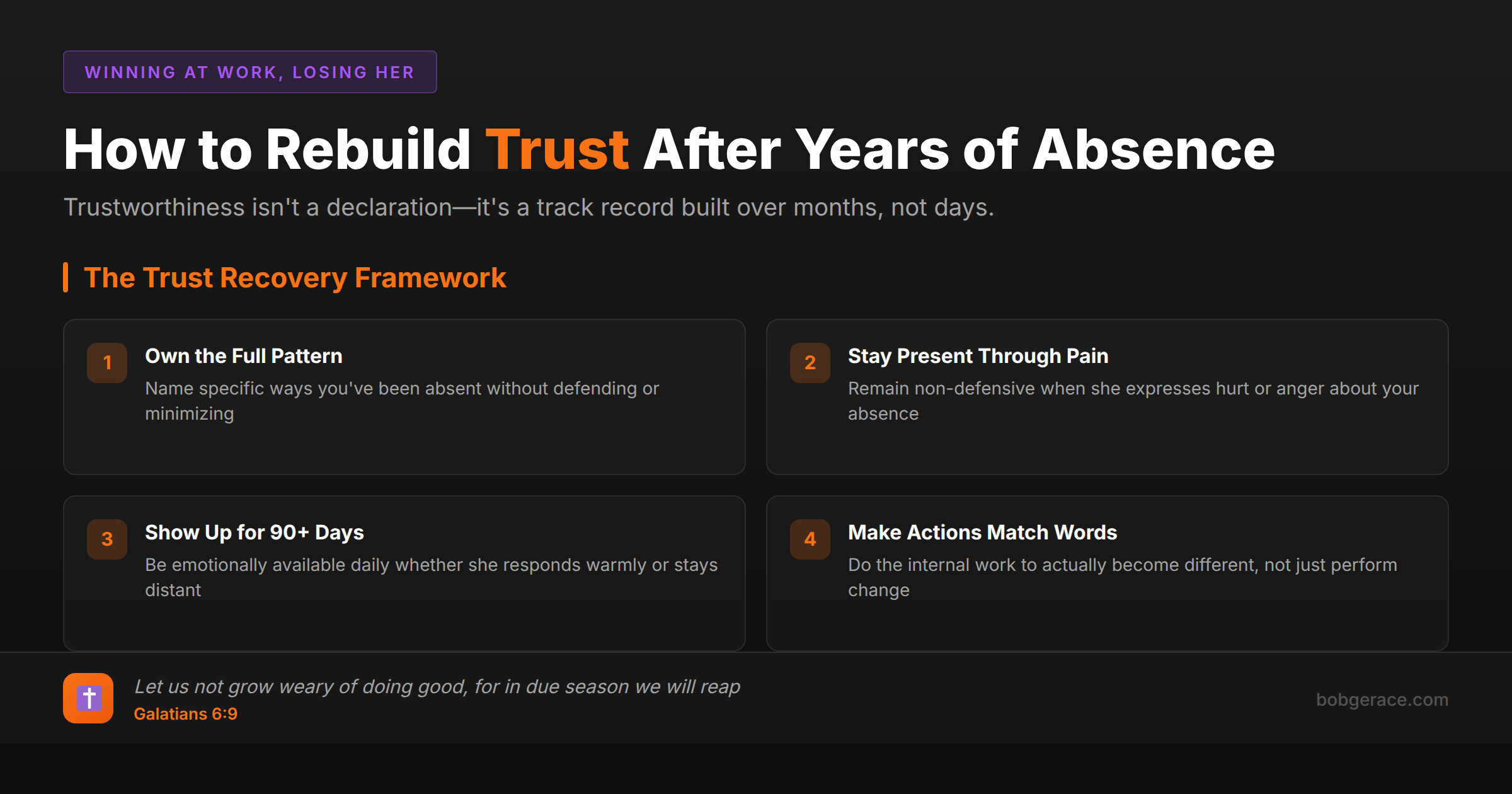
You become trustworthy by owning the full pattern of absence, staying present through her pain without defensiveness, and showing up consistently for months—not days or weeks. Trustworthiness is not a declaration. It is a track record. Your wife has years of data showing that you prioritize work, avoid emotional conversations, and disappear when things get hard. You cannot erase that with a weekend of effort. You rebuild trust by becoming a man whose presence is predictable, whose words match his actions, and who can handle her hurt without shutting down. This is not about grand gestures. It is about small, repeated acts of presence and ownership. It is about staying in the room when she is angry. It is about naming your patterns without excusing them. It is about doing the internal work so that you are not just performing change but actually becoming different. That is what trustworthy looks like.
What Years of Absence Actually Cost
When you have spent years not showing up—emotionally, relationally, spiritually—you have trained your wife to stop expecting you. She learned that you will prioritize work over her needs, that you will shut down when she expresses pain, that you will be physically present but emotionally absent. She adapted. She built a life that does not depend on you. She stopped reaching for you because reaching hurt more than not reaching. That is what years of absence cost.
Now you want to change. That is good. But you need to understand what you are up against. She is not just hurt. She is conditioned. Her nervous system has learned that you are not safe, that you will not stay, that you will revert to old patterns as soon as the pressure is off. So when you suddenly start showing up—asking about her day, helping with the kids, staying in the room during hard conversations—she does not trust it. She is waiting for you to prove that this is just another temporary performance driven by fear of losing her.
Becoming trustworthy means you accept that reality without bitterness. You do not get to be offended that she does not immediately believe you have changed. You do not get to say, 'I am trying, why can't you see that?' You stay steady. You show up. You do the work whether she softens or not. You prove over months, not days, that this is not a crisis-driven performance but a real transformation. That is the cost of years of absence. You do not get to skip the rebuilding phase.
How Trust Is Rebuilt at the Nervous System Level
Trust is not rebuilt through words or intentions. It is rebuilt through repeated experiences of safety. Your wife's nervous system has been shaped by years of you not being emotionally available. When she reached for connection and you were defended, distracted, or dismissive, her nervous system registered that as a threat. Not a physical threat, but a relational one. Over time, she stopped reaching. Her body learned that you are not a safe person to be vulnerable with.
Rebuilding trust means giving her nervous system new data. That happens when you stay present during conflict without shutting down or retaliating. It happens when you can hear her pain without making it about your shame. It happens when you are consistent—not just for a week, but for months. Her nervous system needs to experience you as predictable and safe before it will begin to relax and open again.
This is why most men fail at this stage. They can show up for a few days or weeks, but when she does not respond with warmth or gratitude, they get discouraged. They think, 'I am doing everything right and she still does not trust me.' But her lack of trust is not irrational. It is protective. She is waiting to see if you can sustain this new version of yourself when it is hard, when she is not rewarding you for it, when the crisis pressure is off. If you can, her nervous system will begin to register you as safe again. If you cannot, she will conclude that nothing has actually changed.
Faithfulness Over Time
The Bible does not promise quick fixes. It promises that faithfulness over time produces fruit. Galatians 6:9 says, 'Let us not grow weary of doing good, for in due season we will reap, if we do not give up.' Becoming trustworthy after years of absence requires that kind of endurance. You do not get to show up for a month and then complain that your wife has not forgiven you or softened toward you. You stay faithful whether she responds or not.
Jesus modeled this. He did not love the church because she was lovely. He loved her while she was still a mess, still doubting, still failing. He stayed. He did the work. He was faithful when it cost Him everything. That is the standard for husbands. You are called to love your wife sacrificially, steadily, without requiring her to meet you halfway (Ephesians 5:25). You are called to lead through repentance, presence, and consistent action.
This is hard. It requires you to stay in the room when she is angry, to own your failures without defensiveness, to keep showing up even when she does not reward you for it. But that is what faithfulness looks like. It is not flashy. It is not fast. It is steady, grounded, and willing to endure. If you can do that, you give your marriage the best chance. And even if she still chooses to leave, you will have become a man of integrity and faithfulness. That matters to God, and it should matter to you.
Action Steps
-
1
Own the full pattern. Sit down with your wife and name the specific ways you have been absent—emotionally, relationally, spiritually. Do not defend or minimize. Just own it.
-
2
Show up daily for 90 days minimum. Be present, non-defensive, and emotionally available whether she responds warmly or stays distant. Do not quit when it gets hard.
-
3
Stay in the room during conflict. When she expresses pain or anger, do not shut down, walk away, or retaliate. Stay present. Listen. Say, 'I hear you. I am sorry.'
-
4
Work with a coach or counselor. You need help identifying your patterns, regulating your nervous system, and learning how to stay present under pressure.
-
5
Pray for endurance and humility. Ask God to help you stay faithful, to see your wife clearly, and to love her well whether she decides to trust you again or not.
Related Questions
Also find Bob on
Subscribe for weekly videos on Christian marriage.
Rebuild Trust Before It's Too Late
If your wife has checked out and you know you have years of absence to repair, you need a clear plan and someone who understands how trust is rebuilt at the nervous system level. I help men become trustworthy again—not through performance, but through real transformation.
Talk to Bob →