How do I move from performance to presence?
6 min read
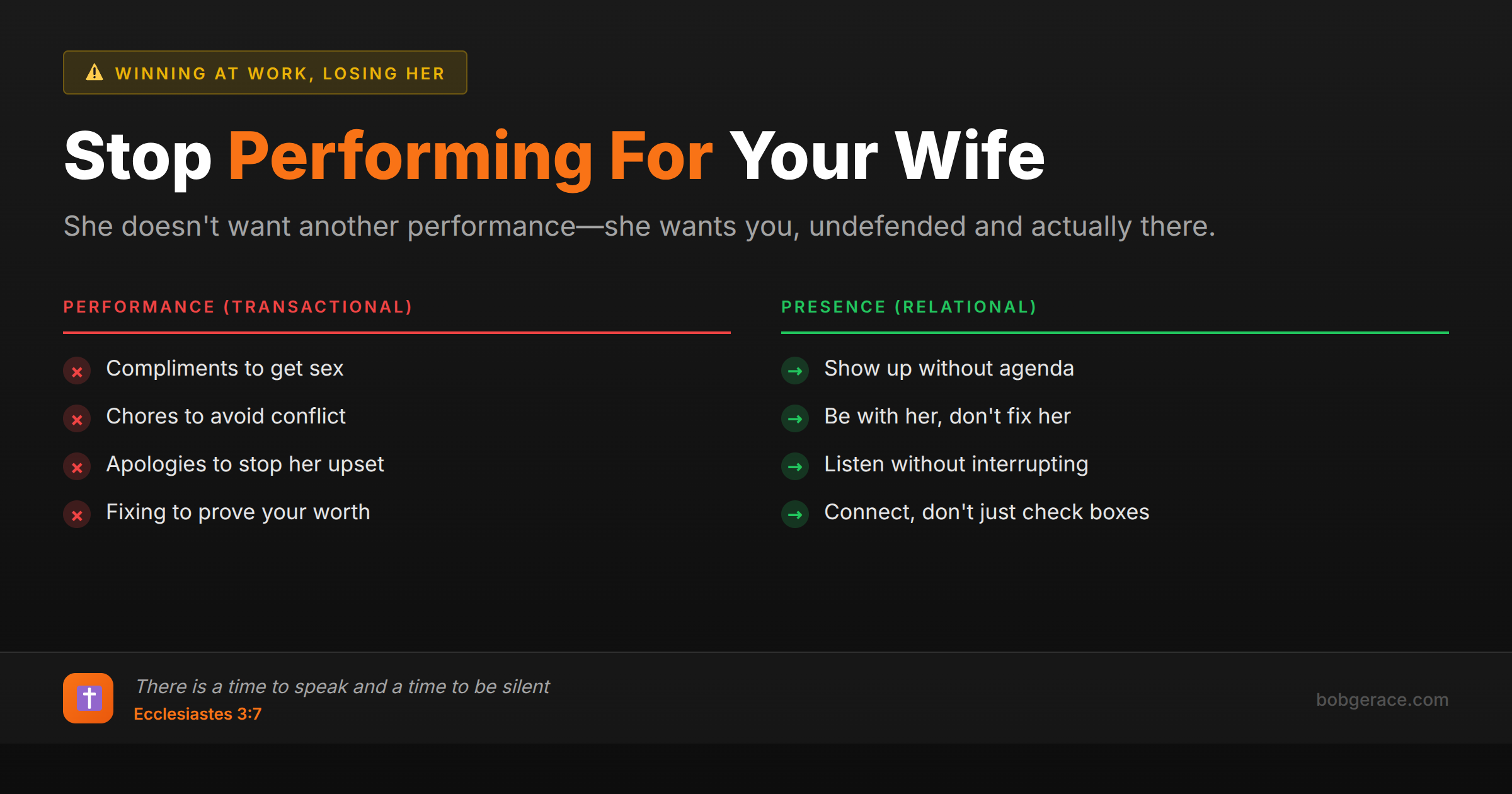
You move from performance to presence by learning to show up without an agenda. Performance is doing things to get a result—compliments to get sex, chores to avoid conflict, apologies to make her stop being upset. Presence is being with her without needing to fix, win, or prove anything. It's the difference between checking a box and actually connecting. Most high-performing men have spent their lives earning approval through achievement. You learned early that your value comes from what you produce, how you perform, and whether you win. That works in business. But in marriage, it creates a transactional dynamic. Your wife feels like a client you're trying to satisfy, not a woman you're choosing to love. She doesn't want another performance. She wants you—undefended, unhurried, and actually there. That shift requires you to redefine what it means to be a man.
Why High-Performers Struggle with Presence
You've built a career on execution. You set goals, hit targets, and deliver results. You're good at it. But somewhere along the way, you started treating your marriage the same way. You perform acts of service, schedule date nights, and say the right words—but your wife still feels alone. Because she's not experiencing you. She's experiencing your strategy.
Performance is a defense mechanism. It keeps you in control. If you can just do enough, say enough, or fix enough, you can avoid the discomfort of being seen, the vulnerability of not knowing what to do, or the fear that you're not enough. But that's the problem. Your wife doesn't need you to be enough. She needs you to be real. And real means showing up even when you don't have the answer, even when you're tired, even when you feel inadequate.
Here's what performance looks like in marriage: You bring her flowers after a fight, but you haven't actually listened to what hurt her. You initiate sex, but you're not emotionally connected—you're just trying to feel close or relieve tension. You ask how her day was, but you're half-listening while mentally solving a work problem. You're going through the motions, but you're not actually there. And she feels it.
Presence, by contrast, is simple but hard. It's sitting with her on the couch without your phone. It's listening to her frustration without trying to fix it. It's touching her without it leading to sex. It's saying 'I don't know what to do here, but I'm not leaving.' It's the willingness to be with her in the mess, the uncertainty, the discomfort—without needing to perform your way out of it. That's what she's been asking for. Not more effort. More of you.
The Neuroscience of Performance vs. Presence
Performance and presence activate different parts of your brain. Performance is task-oriented, goal-driven, and outcome-focused. It's mediated by the prefrontal cortex and the dopamine reward system. You get a hit of satisfaction when you complete a task, solve a problem, or achieve a goal. That's why you're good at it. But it's also why it's addictive. You keep performing because it feels productive, even when it's not creating connection.
Presence, by contrast, requires you to drop into your body and your relational awareness. It's mediated by the insula and the anterior cingulate cortex—the parts of your brain responsible for empathy, attunement, and emotional regulation. Presence is not about doing. It's about being. And for most high-performers, that feels like doing nothing. It feels unproductive, inefficient, even uncomfortable. Because you're not getting the dopamine hit. You're just being with her.
The shift from performance to presence requires you to tolerate discomfort without fixing it. That's a nervous system skill. When you're present, you're not trying to change her mood, solve her problem, or make her feel better. You're just there. That means you have to regulate your own anxiety—the part of you that wants to do something, say something, or make it better. You have to sit in the tension without escaping into action.
This is where most men fail. You feel her sadness, frustration, or distance, and your nervous system interprets it as a problem to solve. So you perform. You apologize, you explain, you offer solutions. But she doesn't want solutions. She wants you to stay with her in the feeling. That's intimacy. And it requires you to be comfortable with discomfort. That's the work.
The Ministry of Presence: Being, Not Just Doing
Jesus modeled presence, not performance. He didn't fix every problem. He didn't answer every question. He didn't perform miracles to prove Himself. He was with people. He wept with Mary and Martha. He sat with the woman at the well. He let the disciples fail and stayed with them anyway. His power was in His presence, not His productivity.
In marriage, you're called to the same ministry of presence. Ecclesiastes 3 says there's a time for everything—a time to speak and a time to be silent, a time to act and a time to rest. Most men only know how to act. You need to learn how to be. That's not passivity. It's a different kind of strength. It's the strength to sit with your wife's pain without needing to make it go away. It's the strength to be still and know that you are not God—you can't fix everything, and you're not supposed to.
Philippians 2:3-4 calls us to look not only to our own interests but also to the interests of others. Performance is self-focused. It's about managing your anxiety, protecting your ego, or earning approval. Presence is other-focused. It's about attuning to your wife, noticing what she needs, and offering yourself without an agenda. That's Christlike love. It's not transactional. It's sacrificial.
This shift requires you to trust God with the outcome. You can't control whether your wife softens, reconnects, or forgives. You can only control whether you show up. And showing up means being present—not performing, not fixing, not managing. Just being with her. That's the kind of love that changes a marriage. And it's the kind of love that changes you.
Action Steps
-
1
Identify one area where you're performing instead of being present. Is it sex? Conflict? Conversation? Name it. Awareness is the first step.
-
2
Practice being with her without an agenda. Sit next to her on the couch. Don't check your phone. Don't try to fix anything. Just be there. Five minutes. Start small.
-
3
When she shares something hard, resist the urge to solve it. Instead, say: 'That sounds really hard. Tell me more.' Let her talk. Don't interrupt. Don't offer advice unless she asks.
-
4
Notice when you're performing. Do you compliment her to get sex? Apologize to end the fight? Do chores to avoid conflict? Catch yourself. Then choose presence instead.
-
5
Ask her: 'What does it feel like when I'm really present with you? And what does it feel like when I'm not?' Listen to her answer. Don't defend. Just learn.
Related Questions
Also find Bob on
Subscribe for weekly videos on Christian marriage.
Stop Performing. Start Leading.
The shift from performance to presence is the shift from striving to leading. If you're ready to become a man who leads with presence, not pressure, let's talk.
Talk to Bob →