What is 'idealization/devaluation' and is it happening?
6 min read
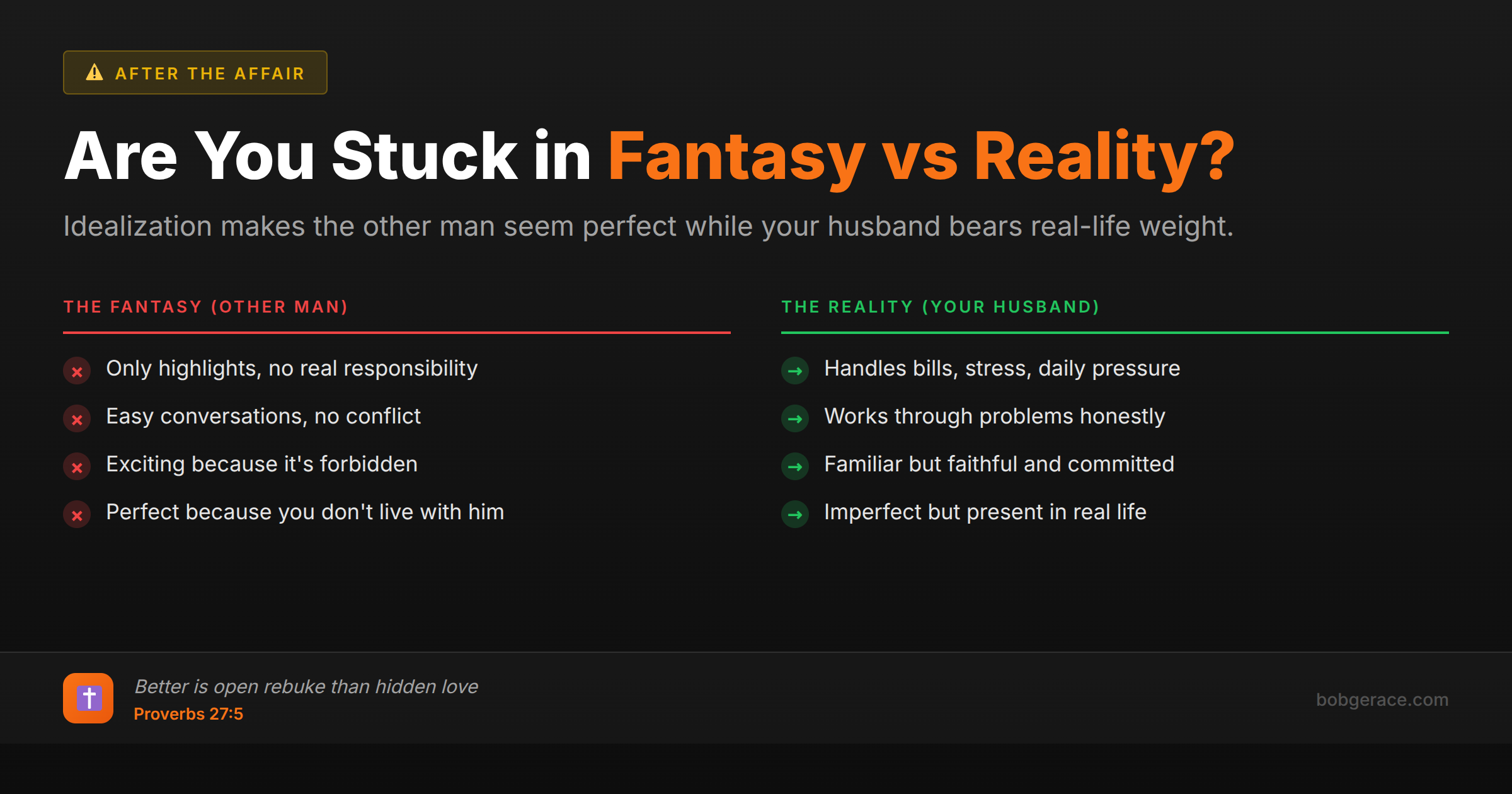
Idealization/devaluation is a psychological pattern where you put the other man on a pedestal (idealization) while mentally tearing down your husband (devaluation). It's your mind's way of justifying the emotional connection by creating an artificial comparison. The other man seems perfect because you only see his highlights, while your husband bears the weight of real-life pressures, responsibilities, and familiarity. This isn't based on reality—it's a cognitive distortion that makes the forbidden feel justified. If you find yourself constantly comparing them, focusing on your husband's flaws while overlooking the other man's, or feeling like your husband 'just doesn't measure up' to someone you barely know in real-life context, this pattern is likely happening.
The Full Picture
Here's what's really happening in your mind. When you're emotionally connected to another man, your brain starts playing tricks on you. It's not intentional, but it's predictable. You begin idealizing him—seeing only his best qualities, his charm, his attentiveness—while simultaneously devaluing your husband by focusing on his flaws, shortcomings, and daily irritations.
This isn't a fair comparison. You're comparing your husband's reality to another man's highlight reel. Your husband deals with mortgages, sick kids, work stress, and the mundane realities of life with you. The other man gets your best conversations, your emotional energy, and exists in a fantasy bubble free from real-world pressures.
The psychology is powerful. Your mind needs to justify this emotional affair, so it creates a narrative where the other man is everything your husband isn't. He's more understanding, more attractive, more successful, more emotionally available. Meanwhile, your husband becomes the obstacle to your happiness rather than your partner.
This distortion feels real. The emotions are genuine, but they're based on false comparisons. You're not seeing either man clearly. The other man benefits from novelty, secrecy, and your projected fantasies. Your husband suffers from familiarity, daily stress, and carrying the actual weight of your shared life.
It's a dangerous spiral. The more you compare, the more justified the emotional affair feels. The more justified it feels, the deeper you go. The deeper you go, the more your marriage suffers, which then seems to 'prove' that the other man is better. It's a self-fulfilling prophecy that destroys marriages.
What's Really Happening
From a clinical perspective, idealization/devaluation is a defense mechanism that serves to reduce cognitive dissonance. When someone is engaging in behavior that conflicts with their values (like having an emotional affair), their mind seeks ways to resolve this internal conflict. Creating an idealized version of the affair partner while simultaneously devaluing the spouse helps justify the behavior and reduce psychological discomfort.
This pattern involves several cognitive distortions: selective attention (focusing only on positive traits of the other man and negative traits of the husband), confirmation bias (interpreting ambiguous situations in ways that support the narrative), and the fundamental attribution error (attributing the husband's negative behaviors to his character while attributing the other man's positive behaviors to his inherent goodness).
Neurologically, the brain's reward system is highly active during the early stages of romantic attraction, flooding the system with dopamine and creating an almost addictive cycle. This biochemical response intensifies the idealization process and makes rational comparison nearly impossible.
The most concerning aspect is how this pattern becomes self-reinforcing. As the spouse is increasingly devalued, less emotional energy is invested in the marriage, leading to actual deterioration in the relationship. This deterioration then seems to validate the original comparison, creating a destructive feedback loop.
Recognizing this pattern is the //blog.bobgerace.com/when-theres-another-man-what-you-need-to-know-first/:first step toward breaking it. The goal isn't to demonize feelings but to understand how our minds can distort reality when we're emotionally compromised.
What Scripture Says
God calls us to see clearly and honestly. Proverbs 27:5-6 reminds us, *'Better is open rebuke than hidden love. Wounds from a friend can be trusted, but an enemy multiplies kisses.'* The other man's 'kisses'—his attention and affirmation—multiply because they cost him nothing. Your husband's honest love includes the friction of real life.
Scripture warns against deceptive comparisons. 2 Corinthians 10:12 says, *'We do not dare to classify or compare ourselves with some who commend themselves. When they measure themselves by themselves and compare themselves with themselves, they are not wise.'* You're measuring your marriage against a fantasy, not reality.
God's design is for covenant commitment. Malachi 2:14 declares, *'The Lord is the witness between you and the wife of your youth. You have been unfaithful to her, though she is your partner, the wife of your marriage covenant.'* Your husband isn't just someone to compare—he's your covenant partner before God.
The heart is deceptive. Jeremiah 17:9 warns, *'The heart is deceitful above all things and beyond cure. Who can understand it?'* Your feelings of comparison feel true, but they're filtered through a heart that can deceive you about what's real and what's fantasy.
Love protects the relationship. 1 Corinthians 13:7 teaches that love *'always protects, always trusts, always hopes, always perseveres.'* True love protects your marriage from unfair comparisons. It doesn't tear down your spouse while building up someone else.
God offers wisdom for right thinking. Philippians 4:8 instructs, *'Finally, brothers and sisters, whatever is true, whatever is noble, whatever is right, whatever is pure, whatever is lovely, whatever is admirable—if anything is excellent or praiseworthy—think about such things.'* Focus on what's true about your marriage, not distorted comparisons.
What To Do Right Now
-
1
Stop all contact with the other man immediately—no exceptions, no 'final conversations'
-
2
Write down three real-world responsibilities your husband handles that the other man never has to deal with
-
3
List five positive qualities about your husband that you've been overlooking or minimizing
-
4
Confess this pattern to a trusted friend or counselor who can help you see clearly
-
5
Begin praying daily for God to show you your husband through His eyes, not your distorted lens
-
6
Commit to speaking positively about your husband for the next 30 days—no complaints, criticisms, or comparisons
Related Questions
- Why am I now all-bad in her mind?
- What is 'affair partner idealization' and why is it happening?
- Why does she see him as perfect and me as flawed?
- What is 'comparison injury' and how do I manage it?
- What is 'positive sentiment override' in the affair context?
- What is 'negative sentiment override' and does she have it?
- Why does she remember everything differently than I do?
- Why does she seem like a different person?
- She says she's never felt this way before
Also find Bob on
Subscribe for weekly videos on Christian marriage.
Your Marriage Isn't a Comparison Chart
A coach who knows your actual story can help you see what's real and what's distortion—before you blow up something that still matters.
Talk to Bob →