What is my responsibility if she forces separation?
6 min read
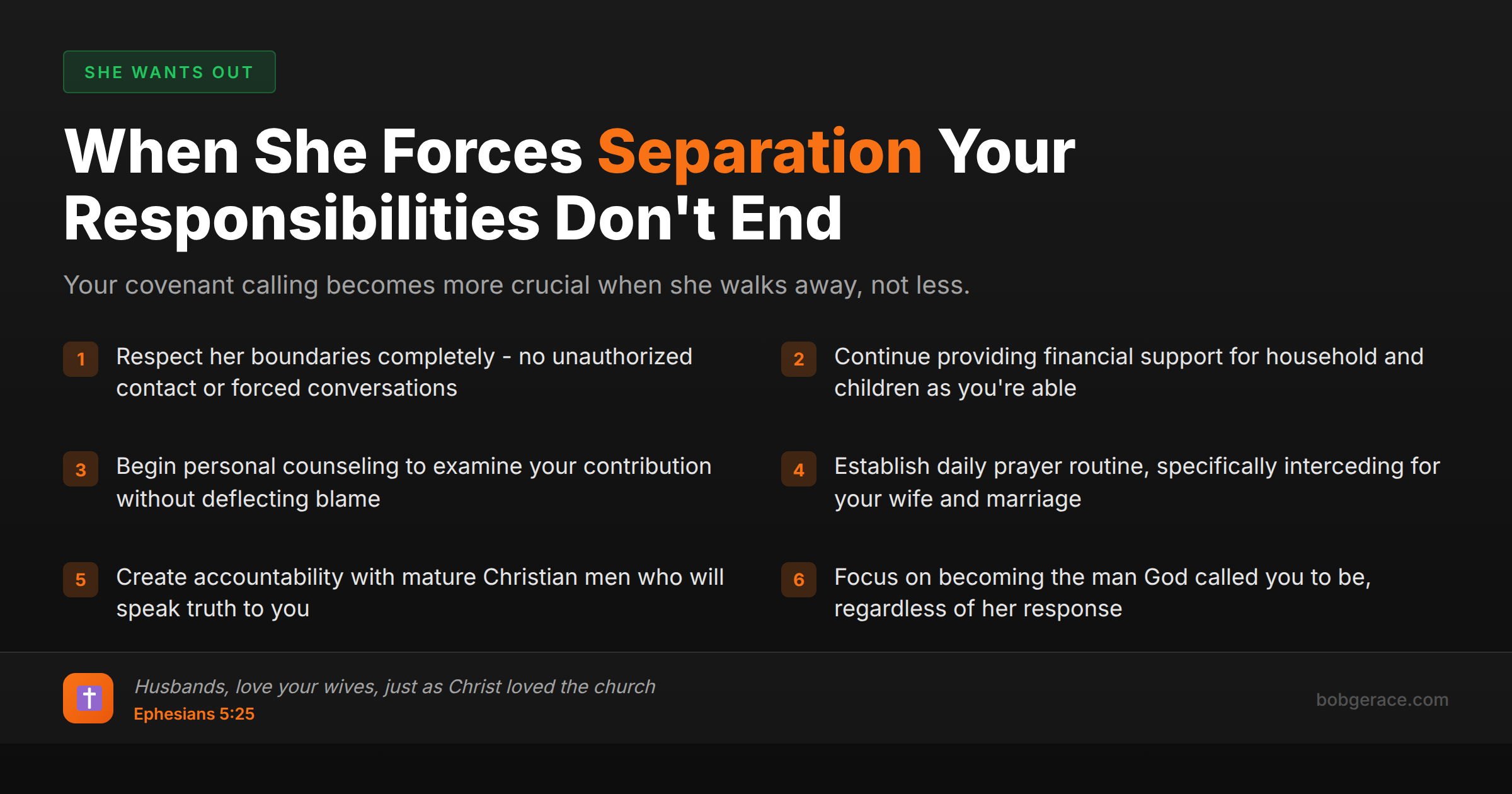
Your covenant responsibility doesn't end because she forces separation. In fact, it becomes more crucial. You're called to honor your vows regardless of her choices - not to win her back through performance, but because your character and integrity matter to God. This means continuing to love, pray, provide, and protect as you're able while respecting boundaries she's established. You can't control her decisions, but you can control your response. Your responsibility is to become the man God called you to be, whether she ever comes home or not. This isn't about being a doormat - it's about being a man of honor who keeps his word even when it's costly.
The Full Picture
When your wife forces separation, you're facing one of the most disorienting experiences a married man can endure. Everything in you wants to either fight harder to bring her back or walk away to protect yourself. Both reactions are understandable, but neither addresses your deeper responsibility as a covenant man.
Your marriage vows weren't conditional on her keeping hers. You promised "for better or worse, for richer or poorer, in sickness and in health." Those words didn't come with an escape clause that activates when she stops trying. This doesn't mean you become a passive victim - it means you operate from principle rather than emotion.
Many men make critical mistakes during forced separation:
• Pursuing aggressively - showing up unannounced, excessive texting, or trying to force conversations • Withdrawing completely - cutting off all support or communication out of hurt or spite • Playing the victim - focusing only on what she's doing wrong without examining their own contribution • Using children as messengers - putting kids in the middle of adult conflicts • Making threats - about finances, custody, or divorce to try to regain control
Your responsibility during separation is to respect her boundaries while maintaining your integrity. This might mean continuing to pay household expenses even when you're living elsewhere. It could mean honoring her request for space while still being available for emergencies. It definitely means examining your own heart and behavior honestly.
Separation often reveals character. How you handle this crisis will either validate her decision to leave or demonstrate the kind of man she might want to reconcile with. More importantly, it reveals whether you're the kind of man God can use to heal this marriage - or whether you're still too focused on your own pain to be part of the solution.
What's Really Happening
From a clinical perspective, forced separation often represents what we call "the protest phase" of attachment disruption. When your wife forces separation, she's typically communicating that her emotional safety needs aren't being met within the marriage system. This doesn't mean you're entirely at fault, but it does mean the relationship dynamic has become unsustainable for her.
Research in Emotionally Focused Therapy shows that most relationship conflicts stem from underlying attachment fears - fear of abandonment or fear of engulfment. When someone forces separation, they're often choosing the familiar pain of distance over the unpredictable pain of staying engaged. Your response during this phase is crucial because it either confirms her fears about the relationship or begins to challenge them.
Neurologically, you're both operating from activated threat-detection systems. Her brain has categorized the marriage as unsafe, while your brain is experiencing the separation as a survival threat. This creates what we call "negative cycles" - the more you pursue, the more she withdraws; the more she withdraws, the more abandoned you feel.
Your responsibility during this phase is to regulate your own nervous system first. This means managing your anxiety, anger, and desperation in healthy ways rather than acting out of emotional reactivity. When you can demonstrate consistent emotional regulation despite the crisis, you're showing her a version of yourself that might feel safer to be around.
The most successful outcomes during forced separation occur when the pursuing partner (usually the husband) learns to hold connection and space simultaneously. This requires developing what therapists call "differentiation" - the ability to stay emotionally connected to someone while not being controlled by their emotional state. This is advanced emotional work, but it's exactly what's required for healing during separation.
What Scripture Says
Scripture provides clear guidance about your responsibility during forced separation, even when you didn't choose it.
Ephesians 5:25 instructs, "Husbands, love your wives, just as Christ loved the church and gave himself up for her." This command isn't conditional on her response. Christ's love for the church isn't based on the church's performance, and your covenant love shouldn't be based on her cooperation.
1 Peter 3:7 calls you to "live with your wives in an understanding way, showing honor to the woman as the weaker vessel, since they are heirs with you of the grace of life." Even during separation, showing honor means respecting her boundaries while maintaining your commitment to the covenant.
Hosea 3:1 demonstrates God's heart: "Go again, love a woman who is loved by another and is an adulteress, even as the Lord loves the children of Israel." God calls Hosea to continue loving despite betrayal - not because it's easy, but because covenant love reflects God's character.
Matthew 5:44 challenges you to "love your enemies and pray for those who persecute you." If you're called to love enemies, how much more should you love the woman you promised to cherish, even when she's hurting you?
Romans 12:18 provides wisdom: "If possible, so far as it depends on you, live peaceably with all." You can't control her choices, but you can control whether you contribute to conflict or peace.
1 Corinthians 7:13-14 addresses this directly: "If any woman has a husband who is an unbeliever, and he consents to live with her, she should not divorce him... the unbelieving husband is made holy because of his wife." Your faithful love during separation can be sanctifying, regardless of the outcome.
Your responsibility isn't to fix the marriage - it's to honor God through your response to the crisis.
What To Do Right Now
-
1
Respect her stated boundaries completely - no unauthorized contact, visits, or attempts to force conversations
-
2
Continue providing financial support for household expenses and children as you're able and legally required
-
3
Begin personal counseling to examine your contribution to the marriage problems without deflecting blame
-
4
Establish a consistent prayer routine, specifically interceding for your wife and marriage daily
-
5
Create accountability with mature Christian men who will speak truth about your attitudes and actions
-
6
Document your efforts to honor the separation while maintaining covenant responsibility for legal and personal records
Related Questions
- Should I move out if she asks?
- She wants separation — should I agree?
- Does the Bible address separation specifically?
- How do I honor her request while honoring my vows?
- What does faithfulness look like when we're apart?
- Am I enabling divorce by agreeing to separation?
- What does biblical forgiveness require of me?
- What boundaries should I set?
- How do I discern God's will for my marriage?
- What does 'love your wife as Christ loves the church' mean?
Also find Bob on
Subscribe for weekly videos on Christian marriage.
Don't Navigate Separation Alone
Your situation has details that matter—her reasons, your history, what boundaries actually look like in your marriage. A coach who knows your story helps you stay grounded when you're second-guessing every move.
Talk to Bob →