Does the Bible address separation specifically?
6 min read
Yes, the Bible does address separation, though not as extensively as divorce. Scripture recognizes that there are times when spouses may need to live apart for safety, spiritual reasons, or to create space for repentance and healing. However, biblical separation always carries the expectation of reconciliation where possible. The key difference is this: separation in Scripture is viewed as a temporary measure designed to protect and potentially restore, not as a stepping stone to divorce. When your wife is asking for separation, understanding what the Bible says about it can help you navigate this crisis with wisdom rather than just reacting out of fear or anger. The goal isn't to use Scripture as a weapon to force her to stay, but to understand God's heart for your marriage and respond accordingly.
The Full Picture
The Bible's approach to separation is both realistic and redemptive. Scripture acknowledges that marriages go through seasons of crisis severe enough that living apart may be necessary, but it never treats this lightly or as a permanent solution.
Biblical separation differs from modern separation in crucial ways:
• Purpose: Biblical separation aims at restoration, not just relief • Commitment: Both parties remain committed to the covenant, even while apart • Behavior: There are clear expectations about conduct during separation • Timeline: It's viewed as temporary, not indefinite
When your wife talks about separation, she may not be thinking biblically about it at all. She might see it as a trial run for divorce, a way to date other people, or simply an escape from problems. Understanding what Scripture actually says gives you a framework for responding wisely.
The reality is that separation can serve legitimate purposes: - Creating safety when there's abuse or addiction - Providing space for genuine repentance and change - Breaking destructive patternss that can't be addressed while living together - Protecting children from ongoing conflict
But here's what most men miss: fighting the separation itself often misses the real issue. If your wife is asking for separation, something has broken down so severely that she can't imagine healing while you're together. Your job isn't to convince her separation is wrong—it's to understand why she feels it's necessary and address those underlying issues with the urgency they deserve.
What's Really Happening
From a clinical perspective, when a wife requests separation, it typically indicates that the emotional safety and connection in the marriage has deteriorated to a critical level. Research shows that women often view separation as a last resort after feeling unheard, unsafe, or emotionally abandoned for extended periods.
The psychological dynamics at play include:
Emotional flooding: When conflict becomes overwhelming, the nervous system goes into protective mode. Separation can provide the emotional regulation needed for clear thinking and decision-making.
Trauma responses: If there's been emotional, physical, or sexual harm, living together may trigger constant fight-or-flight responses that make healing impossible.
Attachment disruption: When trust is broken repeatedly, the attachment bond becomes disorganized. Physical space sometimes allows for the safety needed to process and potentially rebuild that bond.
What's crucial to understand is that her request for separation isn't necessarily about punishing you—it's often about survival. Her nervous system may have concluded that living together is unsafe, even if there's no physical danger.
The mistake many men make is treating separation as the problem rather than recognizing it as a symptom of deeper issues. Fighting the separation while ignoring the underlying pain that necessitated it often confirms her worst fears about your ability to truly hear and respond to her needs.
Clinically, separations that follow biblical principles—with clear boundaries, ongoing accountability, and focused work on the core issues—have better outcomes than either refusing separation entirely or treating it as consequence-free time apart.
What Scripture Says
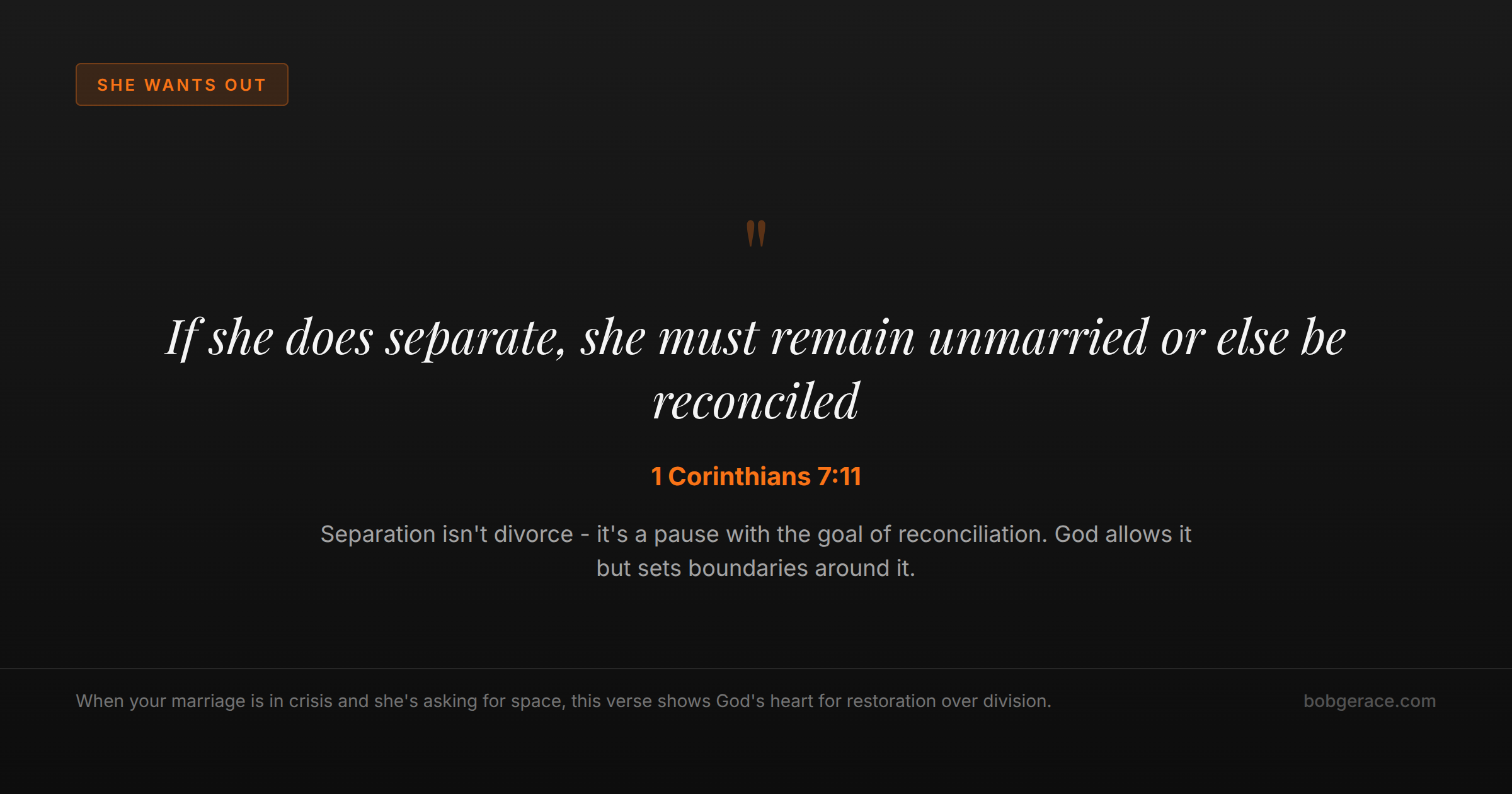
1 Corinthians 7:10-11 provides the clearest biblical guidance on separation: *"To the married I give this command (not I, but the Lord): A wife must not separate from her husband. But if she does, she must remain unmarried or else be reconciled to her husband. And a husband must not divorce his wife."*
This passage acknowledges that separation happens while establishing clear boundaries around it. Notice that Paul doesn't say "if she separates, drag her back." He recognizes the reality while setting expectations for conduct during separation.
Matthew 18:15-17 gives us the principle of progressive confrontation when someone sins against us: *"If your brother or sister sins, go and point out their fault, just between the two of you. If they listen to you, you have won them over. But if they will not listen, take one or two others along..."*
Sometimes separation provides the "space" needed for this process to work effectively.
1 Peter 3:7 commands husbands to live with their wives *"in an understanding way, showing honor to the woman as the weaker vessel, since they are heirs with you of the grace of life, so that your prayers may not be hindered."*
If your wife feels you haven't been understanding or honoring, separation might be her way of protecting herself until that changes.
Ephesians 5:25-26 calls husbands to love their wives *"as Christ loved the church and gave himself up for her to make her holy, cleansing her by the washing with water through the word."*
Sometimes the most loving thing is to give space for healing and growth, even when it's painful for you.
The biblical pattern is clear: separation should be temporary, conducted with integrity, and aimed at restoration wherever possible.
What To Do Right Now
-
1
Stop fighting the separation and start understanding why she feels it's necessary
-
2
Establish clear biblical boundaries if separation happens—no dating, no inappropriate relationships, continued financial responsibility
-
3
Get professional help to address the underlying issues that made separation feel necessary to her
-
4
Create accountability with other mature Christian men who will speak truth into your life during this time
-
5
Focus on genuine repentance and change rather than strategies to get her back
-
6
Commit to treating separation as an opportunity for growth, not just an obstacle to overcome
Related Questions
- What does Scripture say about divorce?
- Is divorce a sin?
- Does God hate divorce?
- What did Jesus say about divorce?
- What does 'do not separate' mean practically?
- Is agreeing to separation the same as agreeing to divorce?
- What does biblical forgiveness require of me?
- Does God want me to stay in this marriage?
- What does faithfulness require when she won't reciprocate?
Also find Bob on
Subscribe for weekly videos on Christian marriage.
Your Marriage Isn't a Textbook Case
Separation in your house looks different than the next guy's. A coach who knows your story can help you respond to what's actually happening—not just what Scripture says in general.
Talk to Bob →