Is agreeing to separation the same as agreeing to divorce?
6 min read
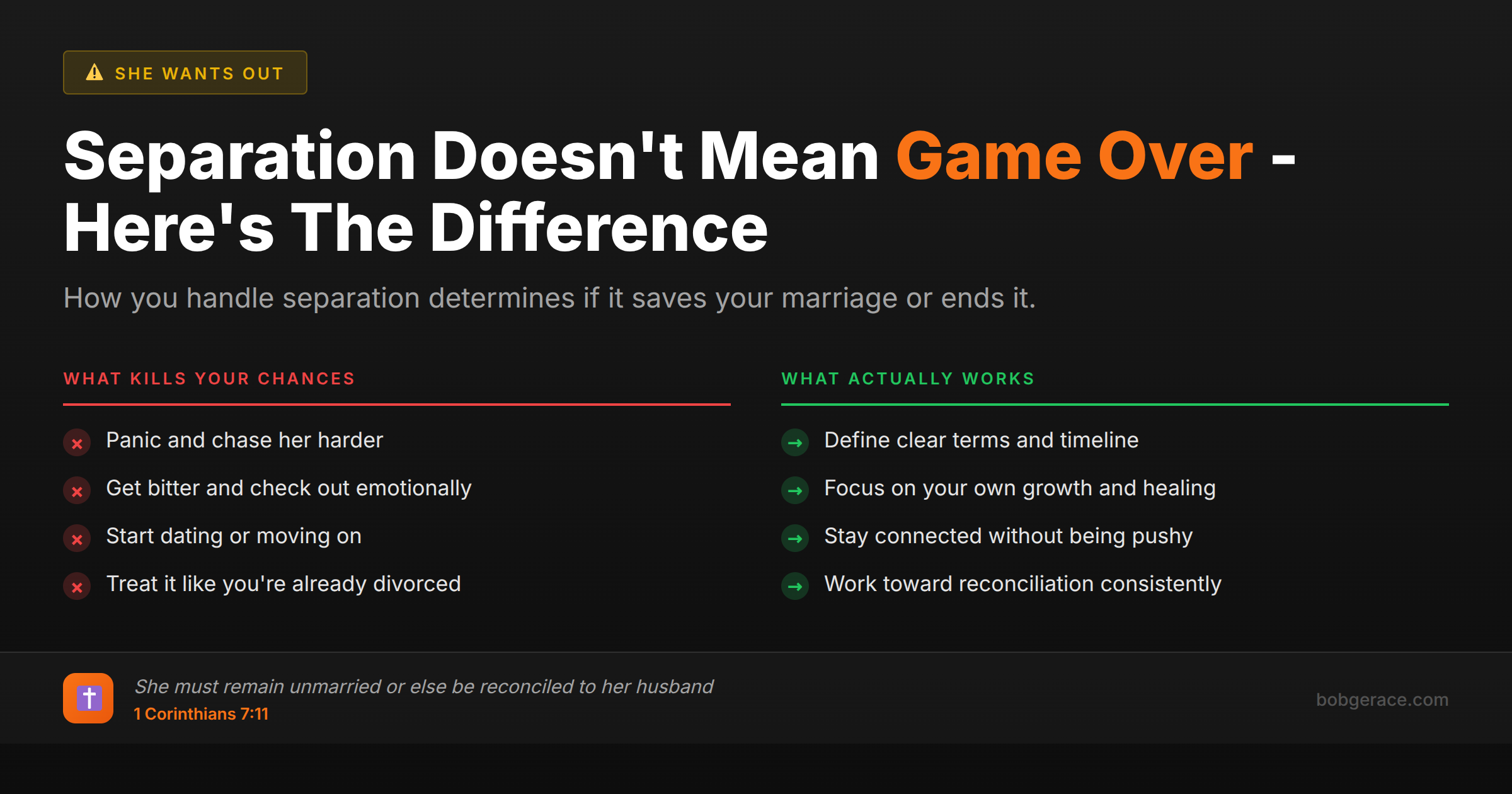
No, agreeing to separation is not the same as agreeing to divorce - but here's what most men miss: the way you handle separation often determines whether it becomes a bridge to reconciliation or a stepping stone to divorce court. When your wife asks for separation, she's typically asking for space to think, breathe, and evaluate the marriage without the daily friction. She hasn't necessarily given up on the relationship. However, if you approach separation as defeat or use it as an excuse to check out emotionally, you're essentially handing her the divorce papers yourself. The distinction matters enormously. Separation can be a wake-up call that saves your marriage - if you use it right. But most men either panic and chase harder, or they get bitter and start dating. Both responses turn a temporary pause into a permanent goodbye.
The Full Picture
Separation exists in a gray zone that can swing either direction. Your wife isn't asking for separation because she's happy with how things are - she's asking because she needs relief from patterns that aren't working. The critical question isn't whether you agree to separate, but how you're going to use that separation.
There are essentially three types of separation:
• Trial separation - "I need space to think about us" • Therapeutic separation - "We need time apart to work on ourselves" • Pre-divorce separation - "I'm done but haven't filed yet"
Most women start with the first type, but your response determines which direction it goes. If you spend separation focused on changing yourself, addressing the real issues in your marriage, and becoming the man she fell in love with, separation becomes rehabilitation. If you spend it arguing about custody schedules and dividing assets, you've turned separation into divorce preparation.
The biggest mistake men make is treating separation like a timeout from marriage instead of intensive care for marriage. They stop working on themselves, stop pursuing their wife emotionally, and start building a separate life. That's not separation - that's practice divorce.
Here's what separation should look like: You're living apart but still married, still committed, still working toward reconciliation. You're using the space to address the core issues that created the crisis. You're demonstrating change through action, not just promises. You're showing her the man you're becoming, not trying to convince her of who you've always been.
What's Really Happening
From a therapeutic perspective, separation represents what we call ambiguous loss - the relationship isn't dead, but it isn't fully alive either. Research shows that couples in separation exist in a state of chronic stress and uncertainty that can actually be more emotionally damaging than divorce if it drags on without purpose or progress.
Gottman's research indicates that separation outcomes depend heavily on the emotional climate during the separation period. Couples who maintain emotional connection, continue working on relationship skills, and avoid introducing new stressors (like dating others) have significantly higher reconciliation rates.
The psychological danger zone is what I call separation drift - when couples use physical distance to avoid the emotional work necessary for either reconciliation or healthy closure. Men often interpret their wife's request for separation through the lens of rejection and abandonment, triggering fight-or-flight responses that sabotage any possibility of reconciliation.
Neurologically, separation activates the same brain regions as physical pain. This is why men often make impulsive decisions during separation - their brain is literally in survival mode. The prefrontal cortex, responsible for rational decision-making, goes offline when we perceive threats to our primary attachment.
Successful separations require what attachment theory calls earned security - the ability to self-regulate emotions while maintaining connection. This means men must learn to tolerate the uncertainty of separation while continuing to show up emotionally and practically as husbands, not as wounded ex-boyfriends.
What Scripture Says
Scripture provides clear guidance on the difference between separation and divorce. 1 Corinthians 7:10-11 states: "To the married I give this command (not I, but the Lord): A wife must not separate from her husband. But if she does, she must remain unmarried or else be reconciled to her husband. And a husband must not divorce his wife."
Notice Paul acknowledges that separation happens, but the expectation is clear: work toward reconciliation, don't use separation as a pathway to remarriage. This isn't about legal technicalities - it's about the heart posture during separation.
Malachi 3:14 reminds us that "the Lord is the witness between you and the wife of your youth. You have been unfaithful to her, though she is your partner, the wife of your marriage covenant." Your covenant doesn't disappear during separation - it's actually when covenant love matters most.
Ephesians 5:25-28 calls husbands to "love your wives, just as Christ loved the church and gave himself up for her." Separation is often when sacrificial love becomes most costly and most necessary. Christ didn't withdraw his love when the church was difficult or distant.
Hosea's entire story illustrates covenant love during relational separation. God uses Hosea's pursuit of his unfaithful wife as a picture of divine love that doesn't give up. Hosea 2:14 shows God saying, "Therefore I am now going to allure her; I will lead her into the wilderness and speak tenderly to her."
Separation, biblically understood, is wilderness time - difficult but potentially transformative. Your job during separation is to become the husband God designed you to be, regardless of your wife's response.
What To Do Right Now
-
1
Define the separation clearly - establish specific terms, timeline, and expectations about contact, finances, and children
-
2
Commit to personal growth during separation - start therapy, join a men's group, address the character issues that contributed to the crisis
-
3
Maintain appropriate connection - regular check-ins, family functions, shared responsibilities without being pushy or demanding
-
4
Avoid separation sabotage - no dating, no moving on emotionally, no treating this like you're already divorced
-
5
Document your changes - write letters, keep a journal, create tangible evidence of the work you're doing on yourself
-
6
Establish reconciliation goals - work with a counselor to identify specific changes needed and create accountability for making them
Related Questions
- She wants separation — should I agree?
- Should I move out if she asks?
- Is trial separation ever a good idea?
- What are the rules of separation?
- Can we separate and still work on things?
- What is 'structured separation' and does it work?
- What does the Bible say about boundaries?
- What does biblical forgiveness require of me?
- How do I honor her request while honoring my vows?
- What does faithfulness require when she won't reciprocate?
Also find Bob on
Subscribe for weekly videos on Christian marriage.
Your Separation Needs a Strategy
Separation is high-stakes. A coach who knows your marriage can help you use this time to rebuild trust instead of accelerating the end.
Talk to Bob →