Did my avoidance push her toward someone else?
6 min read
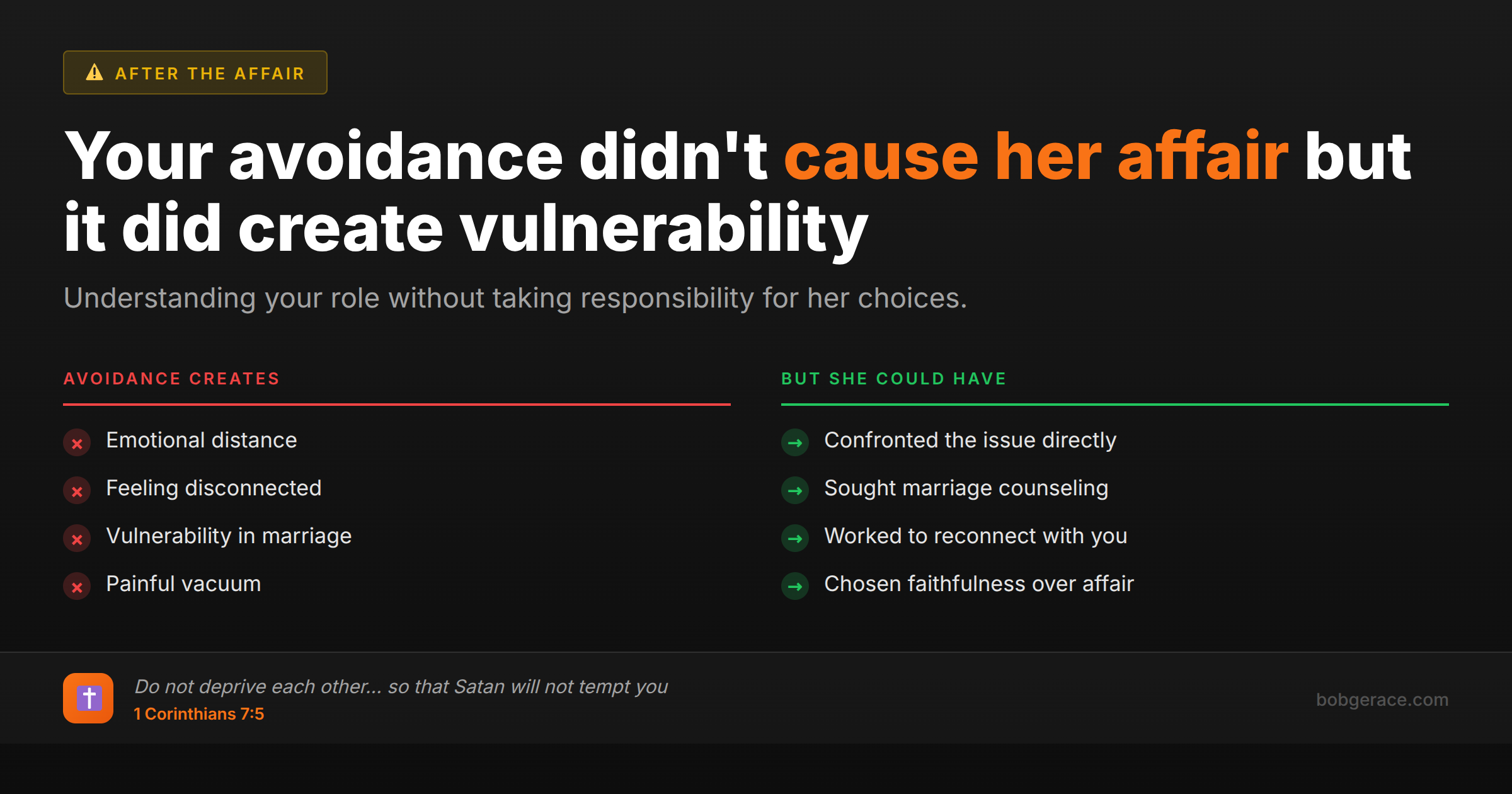
Your avoidance likely contributed to creating emotional distance, but it didn't cause her affair. Affairs happen when someone makes a conscious choice to seek connection outside their marriage rather than addressing problems within it. While your withdrawal may have left her feeling lonely or disconnected, she had other options - like directly confronting the issue, seeking counseling, or working harder to reconnect with you. That said, emotional avoidance does create vulnerability in marriage. When we consistently withdraw from our spouse, we leave an emotional vacuum that feels painful and confusing. This doesn't excuse infidelity, but it does help explain how marriages become susceptible to outside interference. The key now isn't dwelling on blame, but understanding your role so you can make different choices moving forward.
The Full Picture
Avoidance doesn't cause affairs, but it creates conditions where affairs become more likely. When you consistently withdraw emotionally, physically, or relationally from your wife, you're essentially creating a deficit in the marriage that she has to manage.
Think of it this way: marriage is designed to be a place of connection, intimacy, and mutual support. When one person consistently avoids or withdraws, the other person is left carrying the emotional load alone. They're trying to connect with someone who keeps pulling away. Over time, this creates frustration, loneliness, and a sense of rejection.
Here's what typically happens in this cycle: You avoid because conflict, emotion, or intimacy feels overwhelming or uncomfortable. She pursues harder, trying to reconnect. You withdraw further because the pursuit feels like pressure. She eventually stops pursuing and starts feeling hopeless about the relationship. This emotional distance creates space for someone else to step in and offer what feels like connection and understanding.
But let's be crystal clear - this doesn't make the affair your fault. She had choices at every point in this cycle. She could have: - Insisted on counseling - Set clear boundaries about what she needed - Worked harder to understand your avoidance patterns - Refused to accept emotional distance as the new normal
The affair represents her choice to go outside the marriage rather than fight for what was inside it. That's on her, not you.
However, your avoidance patterns are something you need to own and address. Not because they caused her affair, but because they're preventing the kind of marriage God designed you to have. Avoidance robs both of you of the intimacy, connection, and partnership that marriage is supposed to provide.
What's Really Happening
From a clinical perspective, we're looking at two separate issues that became intertwined: your avoidance patterns and her affair. Understanding the difference is crucial for //blog.bobgerace.com/marriage-lament-christian-healing-story-complete/:healing.
Avoidance typically stems from emotional overwhelm, fear of conflict, or learned patterns from childhood. Many men avoid because they genuinely don't know how to navigate emotional intensity or they've learned that withdrawal is safer than engagement. This isn't malicious - it's often a protective mechanism that worked in other contexts but damages marriage.
When avoidance becomes chronic, it creates what we call 'emotional starvation' in the relationship. Your wife likely experienced this as rejection, abandonment, or indifference, even if that wasn't your intention. Over time, this emotional starvation can make someone more susceptible to outside attention and validation.
However, the affair represents a completely separate decision-making process. Research shows that affairs involve a series of boundary violations and conscious choices, regardless of marital satisfaction. Many people in emotionally distant marriages don't have affairs - they seek counseling, separate, or find other ways to address their needs.
The key insight is this: your avoidance created vulnerability, but her affair was still a choice. Both issues need to be addressed independently. You need to understand and change your avoidance patterns not because they caused her affair, but because they're preventing the intimacy and connection your marriage needs to thrive. She needs to own the affair and the betrayal it represents, while also working to rebuild trust and commitment to the marriage.
What Scripture Says
Scripture gives us clear guidance on both avoidance and infidelity, helping us understand God's design for marriage and personal responsibility.
On avoiding your spouse, Paul is direct: *"Do not deprive each other except perhaps by mutual consent and for a time, so that you may devote yourselves to prayer. Then come together again so that Satan will not tempt you because of your lack of self-control"* (1 Corinthians 7:5). While this verse specifically addresses physical intimacy, the principle applies to emotional connection - consistent withdrawal creates vulnerability.
God calls husbands to active engagement: *"Husbands, love your wives as Christ loved the church and gave himself up for her"* (Ephesians 5:25). Christ's love was sacrificial and engaged, not distant or avoidant. This means pushing through our discomfort to be present with our wives.
However, Scripture is equally clear about personal responsibility for sin: *"Each person is tempted when they are dragged away by their own evil desire and enticed. Then, after desire has conceived, it gives birth to sin"* (James 1:14-15). Her affair was her choice, born from her own desires, not your actions.
Ezekiel 18:20 reinforces this: *"The one who sins is the one who will die. The child will not share the guilt of the parent, nor will the parent share the guilt of the child."* You are responsible for your avoidance; she is responsible for her affair.
Moving forward requires both confession and forgiveness: *"Therefore confess your sins to each other and pray for each other so that you may be healed"* (James 5:16). You need to own your patterns of withdrawal and avoidance. She needs to own her betrayal and unfaithfulness.
God's desire is restoration: *"All this is from God, who reconciled us to himself through Christ and gave us the ministry of reconciliation"* (2 Corinthians 5:18). Both your avoidance and her affair can be redeemed if you're both willing to do the hard work of change and healing.
What To Do Right Now
-
1
Own your avoidance patterns without taking responsibility for her affair - Acknowledge how your withdrawal affected the marriage while maintaining that her affair was still her choice
-
2
Identify your avoidance triggers - Write down specific situations, emotions, or conflicts that cause you to withdraw, and start recognizing them in real-time
-
3
Practice staying present during difficulty - When you feel the urge to withdraw, force yourself to stay engaged for just 2-3 minutes longer than feels comfortable
-
4
Communicate your struggle with avoidance to her - Let her know you recognize this pattern and are working to change it, separate from any discussion about the affair
-
5
Seek individual counseling to address avoidance - Work with a therapist to understand the roots of your withdrawal patterns and develop healthier coping strategies
-
6
Establish daily connection rituals - Create non-negotiable times for conversation and presence that you commit to regardless of how you feel
Related Questions
- What role did our relationship problems play?
- What is 'anxious-avoidant trap' and did we have it?
- How does attachment style relate to affair risk?
- What attachment needs was the affair meeting?
- How do attachment injuries make affairs more likely?
- Why do some people seek connection outside when it's available inside?
- She shares her feelings with everyone but me
- She's physically present but emotionally gone
- Why does she seem to attach to everyone but me?
- What is 'earned avoidance' from marriage pain?
Also find Bob on
Subscribe for weekly videos on Christian marriage.
Your Marriage Needs More Than Pattern Recognition
Understanding your avoidance doesn't fix it under pressure. A coach who knows your specific story helps you stay present when every instinct says run.
Talk to Bob →