What did I do that made vulnerability feel unsafe?
5 min read
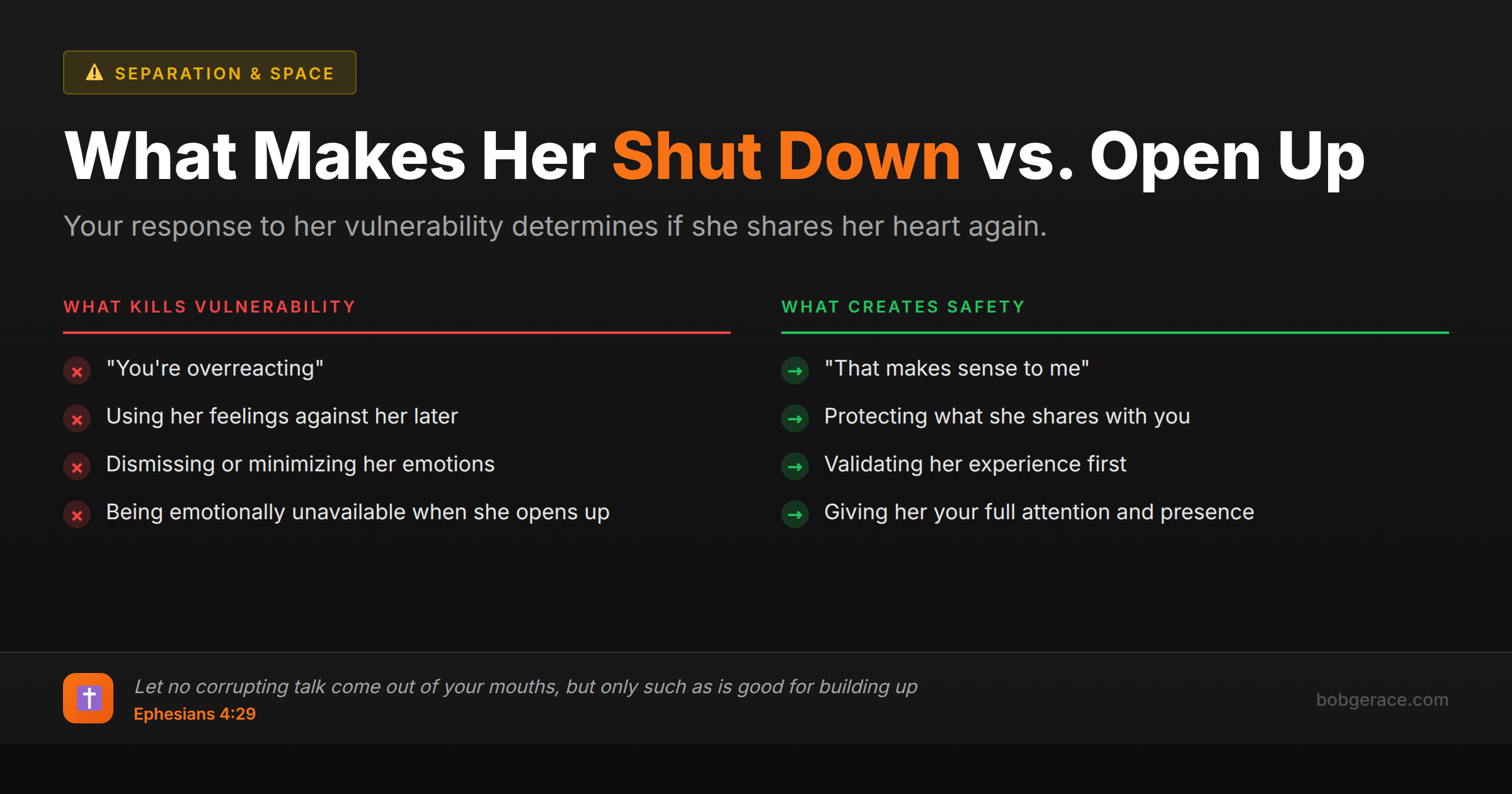
The answer isn't always obvious because creating emotional unsafety often happens through subtle patterns rather than dramatic events. Common culprits include dismissing her emotions ('you're overreacting'), using her vulnerabilities against her during arguments, being inconsistent with emotional availability, or making her feel foolish for sharing deep feelings. Sometimes it's not what you did, but what you didn't do - failing to validate, protect, or respond appropriately when she took emotional risks. The key is understanding that emotional safety isn't about perfection; it's about how you handle her heart when she entrusts it to you.
The Full Picture
Here's what most men miss: emotional safety isn't built through grand gestures - it's destroyed through small moments. When your wife shares something vulnerable and you respond with advice instead of empathy, you're teaching her that emotions aren't welcome. When you bring up her past hurts during an argument, you're weaponizing her vulnerability.
Think about the last time she opened up to you. Did you: - Listen without trying to fix? Most men immediately jump to solutions, which feels dismissive to women who need to be heard first. - Validate her feelings? Or did you explain why she shouldn't feel that way? - Remember what she shared? Following up later shows you value her inner world. - Keep her confidences? Sharing her private struggles with others breaks trust.
The pattern that kills vulnerability looks like this: She shares → You minimize/fix/dismiss → She feels unsafe → She shares less → You feel shut out → The cycle deepens.
Sometimes the damage comes from inconsistent emotional availability. You're present and engaged one day, distracted and dismissive the next. This unpredictability teaches her that vulnerability is a gamble she can't afford to take.
Criticism during vulnerable moments is relationship poison. When she's already feeling exposed and you add judgment or correction, you're essentially punishing her for being open with you.
What's Really Happening
From an attachment perspective, vulnerability requires what we call 'felt safety' - the deep, nervous system level assurance that emotional risk won't result in harm. When this safety is compromised, the brain's threat detection system becomes hypervigilant, automatically scanning for signs of emotional danger.
The most damaging behaviors often involve emotional invalidation - responses that communicate her feelings are wrong, excessive, or unwelcome. This can be subtle: eye-rolling, checking your phone while she talks, or immediately shifting to problem-solving mode. These responses activate her attachment system's alarm, signaling that connection isn't safe.
Defensive responses are particularly toxic to vulnerability. When she shares something difficult and you immediately defend yourself, explain your intentions, or counter with your own hurt, you're teaching her that her emotional experience threatens you. This creates a double bind: she needs connection but expressing her needs feels dangerous.
Another critical factor is emotional flooding. If you become overwhelmed and reactive when she's vulnerable, she learns to manage your emotions instead of expressing her own. She starts editing herself to keep you regulated, which kills authentic intimacy.
The neurological reality is that once emotional safety is compromised, her brain will default to self-protection. Rebuilding this safety requires consistent, patient responses that prove vulnerability won't be punished or dismissed.
What Scripture Says
Scripture calls us to handle others' hearts with extraordinary care. Ephesians 4:29 commands: "Let no corrupting talk come out of your mouths, but only such as is good for building up, as fits the occasion, that it may give grace to those who hear." When your wife is vulnerable, your words should build up, not tear down.
Proverbs 18:21 reminds us that "Death and life are in the power of the tongue." Your response to her vulnerability literally brings life or death to your intimacy. Choose life by responding with gentleness and honor.
1 Peter 3:7 specifically instructs husbands to "live with your wives in an understanding way, showing honor to the woman as the weaker vessel, since they are heirs with you of the grace of life." This isn't about intellectual weakness - it's about the tender vulnerability of the human heart that needs protective care.
Proverbs 27:5-6 teaches us: "Better is open rebuke than hidden love. Faithful are the wounds of a friend." There's a time for difficult conversations, but timing and manner matter. When someone is already wounded and vulnerable, piling on more hurt isn't faithful - it's cruel.
James 1:19 provides the perfect framework: "Let every person be quick to hear, slow to speak, slow to anger." When she's sharing her heart, lead with listening. Your quick responses often communicate that you're not really hearing her.
Galatians 6:1 calls us to restore others "in a spirit of gentleness." Even when addressing real issues, gentleness creates safety for authentic dialogue and growth.
What To Do Right Now
-
1
Ask her directly: 'When you've opened up to me, what responses made you feel unsafe?' Listen without defending.
-
2
Identify your patterns: Write down how you typically respond when she shares emotions. Do you fix, minimize, or defend?
-
3
Practice the pause: Before responding to her vulnerability, take three seconds to ask 'How can I honor her heart right now?'
-
4
Learn validation phrases: 'That makes sense,' 'I can see why you'd feel that way,' 'Tell me more about that.'
-
5
Follow up later: If she shares something vulnerable, check in the next day: 'I've been thinking about what you shared...'
-
6
Apologize specifically: For past times you made vulnerability unsafe. Name the behavior and commit to change.
Related Questions
- What is 'attachment shutdown'?
- How do I become a safe person again?
- What would make her want to risk opening up?
- What is 'stonewalling' and why does she do it?
- Why did she stop fighting?
- What does 'dismissive-avoidant' look like in practice?
- Why do I get defensive every time?
- How do I hear her without defending myself?
- I can't control my anger
- What does 'holding space' actually mean?
Also find Bob on
Subscribe for weekly videos on Christian marriage.
Your Marriage Needs More Than Patterns
A coach who knows your specific story can see what you're missing — and calibrate the work to where your wife actually is right now.
Talk to Bob →