What does 'dismissive-avoidant' look like in practice?
6 min read
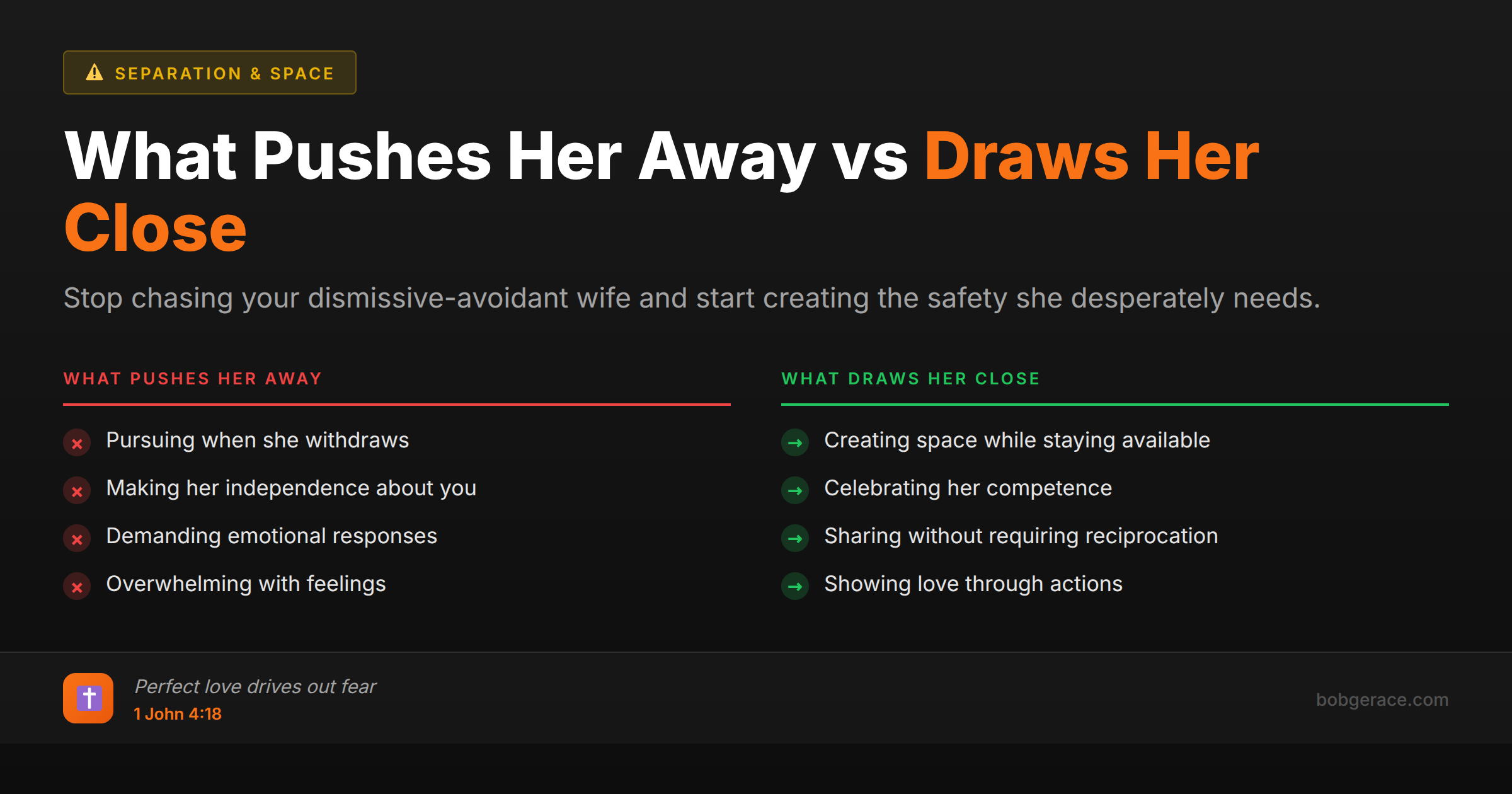
A dismissive-avoidant wife operates from a deep-seated belief that emotional intimacy is unsafe or unnecessary. In practice, this looks like someone who consistently minimizes emotional conversations, deflects with logic or practicalities, and maintains rigid independence even within marriage. She might say things like "you're being too sensitive" or "I don't see what the big deal is" when you try to connect emotionally. The dismissive-avoidant person has learned to shut down their emotional system as a survival mechanism, often from childhood experiences where vulnerability led to pain or rejection. What makes this particularly challenging is that they genuinely don't understand why emotional connection matters so much to you – it's not that they're trying to hurt you, but rather that they've developed a completely different operating system for relationships.
The Full Picture
Understanding dismissive-avoidant behavior requires seeing beyond the surface actions to the underlying emotional programming. This isn't about someone being mean or selfish – it's about a person who has learned that emotional safety comes through emotional distance.
In your marriage, this might show up as:
Daily Interactions: She responds to your emotional bids with facts, solutions, or dismissal. When you say "I had a rough day," she might immediately jump to "Well, what are you going to do about it?" rather than offering comfort or empathy.
Conflict Patterns: During disagreements, she becomes increasingly logical and detached while you become more emotional. She might actually get calmer as you get more upset, which feels incredibly invalidating.
Physical and Emotional Intimacy: She compartmentalizes these areas, treating physical intimacy as separate from emotional connection. Emotional intimacy might feel "too much" or "unnecessary" to her.
Independence Maintenance: She insists on handling things alone, makes unilateral decisions, and may seem to function better when you're not around. This isn't personal – it's how she's learned to feel safe.
Communication Style: She uses phrases like "I'm fine," "It's not a big deal," or "You're overreacting" frequently. She genuinely believes that minimizing emotional responses is the healthier approach.
The key insight here is that her avoidance isn't about you – it's about her learned survival strategy. She's not trying to hurt you; she's trying to protect herself using the only method she knows works.
What's Really Happening
From a clinical perspective, dismissive-avoidant attachment develops as an adaptive response to inconsistent or rejecting caregiving in early life. The child learns that emotional needs won't be met reliably, so they develop what we call 'compulsive self-reliance' – a deep belief that depending on others emotionally is dangerous.
Neurologically, these individuals have learned to suppress their attachment system. When faced with emotional intensity from their partner, their nervous system actually activates a 'deactivation strategy' – they literally cannot access their emotional responses in the moment. This is why logic and facts feel safer and more accessible to them.
What's particularly important for husbands to understand is that this isn't conscious rejection. Her brain has been wired to view emotional dependency as a threat to her survival. When you pursue emotional connection, her system interprets this as danger, triggering withdrawal behaviors.
The dismissive-avoidant person often has a 'phantom ex' mentality – they maintain an internal narrative that they could be fine without the relationship, even when they deeply value it. This gives them a sense of control and safety.
Recovery requires slowly rewiring these neural pathways through consistent, non-threatening emotional experiences. The key is creating safety without pressure, allowing her nervous system to gradually learn that emotional connection can be safe. This process requires immense patience because you're literally asking someone to override their survival programming.
What Scripture Says
Scripture speaks directly to the heart issues behind dismissive-avoidant patterns, addressing both the wounds that create these defenses and God's design for intimate connection.
The Root Issue - Fear and Self-Protection: *"There is no fear in love. But perfect love drives out fear, because fear has to do with punishment. The one who fears is not made perfect in love."* (1 John 4:18). The dismissive-avoidant heart operates from fear – fear of rejection, fear of being overwhelmed, fear of losing control.
God's Design for Vulnerability: *"Therefore a man shall leave his father and mother and hold fast to his wife, and the two shall become one flesh."* (Ephesians 5:31). The 'one flesh' unity God designed requires emotional vulnerability and interdependence, not self-sufficient independence.
Healing Through Love: *"Above all, love each other deeply, because love covers over a multitude of sins."* (1 Peter 4:8). The patient, consistent love of a spouse can become a healing agent, slowly dismantling the walls built by past wounds.
The Call to Emotional Connection: *"Rejoice with those who rejoice; mourn with those who mourn."* (Romans 12:15). God calls us into emotional empathy and connection, not emotional isolation.
Understanding the Wounded Heart: *"He heals the brokenhearted and binds up their wounds."* (Psalm 147:3). God understands that defensive patterns often come from deep wounds that need His healing touch.
The Goal - Authentic Intimacy: *"As iron sharpens iron, so one person sharpens another."* (Proverbs 27:17). True intimacy involves the kind of authentic connection that helps both partners grow, not the false peace of emotional distance.
What To Do Right Now
-
1
Stop pursuing and start creating safety - Give her emotional space while remaining consistently loving and available
-
2
Validate her autonomy - Acknowledge her independence and competence without making it about you being rejected
-
3
Lower the emotional intensity - Share your feelings without requiring immediate emotional reciprocation from her
-
4
Focus on practical acts of love - Show care through actions she can receive rather than emotional expressions she can't
-
5
Address your own attachment needs - Don't make her your only source of emotional connection and validation
-
6
Be patient with the process - Understand that rewiring attachment patterns takes years, not months, of consistent safety
Related Questions
- What is 'stonewalling' and why does she do it?
- What is 'emotional disengagement'?
- What is 'deactivation' and did I cause it?
- Is her shutdown protective or permanent?
- What is 'earned avoidance' from marriage pain?
- Why does she seem numb/flat/dead inside?
- What is 'deactivation' and has she done it?
- What does secure attachment behavior look like in him?
Also find Bob on
Subscribe for weekly videos on Christian marriage.
Your Marriage Isn't a Textbook Case
Dismissive-avoidant is a useful frame, but your wife is a specific person with a specific history. A coach helps you see what's actually happening in your marriage, not just the pattern.
Talk to Bob →