She seems cold and detached — is that avoidant attachment?
6 min read
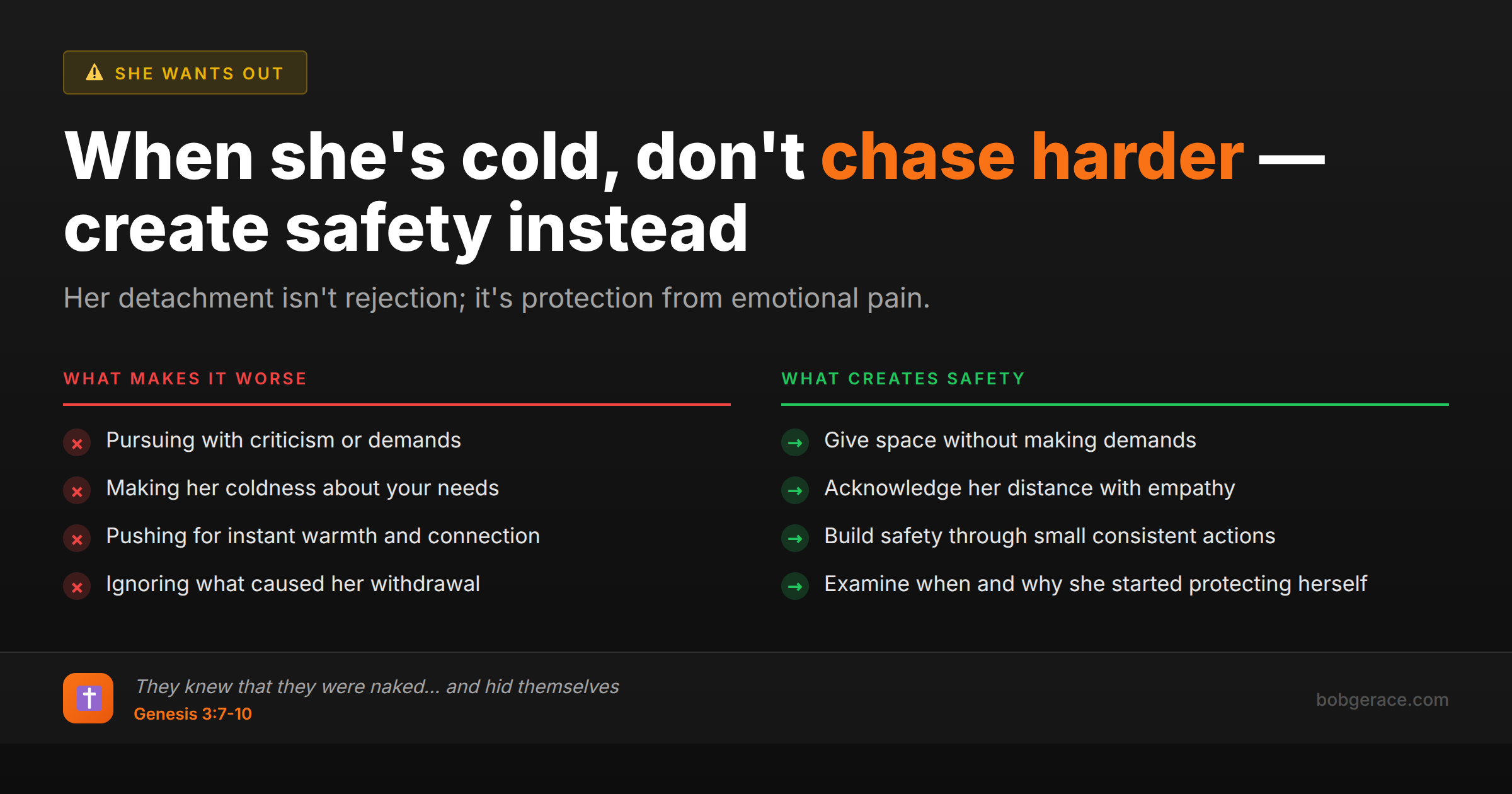
When your wife seems cold and detached, you're probably seeing a protective response, not necessarily avoidant attachment. True avoidant attachment develops in childhood and shows up consistently across relationships. What you're witnessing now is likely her nervous system going into shutdown mode because she feels emotionally unsafe in the marriage. This detachment often happens when a woman has repeatedly tried to connect, been hurt or dismissed, and finally stops trying. It's not that she doesn't care - it's that caring has become too painful. She's protecting herself the only way she knows how. The coldness you're experiencing is her heart's attempt at self-preservation, not a character flaw or personality disorder.
The Full Picture
The difference between avoidant attachment and protective detachment matters tremendously. Avoidant attachment is a lifelong pattern that begins in infancy when caregivers are consistently unresponsive or rejecting. People with true avoidant attachment struggle with intimacy in all relationships and often don't recognize their own emotions.
What you're likely seeing in your marriage is protective detachment - a trauma response to feeling repeatedly hurt, unheard, or dismissed. This woman may have been warm and connected early in your relationship, but gradually withdrew as she experienced:
• Emotional invalidation - her feelings being minimized or dismissed • Consistent conflict patterns that leave her feeling defeated • Unmet bids for connection - attempts at intimacy that were ignored or rejected • Criticism or contempt that made vulnerability feel dangerous • Broken promises or trust violations that taught her not to hope
Here's what protective detachment looks like: She stops initiating conversations about problems. She becomes functional but not warm. She may handle household tasks efficiently but without the loving touches she once offered. She's polite but distant, present but not engaged.
The cruel irony is this: The more you pursue her coldness with criticism ("You're so cold," "You never show affection"), the deeper she retreats. Her nervous system interprets your pursuit as more evidence that connection isn't safe. She's not trying to punish you - she's trying to survive emotionally.
This detachment serves a purpose. It allows her to function without the constant pain of unmet longing. It protects her from further disappointment. But it's also slowly killing the marriage, which is why addressing it quickly and correctly is crucial.
What's Really Happening
From a clinical perspective, what you're describing sounds more like attachment injury response than avoidant attachment disorder. When we look at adult attachment theory, true avoidant attachment shows up as consistent discomfort with closeness across all relationships, often from early childhood.
What we see in marriage crisis situations is different. This is typically a trauma response to repeated attachment injuries within the marriage itself. The nervous system's polyvagal response kicks in - she's moved from fight (arguing, pursuing connection) through flight (emotional pleading, trying harder) into freeze/shutdown mode.
Neurologically, several things are happening: Her amygdala has become hypervigilant to perceived threats in the relationship. What might seem like normal interaction to you may trigger her threat detection system. Her prefrontal cortex - the part responsible for connection and warmth - goes offline when she feels unsafe.
The attachment system in marriage works differently than in childhood. Adults can develop secure or insecure patterns within specific relationships based on their experiences with that particular partner. Research by Dr. John Gottman shows that emotional safety is the foundation of all secure adult attachment.
Here's the clinical reality: This detachment didn't happen overnight, and it won't resolve quickly. It represents months or years of her attachment system learning that reaching out leads to pain. Her coldness is actually a survival adaptation - it's working to protect her from further emotional injury.
The good news is this: Unlike childhood attachment disorders, protective detachment in marriage can be healed when safety is consistently reestablished. But it requires the pursuing partner to stop trying to break through the walls and instead focus on creating the conditions where those walls are no longer necessary.
What Scripture Says
Scripture gives us profound insight into how we're designed for connection and what happens when that design gets damaged. Genesis 2:25 tells us that Adam and Eve "were both naked and were not ashamed" - this represents the blueprint for marriage: complete vulnerability without fear.
When sin entered the world in Genesis 3:7-10, notice what happened immediately: "They knew that they were naked... and Adam and his wife hid themselves." Fear entered the relationship, and their first instinct was to hide and protect themselves. This is exactly what you're seeing in your wife's detachment - not sin, but a response to feeling unsafe.
Proverbs 18:19 warns us: "A brother offended is harder to be won than a strong city, and their contentions are like the bars of a castle." When someone feels repeatedly hurt, they build walls that become increasingly difficult to breach. Your wife's coldness may be those "bars of a castle" - protective barriers around her heart.
1 Peter 3:7 instructs husbands to dwell with their wives "according to knowledge, giving honor to the wife, as to the weaker vessel... that your prayers may not be hindered." The word "knowledge" here means understanding her unique needs and responses. Her detachment may be telling you something important about how she's been feeling in the relationship.
Ephesians 5:29 reminds us that Christ "nourishes and cherishes" the church. The word "cherish" means to warm, like a bird warming its young. When someone becomes cold and detached, they need consistent warmth and safety, not more pressure or criticism.
Romans 12:18 calls us: "If it is possible, as much as depends on you, live peaceably with all men." Sometimes creating peace means backing away from pursuit and creating space for healing, trusting God to work in both hearts.
What To Do Right Now
-
1
Stop pursuing her coldness with criticism or demands for warmth - this only confirms her need for protection
-
2
Acknowledge her detachment without making it about you: 'I notice you seem distant, and I want to understand what you need'
-
3
Focus on creating safety through consistent, small actions rather than grand gestures or intense conversations
-
4
Examine your own patterns - when did she start withdrawing, and what was happening in the relationship then
-
5
Give her space to feel her feelings without trying to fix, change, or argue with her emotional state
-
6
Demonstrate change through actions over time rather than trying to convince her with words that you've changed
Related Questions
- What is anxious attachment and am I doing it right now?
- What's the pursue-withdraw cycle and how do I stop it?
- What does 'protest behavior' look like and am I doing it?
- How do attachment injuries from childhood show up now?
- Why does my pursuing make her pull away more?
- What is 'deactivation' and has she done it?
- What is 'deactivation' and did I cause it?
- What attachment style did I develop in childhood?
- What does secure attachment behavior look like in him?
Also find Bob on
Subscribe for weekly videos on Christian marriage.
Her Detachment Has a Specific Cause in Your Marriage
A coach who knows your story can help you see what's driving her shutdown and what moves will actually rebuild safety with her.
Talk to Bob →