What is anxious attachment and am I doing it right now?
6 min read
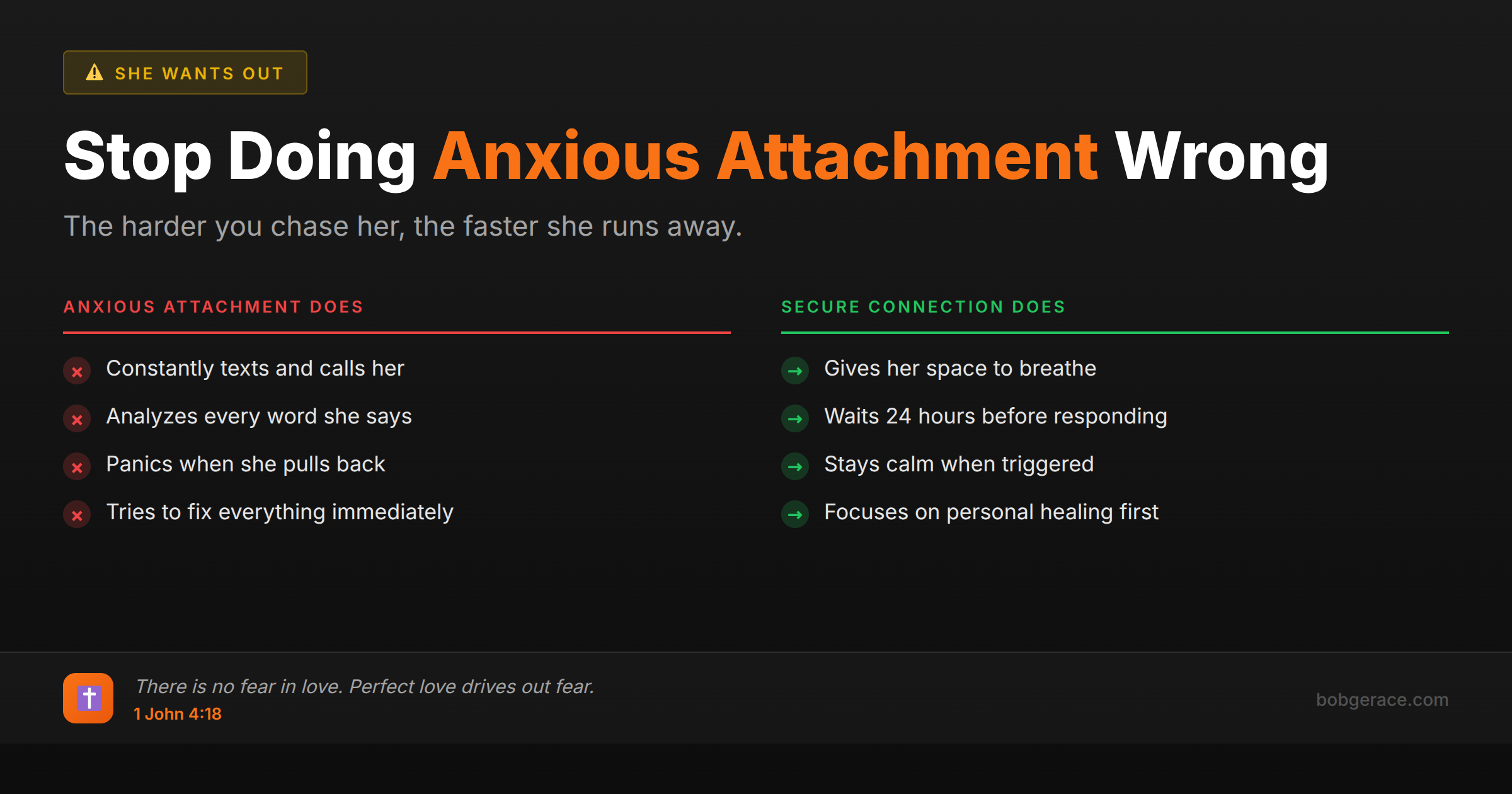
Anxious attachment is when you desperately chase connection but end up pushing your wife further away. You're likely doing it right now if you're constantly texting, analyzing her every response, or feeling like you're dying inside when she pulls back. It shows up as that gnawing fear that she's done with you, driving you to pursue, explain, or fix things immediately. The cruel irony? The harder you chase, the more she retreats. You're not weak or pathetic – you're human. Your attachment system is in overdrive because it senses threat. But here's what you need to know: anxious attachment isn't your permanent identity, it's a learned response that can be changed.
The Full Picture
Anxious attachment develops when your nervous system learns that relationships are unpredictable. Maybe your parents were inconsistent, or past relationships taught you that love could disappear without warning. Now, when your marriage hits crisis, that old programming kicks into high gear.
Here's how it typically shows up:
• Pursuit mode - Texting multiple times when she doesn't respond, wanting to "talk it through" immediately • Mind reading - Analyzing every facial expression, tone of voice, or delayed response • Catastrophic thinking - One bad conversation means divorce, one good moment means you're saved • Emotional flooding - Feeling overwhelmed by fear, anger, or desperation when she creates distance • People pleasing - Saying yes to everything, avoiding conflict, losing yourself to keep her happy
The problem isn't that you care deeply – that's actually beautiful. The problem is that anxious attachment makes you operate from fear instead of love. When you're anxiously attached, you're constantly scanning for threat, which means you miss opportunities for genuine connection.
Common mistakes men make:
They try to logic their way out of it, thinking "I'll just stop being anxious." That's like telling someone having a panic attack to calm down. They also swing to the opposite extreme, becoming cold and distant, which isn't secure attachment – it's just avoidance wearing a mask.
The truth is, your wife can feel your anxiety. It shows up as neediness, control, or emotional volatility. She's not rejecting your love; she's protecting herself from the intensity of your fear.
What's Really Happening
From a clinical perspective, anxious attachment originates in early relational experiences where caregiving was inconsistent or unpredictable. Research by Bowlby and Ainsworth demonstrates that children develop attachment strategies based on their caregiver's responsiveness. When caregiving is sporadic – sometimes available, sometimes not – children learn to protest loudly and pursue intensely to get their needs met.
In adult relationships, this translates to hyperactivation of the attachment system. Your nervous system is essentially stuck in a state of perceived threat, flooding your body with stress hormones like cortisol and adrenaline. This creates a cycle: fear triggers pursuit, pursuit creates distance, distance confirms the fear.
Neurologically, anxious attachment involves overactivity in the amygdala (fear center) and underactivity in the prefrontal cortex (rational thinking). This explains why you might know logically that your behavior is counterproductive, yet feel compelled to continue it.
The good news is neuroplasticity – your brain can form new pathways. Through consistent practice of secure behaviors and regulation techniques, you can literally rewire your attachment responses. Studies show that earned security is possible through therapeutic intervention, mindfulness practices, and corrective relational experiences.
What's crucial to understand is that your wife's withdrawal isn't necessarily rejection – it might be her own attachment response to your dysregulation. Many partners of anxiously attached individuals develop avoidant patterns as a protective mechanism. This creates what we call a pursue-withdraw cycle, where both parties are actually seeking connection but their strategies are incompatible.
What Scripture Says
Scripture speaks directly to the anxiety that drives unhealthy attachment. 1 John 4:18 reminds us, "There is no fear in love. But perfect love drives out fear, because fear has to do with punishment. The one who fears is not made perfect in love." Your anxious attachment is rooted in fear – fear of abandonment, rejection, or loss. But God's perfect love offers a different foundation.
Philippians 4:6-7 instructs us, "Do not be anxious about anything, but in every situation, by prayer and petition, with thanksgiving, present your requests to God. And the peace of God, which transcends all understanding, will guard your hearts and your minds in Christ Jesus." This doesn't mean anxiety is sinful, but that there's a pathway through it.
Psalm 139:23-24 provides a framework for self-examination: "Search me, God, and know my heart; test me and know my anxious thoughts. See if there is any offensive way in me, and lead me in the way everlasting." God invites you to bring your anxious thoughts to Him, not to shame you, but to transform you.
The biblical model of love is 1 Corinthians 13:4-7 – "Love is patient, love is kind. It does not envy, it does not boast, it is not proud. It does not dishonor others, it is not self-seeking, it is not easily angered, it keeps no record of wrongs." Notice that anxious attachment violates several of these principles – it's impatient, self-seeking, and easily angered.
Matthew 6:26 offers perspective: "Look at the birds of the air; they do not sow or reap or store away in barns, and yet your heavenly Father feeds them. Are you not much more valuable than they?" Your identity and security rest in God's love, not your wife's response to you.
What To Do Right Now
-
1
Stop pursuing immediately - Put your phone down, resist the urge to text or call, and give her space to breathe
-
2
Practice the 24-hour rule - Before responding to anything emotionally charged, wait a full day and pray about it first
-
3
Identify your triggers - Write down the specific situations, words, or behaviors that activate your anxiety
-
4
Develop a self-soothing routine - Deep breathing, prayer, or physical exercise when you feel the anxiety rising
-
5
Focus on your own healing - Schedule therapy, join a men's group, or start a daily devotional practice
-
6
Communicate your awareness - Tell your wife you recognize your anxious patterns and are working on them, then prove it through changed behavior
Related Questions
- Why do I feel like I'm going to die if she leaves?
- I'm panicking and want to pursue her — is that my attachment style?
- She seems cold and detached — is that avoidant attachment?
- Why does my pursuing make her pull away more?
- What's the pursue-withdraw cycle and how do I stop it?
- What does 'protest behavior' look like and am I doing it?
- What attachment style did I develop in childhood?
- How do childhood attachment wounds show up in marriage?
Also find Bob on
Subscribe for weekly videos on Christian marriage.
Your Marriage Isn't a Textbook Case
A coach who knows your specific story can help you see what's actually driving the anxiety in your marriage — and what to do about it that doesn't push her further away.
Talk to Bob →