I'm panicking and want to pursue her — is that my attachment style?
5 min read
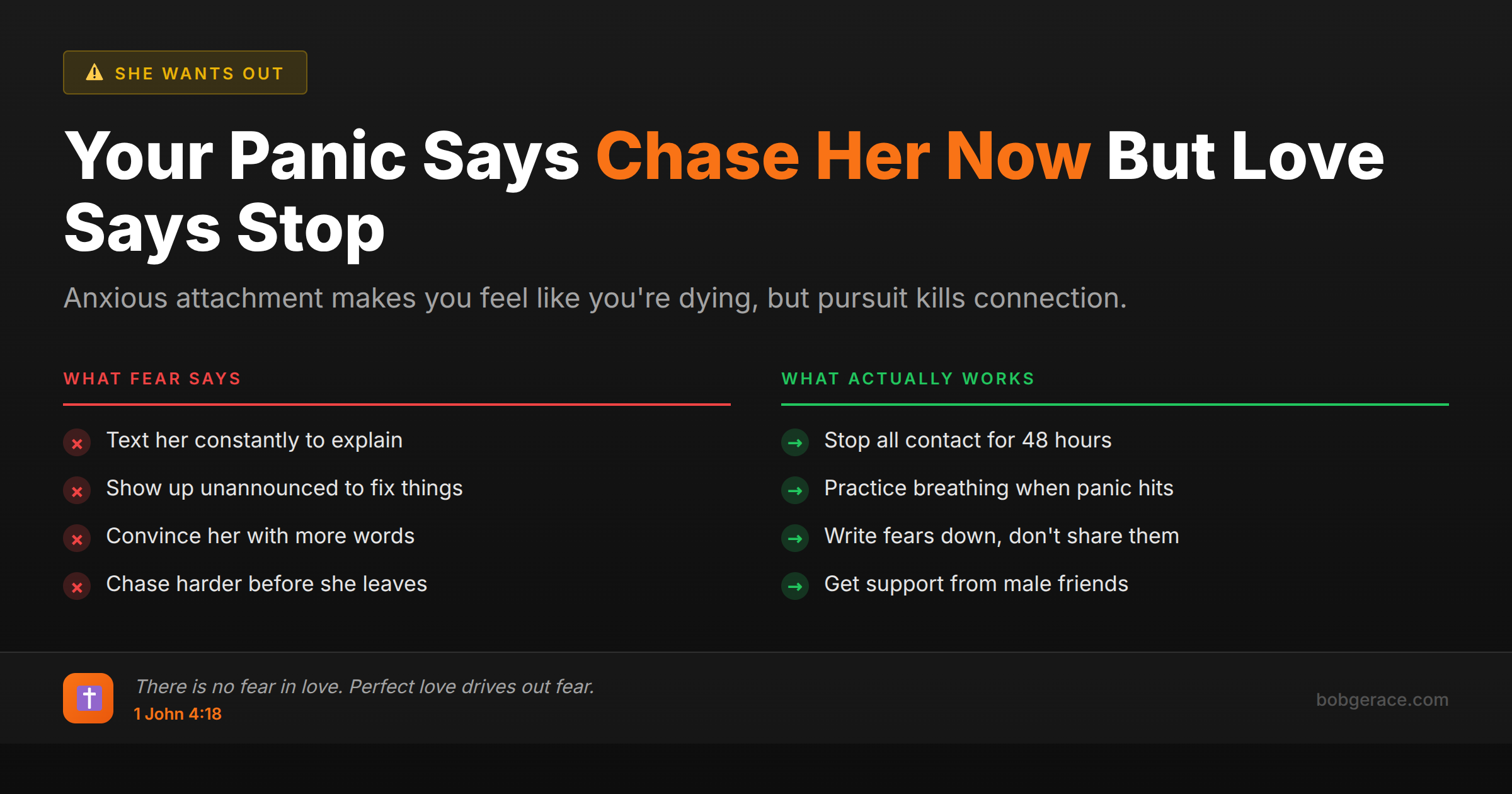
Yes, that overwhelming urge to pursue your wife when she's pulling away is absolutely your attachment system—specifically anxious attachment—kicking into overdrive. When someone with anxious attachment feels disconnected from their partner, their nervous system interprets this as a life-threatening emergency. Your brain literally believes you're going to die without her connection, which triggers that desperate need to chase, explain, fix, or convince her to stay. But here's what you need to understand: pursuing her right now will push her further away. I know it feels counterintuitive when every cell in your body is screaming at you to do something, anything, to get her back. This panic response served our ancestors well when physical separation meant death, but in modern relationships, it often destroys the very connection you're trying to save.
The Full Picture
Your attachment system developed in your earliest relationships, usually with your primary caregivers. If you experienced inconsistent care—sometimes getting the love and attention you needed, sometimes not—your nervous system learned to stay hypervigilant for signs of abandonment.
This creates a pattern where: • You become overly sensitive to any sign of disconnection • Small conflicts feel like relationship-ending catastrophes • You default to pursuing, explaining, or trying to "fix" things immediately • Her need for space feels like rejection, triggering more pursuit • You lose yourself in the relationship, making her your primary source of security
The cruel irony is that the more you pursue, the more suffocated she feels, which makes her pull away more, which triggers your attachment system even harder. It's like quicksand—the more you struggle, the deeper you sink.
Common mistakes men make in this state: • Sending long texts explaining their feelings • Showing up unannounced to "talk things through" • Making grand romantic gestures when she's asked for space • Constantly asking "Are we okay?" or "What are you thinking?" • Trying to logic their way back into her good graces
Your wife isn't trying to hurt you—she's likely overwhelmed by the intensity of your need and doesn't know how to respond without feeling like she's losing herself. She may have her own attachment wounds that make your pursuit feel suffocating rather than loving.
The path forward isn't about suppressing your attachment needs—they're valid and human. It's about learning to self-regulate when they're triggered and creating the kind of secure connection that actually meets both of your needs.
What's Really Happening
What you're experiencing is your attachment system's protest behavior, a concept first identified by psychologist John Bowlby. When we perceive a threat to our primary attachment bond, our nervous system activates a predictable sequence: first protest (pursuit, pleading, anger), then despair, and finally detachment if the bond isn't restored.
Research by Dr. Sue Johnson shows that about 20% of adults have anxious attachment patterns, characterized by a hyperactivated attachment system. Your amygdala—the brain's alarm center—becomes hypersensitive to any sign of relationship threat, flooding your system with stress hormones like cortisol and adrenaline. This literally hijacks your prefrontal cortex, making it nearly impossible to think clearly or respond rationally.
The pursue-withdraw cycle you're caught in is one of the most destructive patterns in relationships. Studies indicate that 70% of couples fall into this dynamic, with anxiously attached partners typically in the pursuer role. The more you pursue, the more your partner's nervous system interprets your behavior as demanding or controlling, triggering their own defensive responses.
Neurologically, when someone feels pursued or pressured, their brain activates threat-detection systems, making connection nearly impossible. Your wife's withdrawal isn't necessarily about you—it's her nervous system's way of trying to regulate and feel safe.
The good news is that attachment patterns, while deeply ingrained, can be modified through conscious effort and new relational experiences. Developing what we call "earned security" involves learning to self-soothe when your attachment system is activated and gradually building trust that relationships can be stable even when they're not constantly validated.
What Scripture Says
Scripture speaks directly to the fear and anxiety that drives our pursuit patterns. 1 John 4:18 tells us, "There is no fear in love. But perfect love drives out fear, because fear has to do with punishment. The one who fears is not made perfect in love." Your desperate need to pursue often comes from fear—fear of abandonment, rejection, or loss—rather than from love.
Philippians 4:6-7 provides a framework for handling anxiety: "Do not be anxious about anything, but in every situation, by prayer and petition, with thanksgiving, present your requests to God. And the peace of God, which transcends all understanding, will guard your hearts and your minds in Christ Jesus." This doesn't mean suppressing your concerns about your marriage, but rather bringing them to God first before acting on them impulsively.
God designed us for connection, but Psalm 62:5 reminds us where our primary security should come from: "Yes, my soul, find rest in God; my hope comes from him." When we make our spouse our ultimate source of security instead of God, we create an idol that can never fully satisfy our deepest needs. This puts unbearable pressure on our marriages.
Proverbs 27:14 warns about overwhelming others with our intensity: "Whoever blesses their neighbor with a loud voice early in the morning will have it counted as a curse." Sometimes our pursuit, even when well-intentioned, becomes a burden to our wives rather than a blessing.
Ecclesiastes 3:7 teaches us there is "a time to be silent and a time to speak." Learning to discern when to pursue and when to step back requires wisdom that comes from God, not just from our emotional impulses. Trust that God is working even in the silence and space.
What To Do Right Now
-
1
Stop all pursuit behaviors immediately—no texts, calls, surprise visits, or attempts to "fix" things for the next 48 hours
-
2
Practice the physiological sigh technique: two inhales through your nose followed by a long exhale through your mouth when panic rises
-
3
Write down your fears and anxieties instead of sharing them with your wife—get them out of your head without burdening her
-
4
Reach out to a male friend or counselor who can provide support without you having to lean on your wife emotionally
-
5
Engage in vigorous physical exercise to help regulate your nervous system and burn off stress hormones
-
6
Pray specifically for wisdom to know when to speak and when to remain silent, asking God to be your primary source of security
Related Questions
Break the Cycle Before It's Too Late
Your attachment patterns don't have to destroy your marriage. Get the specific tools and support you need to create secure connection instead of desperate pursuit.
Get Help Now →