What is the relationship between confession and defensiveness?
6 min read
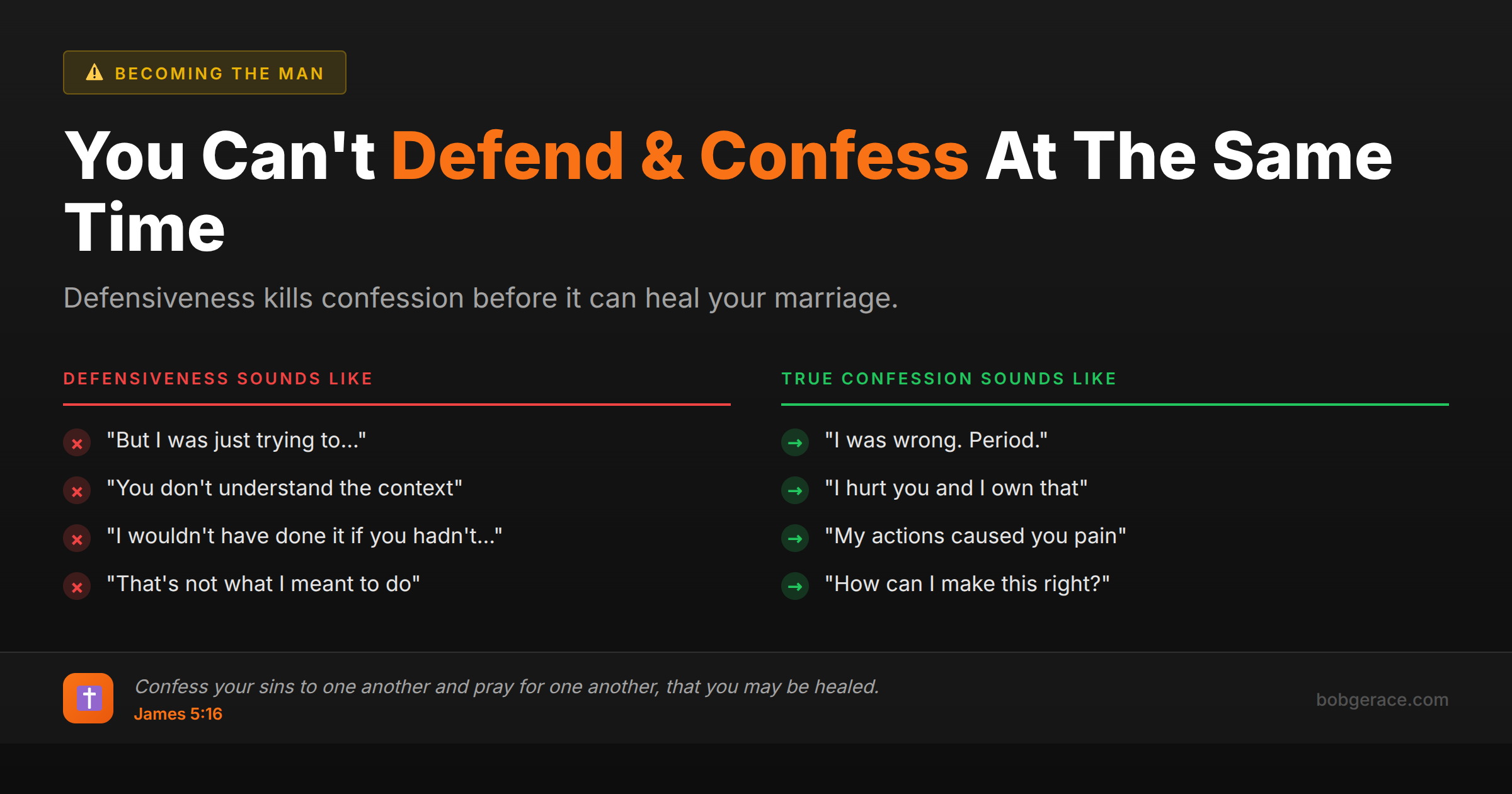
Confession and defensiveness are fundamentally incompatible. True confession requires complete vulnerability and ownership of wrongdoing, while defensiveness seeks to protect, justify, or deflect responsibility. When you're defensive, you're essentially saying 'I'm not fully wrong here,' which makes genuine confession impossible. Biblical confession demands we lay down our defenses entirely - no explanations, no context that minimizes our sin, no shifting blame. This is why confession is so powerful in marriage: it breaks through the defensive walls that keep couples stuck in cycles of hurt and disconnection. The moment you choose authentic confession over self-protection, you create space for healing and restoration.
The Full Picture
Defensiveness is the enemy of confession. When your spouse brings up something you've done wrong, your natural instinct is to protect yourself. You want to explain your motives, provide context, or point out what they did too. This is defensiveness - and it makes true confession impossible.
Real confession requires complete vulnerability. It means saying 'I was wrong' without any 'but' statements. No explanations about why you did it. No reminders of what they've done. Just pure, unfiltered ownership of your sin and its impact on your spouse.
This is terrifying for most people. Confession feels like emotional death because you're laying down all your defenses and trusting your spouse with your complete vulnerability. You're choosing to be completely wrong, completely responsible, and completely at their mercy.
But here's what happens when you do it: Your defensiveness has been the wall keeping your spouse at a distance. Every time you defend yourself, you're essentially telling them their hurt doesn't matter as much as your reputation. When you confess without defense, you tear down that wall. You validate their pain. You show them they matter more than your pride.
The result is usually immediate softening. Not always - sometimes your spouse needs time to process. But confession creates the conditions for forgiveness and restoration in ways that defensiveness never can.
What's Really Happening
From a clinical perspective, defensiveness serves a protective function - it's your nervous system trying to keep you safe from perceived threats to your identity or worth. When your spouse confronts you about something, your brain interprets this as an attack, triggering fight-or-flight responses that make confession nearly impossible. Defensiveness activates what we call the 'self-preservation system' - you're literally wired to protect yourself rather than be vulnerable. This creates a neurological conflict with confession, which requires the exact opposite response: complete openness and vulnerability. What's fascinating is that genuine confession actually rewires these defensive patterns over time. When you choose vulnerability despite your brain's alarm bells, you're teaching your nervous system that your marriage is safe, that your spouse isn't an enemy to defend against. This is why confession becomes easier with practice - you're literally creating new neural pathways that prioritize connection over self-protection. The couples I work with who master this skill report dramatic improvements in intimacy and trust, because confession breaks the defensive cycles that keep couples emotionally distant.
What Scripture Says
Scripture makes it clear that confession requires complete humility and vulnerability, which is the opposite of defensiveness.
James 5:16 - "Therefore, confess your sins to one another and pray for one another, that you may be healed." Notice there's no caveat here about explaining your reasons or defending your motives. Just confess.
1 John 1:9 - "If we confess our sins, he is faithful and just to forgive us our sins and to cleanse us from all unrighteousness." Confession brings cleansing and forgiveness, but only when it's genuine and complete.
Psalm 32:5 - "I acknowledged my sin to you, and I did not cover my iniquity; I said, 'I will confess my transgressions to the Lord,' and you forgave the iniquity of my sin." David didn't cover or defend his sin - he exposed it completely.
Proverbs 28:13 - "Whoever conceals his transgressions will not prosper, but he who confesses and forsakes them will obtain mercy." Defensiveness is a form of concealment. True confession exposes everything.
Luke 18:13-14 describes the tax collector who "would not even lift up his eyes to heaven, but beat his breast, saying, 'God, be merciful to me, a sinner!'" Jesus said this man went home justified. No defenses, no explanations - just complete acknowledgment of his sin.
Philippians 2:3 - "Do nothing from selfish ambition or conceit, but in humility count others more significant than yourselves." Confession is the ultimate act of putting your spouse's hurt above your own reputation.
What To Do Right Now
-
1
Identify where you've been defensive instead of confessing - write down specific recent examples
-
2
Practice saying 'I was wrong' without adding 'but' or any explanations - literally rehearse this
-
3
When your spouse brings up an offense, resist the urge to explain yourself immediately
-
4
Ask your spouse how your actions affected them and listen without defending
-
5
Confess the specific behavior and its impact without minimizing or justifying
-
6
Follow up your confession by asking what you can do to make things right
Related Questions
- What does 'taking responsibility' actually look like?
- Why do I get defensive every time?
- How do I receive feedback without counter-attacking?
- What does Proverbs say about receiving correction?
- What does humility in conflict look like?
- How do I model Christ who 'did not revile in return'?
- What does genuine repair look like for old wounds?
- What does 'godly sorrow' look like in practice?
- What are markers of genuine remorse vs. guilt?
- What does repentance look like for accumulated sin?
Also find Bob on
Subscribe for weekly videos on Christian marriage.
Can't Drop the Defensiveness on Your Own?
A coach who knows your marriage can see where you're still protecting yourself — and help you get to real confession without the script falling apart.
Talk to Bob →